


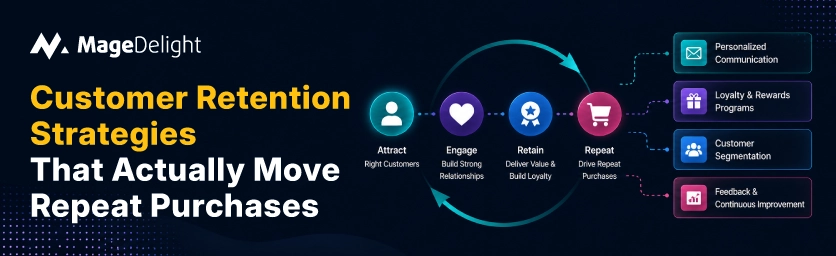
Returning customers generate 40 percent of ecommerce revenue while making up 8 percent of all visitors, according to Adobe's Digital Economy Index. Despite this, most store owners still dedicate about 80 percent of their marketing budget to acquiring customers and only 20 percent to keeping existing ones, based on widely cited research from 2024. This imbalance deserves a look. A 5 percent rise in retention can boost profits by 25 to 95 percent, a range that Harvard Business Review has tracked for years and that recent 2026 retention studies continue to support.
The average ecommerce retention rate across industries is 30 to 31 percent according to Flowium’s 2026 benchmarks. Performing stores, however, reach retention rates between 45 and 62 percent depending on the source and the sector. That gap of 15 to 30 percentage points between average and top performers is the real opportunity this guide focuses on. Below are retention strategies backed by results, not just theory. You’ll also find what it actually takes to make each one work in practice.
Why the Retention Math Works in Your Favor
Acquiring a customer often costs five to 25 times more than keeping an existing one. This range should be seen as a general estimate, not a fixed rule. Your actual cost ratio depends on your acquisition costs, profit margins, and how often customers buy. What’s more consistent across studies is the spending difference: repeat buyers spend 67 percent more per transaction than first-time customers, according to research from Bain & Company.
Retention also varies widely by business model. So it’s important to compare yourself to your category, not a one-size-fits-all average. Subscription boxes, for example, retain between 60 and 70 percent of customers. Transactional ecommerce hovers around 38 percent, according to First Page Sage. Luxury fashion, with high prices, retains just 9.9 percent due to its trend-driven and infrequent buying patterns. Know your space before you set a retention goal.
Retention Strategies Ranked by Measurable Impact
|
Strategy |
Measurable Impact |
Effort to Implement |
|
Post-purchase email sequences |
$3.60 earned per email vs. $0.71 for standard campaigns |
Low |
|
Loyalty programs |
5.2x average ROI; members generate 12–18% more revenue |
Medium |
|
Subscription options |
4.1x higher customer lifetime value; 45% retention at 12 months |
Medium–High |
|
Personalized recommendations |
78% of consumers more likely to repeat-purchase when personalized |
Medium |
|
AI-driven personalization |
10–15% retention lift; 40% more revenue per McKinsey |
High |
|
Frictionless returns |
Reduces a top voluntary-churn trigger; supports repeat purchase confidence |
Medium |
Effort to implement isn't the same as cost to implement. Post-purchase email sequences are low-effort because most ecommerce platforms already support triggered email; AI-driven personalization is high-effort because it typically requires a unified customer data layer before the personalization itself can run.
The Strategies Worth Prioritizing
Post-Purchase Email Sequences
Post-purchase emails earn $3.60 per email sent versus $0.71 for standard broadcast campaigns, making this the highest return-per-effort strategy on the list. The sequence itself doesn't need to be complex: an order confirmation, a shipping update, a delivery follow-up, and a review request around day 14 cover the core of it. Products with reviews see 270 percent higher conversion rates, which makes that day-14 email do double duty, building both retention and future conversion.
Loyalty Programs
Loyalty programs generate a 5.2x average ROI, and 83 percent of companies running one report a positive return, with members generating 12 to 18 percent more revenue than non-members. Nike's membership program, with more than 150 million members who spend roughly three times as much as non-members, is the extreme end of what's possible, but the mechanism scales down: even a simple points-and-tiers structure gives customers a reason to consolidate their spending with one store instead of splitting it across competitors.
For Magento and Adobe Commerce stores building this out, MageDelight's Membership Subscription extension combines loyalty tiering with subscription plans in a single module, rather than requiring two separate systems to manage.
Subscription Options
Subscription customers carry a 4.1x higher lifetime value than one-time buyers and a 45 percent retention rate at the 12-month mark, a benchmark most transactional ecommerce categories don't come close to. The mechanism is structural rather than emotional: a subscription removes the repeat-purchase decision entirely, so retention becomes the default state rather than something you have to re-earn with every order.
• Get the delivery cadence right so customers never end up with a product pile-up, a common reason for voluntary cancellation.
• Add a pause/skip/swap option instead of forcing a binary subscribe-or-cancel choice; this alone measurably reduces voluntary churn.
• Build a cancellation flow with a save offer and a short reason survey, since the data from declined cancellations is often more useful than the save itself.
MageDelight's Recurring Payments and Subscriptions extensions cover this end-to-end, including pause, skip, and cancel flows, for Magento and Adobe Commerce stores that want subscription revenue without building the billing logic from scratch.
Personalized Product Recommendations
78 percent of consumers report a higher likelihood of repeat purchases from businesses that personalize their experience, and 92 percent of businesses now use some form of AI-driven personalization for customer engagement. The gap between businesses using it and businesses seeing results from it is real, though: AI-enabled sales teams see revenue growth 83 percent of the time, compared to 66 percent for teams without it, which suggests personalization done well outperforms personalization done at all.
Frictionless Post-Purchase Experience
85 percent of churn is preventable through better customer service, according to SuperOffice research, and the post-purchase experience fast order tracking, easy returns, support that's actually available is where most of that prevention happens. This is the least glamorous strategy on the list and often the most neglected, since it doesn't show up as a discrete marketing campaign the way an email flow or loyalty launch does.
Diagnose Before You Choose a Strategy
The right retention strategy depends on why customers aren't returning, and that reason is rarely the same across stores. A store losing customers to a clunky checkout needs a different fix than one losing customers because there's no reason to come back between purchases. Segment your churn into voluntary (customers actively leaving) and involuntary (failed payments, for subscription businesses) before picking a channel or incentive, since the fixes for each are unrelated.
• Run a cohort retention analysis, grouping customers by signup or first-purchase period, to see when and where drop-off actually happens.
• Check whether your churn is concentrated in the first purchase cycle; most subscription churn happens during onboarding, not months in.
• Compare your retention rate against your specific vertical's benchmark, not a blanket ecommerce average, before deciding you have a problem at all.
Start With the Highest-Leverage Move
Retention doesn't require picking one strategy and committing fully before trying another. The brands that treat retention as a system in 2026 typically start with a purchase email. It’s fast to set up and easy to track. After that, they add loyalty and subscription features. The jump from a 30 percent retention rate to a 45 to 55 percent top-performer rate isn’t due to one tactic. It comes from layering effective tools together.
If your store is ready to build both loyalty and subscription systems, not email flows, MageDelight’s Membership Subscription extension is a good option for Magento and Adobe Commerce stores. It combines both features in one system, making it easier to grow long-term customer value.
Frequently Asked Questions
What's a good customer retention rate for ecommerce?
It depends heavily on your business model. Transactional ecommerce usually sits between 30 and 38 percent. Subscription boxes commonly retain between 60 and 70 percent. Compare yourself to your category, not a single number. Track your progress over time rather than getting stuck on one benchmark.
Which retention strategy should I implement first?
Post-purchase email sequences usually give the return with the least effort. Most platforms already support automated emails, so setup is quick. Loyalty programs and subscriptions take time to build but deliver longer-term gains. A smart approach is to start with email and loyalty or subscriptions once your basics are solid.
Does a loyalty program work for a small store, or only large brands?
It works at both ends. Nike's 150-million-member program is the extreme case, but the underlying mechanism, giving customers a reason to consolidate spending with one store, scales down to a simple points-and-tiers structure for much smaller catalogs.
How is retention rate different from churn rate?
They're mirror images of the same number: retention rate equals 100 percent minus churn rate. For consumer subscriptions specifically, monthly retention of 93 to 95 percent or higher, meaning 5 to 7 percent churn or lower, is considered healthy, with 97 percent or higher considered strong.
