


Every ecommerce store loses sales to cart abandonment. Not some stores - every store. The question is how much of it is recoverable, and whether you're set up to recover it.
Baymard Institute's meta-analysis of 49 studies puts the global average cart abandonment rate at 70.19%. Seven out of ten people who add something to a cart leave without completing the purchase. That number has held roughly steady for over a decade, which tells you something important: it isn't going to improve on its own. The abandonment is structural, driven by how people shop online - browsing across tabs, comparing prices, getting distracted, getting surprised by shipping costs at checkout.
Here's the nuance most guides skip entirely: Baymard's own research shows that 43% of those abandoners were "just browsing" and had no genuine purchase intent in that session regardless of what you do. Which means the actual recoverable population is closer to 27–30% of your total visitors who had real intent and left for a reason that email can address - unexpected costs, a question that wasn't answered, a distraction, hesitation on price or trust.
That 27–30% is who abandoned cart emails are actually for.
The performance data justifies the investment. Klaviyo's analysis of over 143,000 abandoned cart flows found that abandoned cart flows generate the highest average revenue per recipient ($3.65) of any automated email flow - 37.74% higher than the next-best flow. Top 10% performers reach $28.89 per recipient. Omnisend's 2025 data shows that abandoned cart and welcome emails together generated 76% of all automation-driven orders.
This guide covers what's actually behind those numbers: 10 real email examples broken down by tactic, the 3-email sequence framework that works for most stores, timing strategy by product type, subject line patterns that get opened, and the best practices that move the needle - including the ones that are counterintuitive.
Why Shoppers Actually Abandon - and Why Your Email Strategy Depends on It
The reason someone abandoned their cart should determine what your email says. This is the strategic foundation that most stores ignore, treating every abandoner identically and getting mediocre results.
Baymard Institute's 2025 research (excluding the "just browsing" segment, which can't be addressed through email) breaks down the actionable reasons:
|
Reason |
% of Abandoners |
|
Extra costs too high (shipping, taxes, fees) |
48% |
|
Required to create an account |
26% |
|
Didn't trust the site with credit card info |
25% |
|
Delivery too slow |
23% |
|
Too long / complicated checkout process |
22% |
|
Couldn't see total order cost upfront |
21% |
|
Website had errors or crashes |
20% |
The dominant reason - unexpected extra costs - accounts for nearly half of actionable abandonment. A shopper who built a $75 cart and then saw $18 in shipping at checkout is a very different conversation than a shopper who hesitated because they couldn't find a review for the specific product they wanted.
Matching email content to the most likely reason for abandonment is now possible through behavioral segmentation in tools like Klaviyo and Omnisend. High-cart-value abandoners often need risk reversal and trust signals. Recent visitors with short session times were probably just browsing. Abandoners who started checkout but stopped at the shipping step almost certainly left because of cost. That context should change what Email 2 says.
Baymard Institute also estimates that $260 billion in lost orders are recoverable annually through better checkout design and recovery tactics combined - making this one of the highest-leverage areas in ecommerce optimization.
The 3-Email Sequence Framework: Timing, Purpose, and What Each Email Should Do
Before looking at examples, the most important structural decision is what your sequence looks like. A single cart email recovers a fraction of what a properly spaced sequence does.
Based on benchmark data from Klaviyo, Omnisend, and BigCommerce, the standard 3-email framework is:
|
|
Send Timing |
Core Purpose |
Tone |
|
Email 1 |
1–4 hours after abandonment |
Reminder - "you left something" |
Helpful, zero pressure |
|
Email 2 |
24 hours after abandonment |
Address objections, add social proof |
Reassuring, informative |
|
Email 3 |
72 hours after abandonment |
Final nudge - urgency or incentive |
Decisive, last chance |
Timing by product type - the nuance most guides miss:
Sending Email 1 too early can backfire. If the shopper is still on your site comparing options, getting an email feels intrusive. If they're on their phone mid-commute, the email may land before they're able to act on it.
- Impulse purchases (under $50, accessories, fashion): Send Email 1 within 1 hour. Purchase intent on low-consideration items decays rapidly. The gap between "I wanted that" and "I forgot about it" is short.
- Considered purchases (over $150, electronics, furniture, high-end apparel): Send Email 1 at 3–4 hours. The buyer is likely still actively researching and comparing. Sending too fast feels pushy and may arrive before they've finished their comparison. A gentle reminder a few hours later lands at a better moment.
When to stop:
After 3 emails, diminishing returns set in sharply for standard products. Most recoveries happen on Email 1 or 2. Email 3 is the floor for typical ecommerce. Beyond that, unsubscribe risk increases meaningfully. The exception is luxury, high-AOV, or considered-purchase categories - jewelry, furniture, B2B - where a 5–7 day sequence with content-driven nudges (not discounts) is appropriate.
10 Abandoned Cart Email Examples - Real Tactics, Real Reasons They Work
Here are the 10 useful abandoned cart email examples.
1. The Simple Reminder (Casper-style)
Subject line: "You left something behind, [Name]"
What it does: Email 1 at its most effective form. A clean, minimal email showing the exact product left in the cart, with a single CTA returning the shopper to checkout. No discount. No urgency language. No promotional language of any kind.
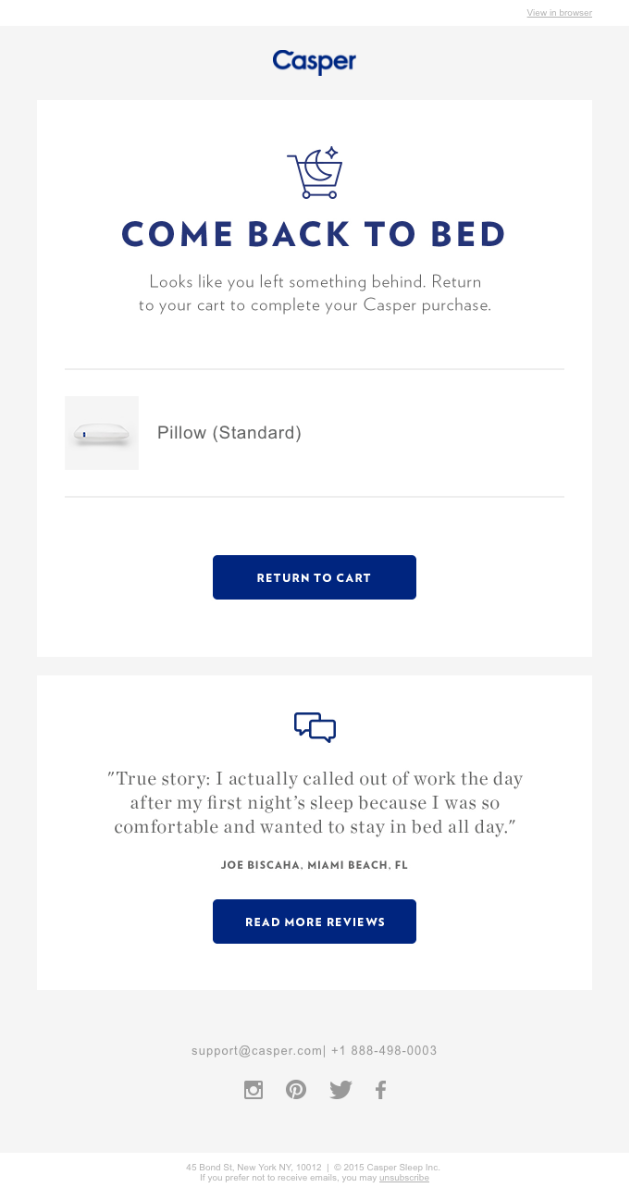
Source: Really Good Emails
Why it works: At 1–2 hours post-abandonment, the majority of abandoners with genuine intent don't need an incentive. They need a nudge. Many left because they got a phone call, their boss walked in, or their phone died. Over-engineering Email 1 by leading with a discount or creating artificial urgency wastes the moment when recovery is easiest and cheapest.
Copy approach: Conversational and low-pressure. Something like: "Hey [Name] - you left something in your cart. It's still there if you want it." The product image should dominate the top half of the email. One button. One job.
Key takeaway: Email 1 should function like a helpful text from a friend who noticed you walked away from something. Not a promotion.
2. The Specific Urgency Play (Adidas-style)
Subject line: "Only 2 left in your size"
What it does: Uses real-time inventory data to trigger a low-stock alert when the abandoned item is genuinely running low in the shopper's specific size or variant.
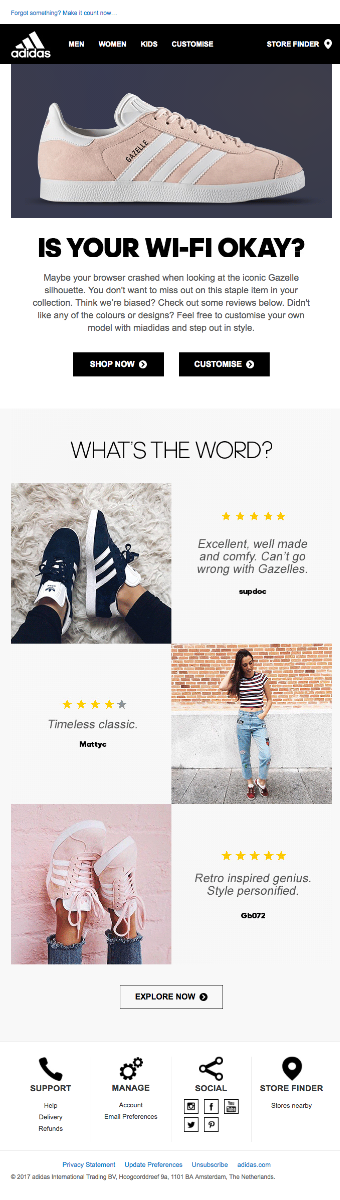
Source: Really Good Emails
Why it works: There are two kinds of urgency in ecommerce email: real and manufactured. Generic urgency ("Act now! Limited time only!") is ignored so universally that it's essentially background noise. Specific urgency tied to real inventory data converts because it's verifiably true - the shopper can check.
Copy approach: The subject line does most of the work. The email body shows the product, confirms the low stock status, and uses a single CTA: "Secure my size." No discount needed. Scarcity is the incentive.
Key takeaway: If your platform can pull live inventory data into email templates (Klaviyo can do this natively), use it. For common sizes or high-demand variants, this tactic alone can meaningfully lift Email 2 or 3 conversion rates.
3. The Free Shipping Offer (Huckberry-style)
Subject line: "Free shipping on your cart - today only"
What it does: Offers free shipping as an exclusive, time-limited offer in the cart recovery email - not available sitewide.
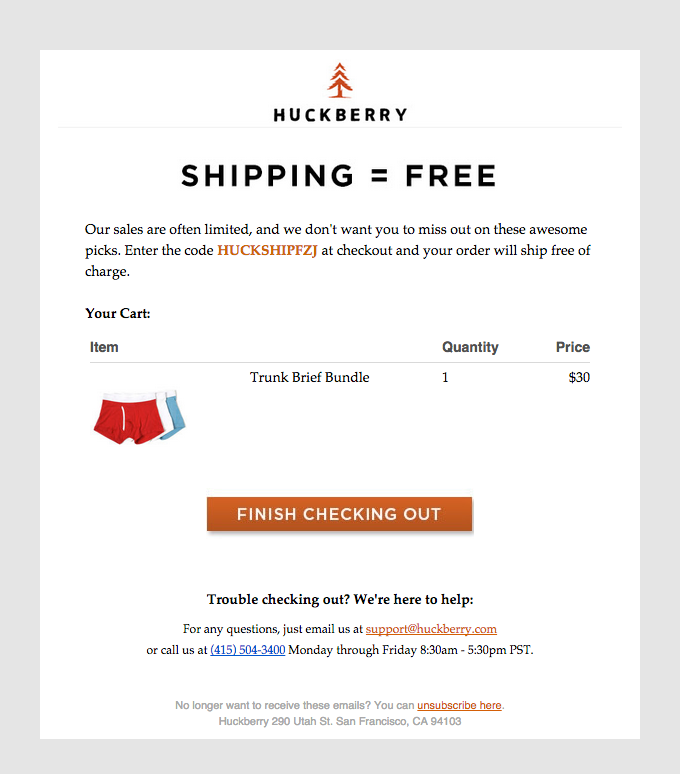
Source: Really Good Emails
Why it works: Unexpected extra costs are the single most common reason for abandonment per Baymard's 2025 data, cited by 48% of actionable abandoners. If shipping cost is the primary friction point at your store, addressing it directly in Email 2 or 3 eliminates the objection rather than dancing around it.
The reason this works better as an email offer than a sitewide policy is exclusivity. The shopper feels they've received something personal - a recovery offer - which increases the perceived value of completing the purchase now.
Copy approach: Keep it clean. Subject line states the offer. Body confirms the cart contents, the free shipping offer, and the deadline. One CTA. No other promotional content.
Key takeaway: If your abandonment analytics show a high drop-off rate at the shipping step of checkout specifically, this is the email to build. Reserve it for Email 2 or 3 - not Email 1, where you should never lead with an incentive.
4. The Social Proof Email (Brooklinen-style)
Subject line: "Here's what 2,847 people think about [Product Name]"
What it does: Email 2 leads not with the product or a discount, but with customer reviews of the specific item left in the cart. The review is matched to the exact SKU, not generic brand testimonials.
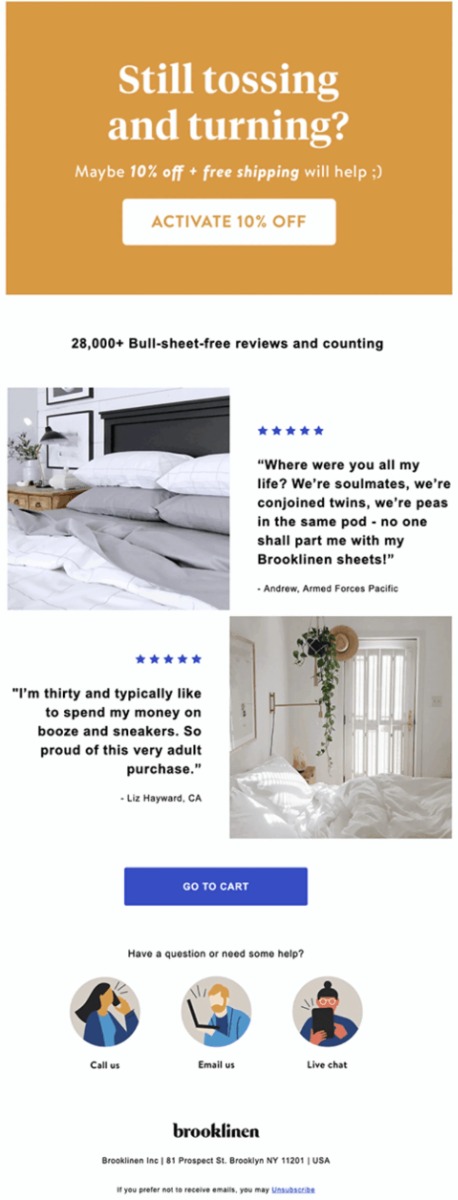
Source: Brooklinen Email
Why it works: Trust and security concerns are the third most common actionable abandonment reason - 25% of abandoners per Baymard. For product categories where quality or fit is uncertain (bedding, apparel, skincare), a verified five-star review from someone with a similar situation directly removes a specific decision barrier.
Klaviyo's 2026 benchmark report found that AI-powered product recommendations lift email click rates to 3.75% on average - and matching specific reviews to specific abandoned SKUs operates on the same personalization principle.
Copy approach: Lead with the review, ideally with the reviewer's name, verified purchase badge, and star rating. Follow with the product image and a "Read more reviews" CTA alongside "Return to cart." Two CTAs here is acceptable because both return the shopper to the purchase context.
Key takeaway: Generic "Our customers love us!" testimonials don't address the specific hesitation. A review that says "This comforter is worth every penny - I was skeptical of the price but it's been three years and it still looks new" does.
5. The Discount With a Deadline (Rudy's Barbershop-style)
Subject line: "10% off your cart - expires in 24 hours"
What it does: Email 3 introduces a percentage discount with a hard expiration. The offer has never appeared in Email 1 or 2. This is the only email in the sequence that mentions price reduction.
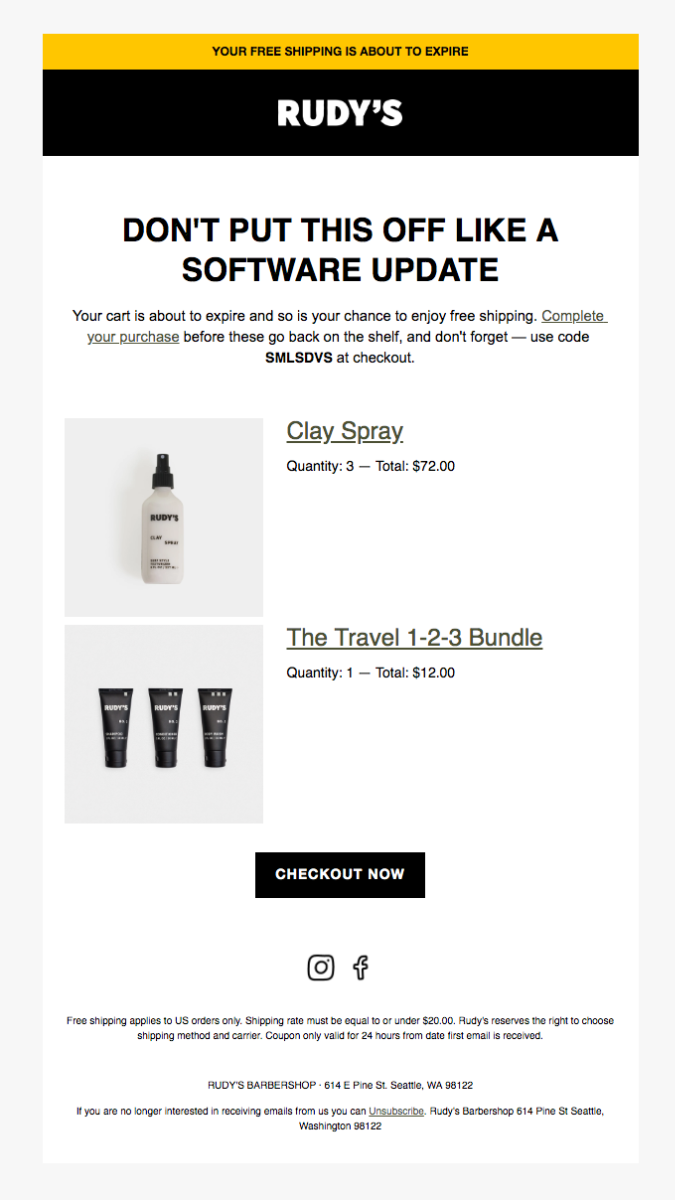
Source: Really Good Emails
Why it works: The expiration makes the offer feel real rather than permanent. A permanent discount trains buyers to simply wait - they know another one is coming. A 24-hour window creates a genuine decision point.
Klaviyo's own benchmark guidance explicitly addresses this: discounts can encourage shoppers to wait for one before buying, which erodes margins over time. Reserving the discount for Email 3 limits that behavior because the shopper only sees it after the first two emails have already attempted recovery without one.
Copy approach: The subject line names the discount and the deadline. The email body confirms both, shows the cart, and has a single prominent CTA: "Claim my 10% - expires [time]." No additional promotional content.
Key takeaway: Sequence discipline matters more than the discount percentage. A 10% offer in Email 3 of a well-structured sequence outperforms a 15% offer in Email 1 of a poorly structured one - because Email 1 discounts train abandonment behavior.
6. The Humor Approach (Liquid Death-style)
Subject line: "Maybe you died? "
What it does: Email 3 opens with the darkest possible explanation for why a shopper didn't complete their purchase. The body follows through on the bit — two paragraphs of white text against a black background under the header "We're worried about you." No product image above the fold. No discount. Just the brand doing exactly what it always does.
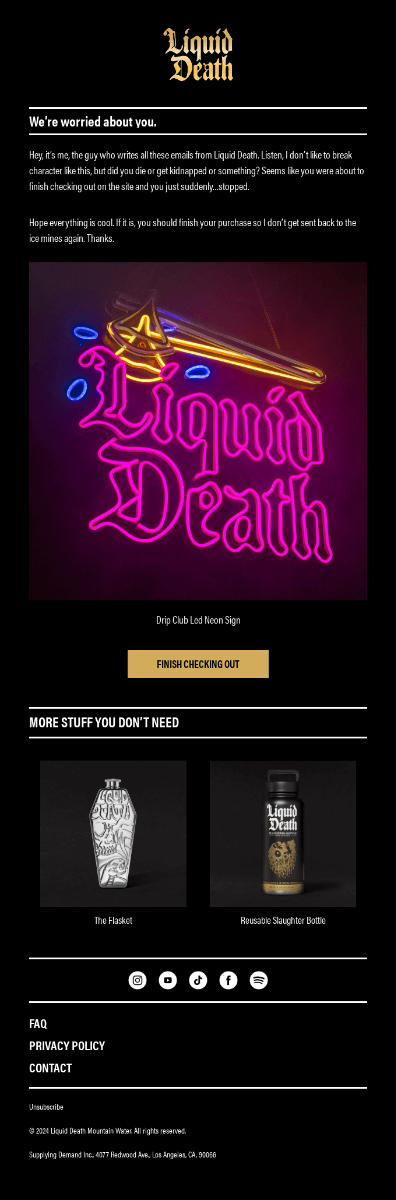
Source: Really Good Emails
Why it works: By Email 3, the shopper has seen two reminders and ignored both. Urgency and reminders clearly aren't the problem — engagement is. A subject line this unexpected forces a double-take in the inbox. The shopper thinks: "Did they actually just say that?" — and opens the email.
This only works because it's completely on-brand. Liquid Death's entire identity is built on irreverent, death-metal aesthetics applied to canned water. An email that asks "Maybe you died?" isn't a departure from their brand voice — it's a direct expression of it. The same email sent from a skincare brand or a children's clothing store would be a disaster.
Copy approach: Extremely short. The subject line carries all the weight. The email body leans into the joke for two sentences, then transitions naturally to the product and a single CTA. There's no hard sell anywhere in the email.
Key takeaway: Humor in Email 3 can re-engage subscribers who've gone cold on the first two touches — but only if the joke fits the brand identity without forcing it. The test is simple: if your brand wouldn't say it in any other context, don't say it in a cart recovery email. If it's something your brand would absolutely say, it's probably the most memorable thing in that shopper's inbox today.
7. The Time-Limited Reservation (Society6)
Subject line: "Cart reserved (with the best offer available)"
What it does: The email opens immediately with a deadline — the shopper's cart is being held for 48 hours, and a 30% discount comes with it. A single CTA button reads "Get My 30% Off." Below the fold: the abandoned items, a returns policy note, and an "As seen in" press section. The email is image-heavy and text-light, which fits Society6's design-marketplace identity.
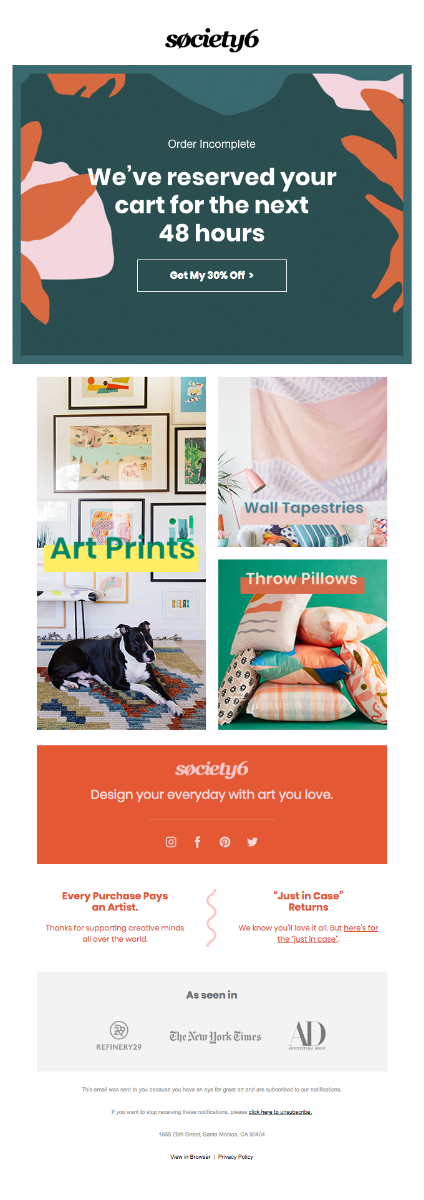
Source: Really Good Emails
Why it works: Two things happen at once here. The 48-hour reservation window creates genuine urgency — not vague "don't miss out" language, but a specific countdown that tells the shopper exactly how long they have. ConvertCart's analysis of urgency emails notes that Society6 "specifies the exact time remaining rather than using vague urgency language — that specificity is what makes it land." Meanwhile, the discount is front-loaded in the subject line, so the value proposition is clear before the email is even opened.
The subject line itself is worth studying. "Cart reserved (with the best offer available)" does two jobs: it signals that the cart is being actively held (creates mild scarcity), and it promises an offer without revealing it (creates enough curiosity to open). The shopper has to open the email to find out what "best offer" means.
Copy approach: Minimal text, maximum visual. The CTA does all the selling. The "Every purchase pays an artist" mission line at the bottom is a smart addition — it gives the shopper a feel-good reason to buy beyond the discount, which is particularly relevant for Society6's audience of design-conscious buyers.
Key takeaway: Specific time windows ("48 hours") outperform vague urgency language because they're verifiable and create a real decision point. If you're going to use a time-limited reservation, commit to the specific deadline in the subject line and make it prominent above the fold. And as with all discount tactics — reserve it for Email 3, not Email 1.
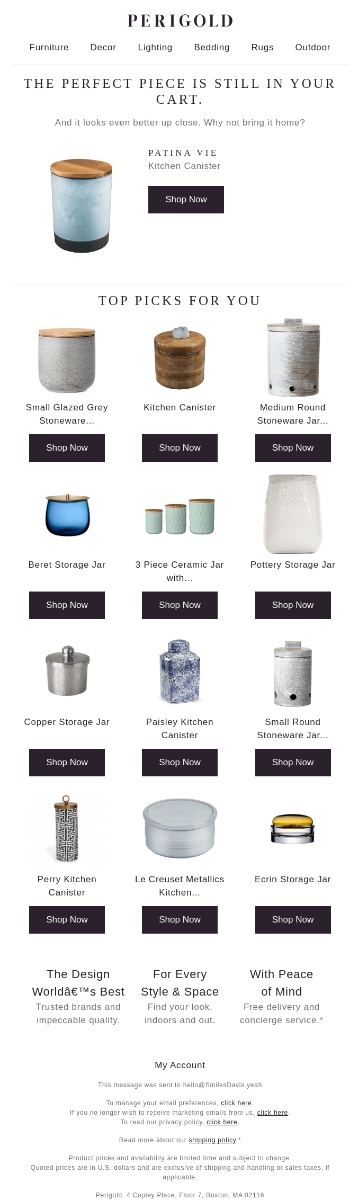
8. The Product Recommendation Pivot (Perigold-style)
Subject line: "The Kitchen Canister is in your cart →"
What it does: Email 2 shows the abandoned cart item, then surfaces 3–4 algorithmically recommended alternatives the shopper hasn't seen, personalized by browsing history and size.
Source: Really Good Emails
Why it works: Some abandoners were genuinely undecided about the specific product rather than the purchase category. They might have loved the style but been uncertain about the exact item. Showing alternatives keeps them in the buying journey rather than losing them entirely.
Klaviyo's 2026 benchmark report confirms that AI-powered product recommendations in emails lift click rates to 3.75% average - with top performers reaching 8.79% - compared to lower rates without them. The lift is material enough to justify building recommendation logic into Email 2 for stores with sufficient catalog depth.
Copy approach: Lead with the abandoned item. Below it: "Top Picks for you:" followed by the recommended alternatives.
Key takeaway: This tactic works best for stores with a broad catalog and shoppers who were visibly browsing multiple products before abandoning. For single-product stores or narrow catalogs, stick with the standard reminder approach.
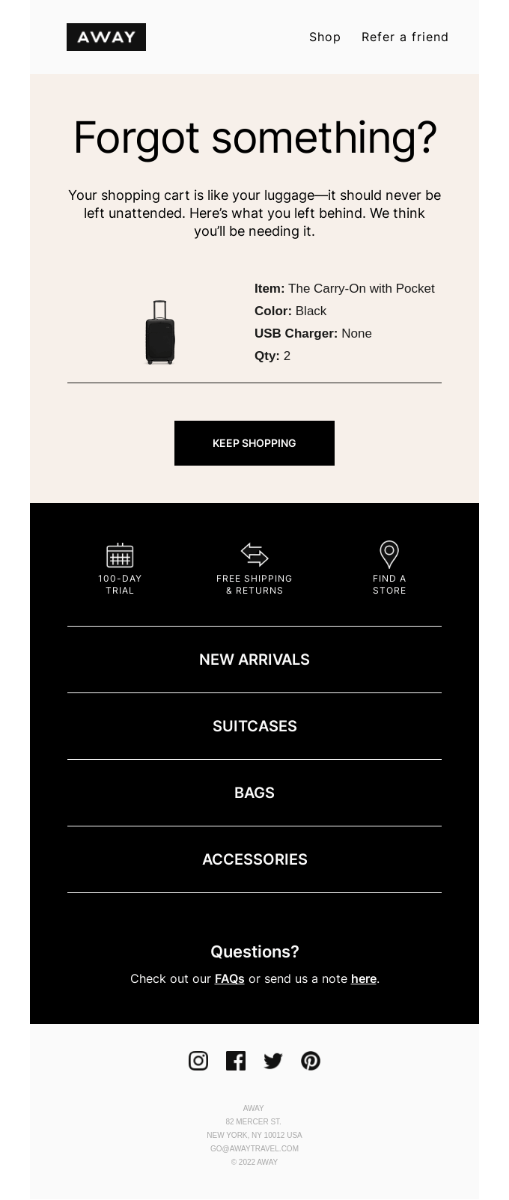
9. The Risk-Reversal Email (Away Luggage-style)
Subject line: "Try it for 100 days - or return it free"
What it does: Email 2 leads with the return policy and purchase protection rather than the product. The abandoned item is shown, but the email's first act is removing the risk of buying rather than re-selling the product.
Source: Really Good Emails
Why it works: For products over $100 - luggage, mattresses, skincare, electronics - the primary conversion barrier isn't desire. It's risk. "What if I don't like it?" or "What if it breaks?" are real hesitations that no amount of product photography resolves. A 100-day trial or free returns guarantee removes the specific friction that's keeping the shopper from committing.
Copy approach: Lead with the guarantee: "We stand behind this completely. Try it for 100 days. If it's not right, return it free." Then show the product. The CTA should acknowledge the reduced risk: "Try it risk-free."
Key takeaway: Every store above a $100 AOV should have a strong return policy visible in at least one recovery email. If you don't have a generous return policy, that's worth reconsidering - it's one of the highest-leverage trust signals in ecommerce, and it affects conversion everywhere, not just email.
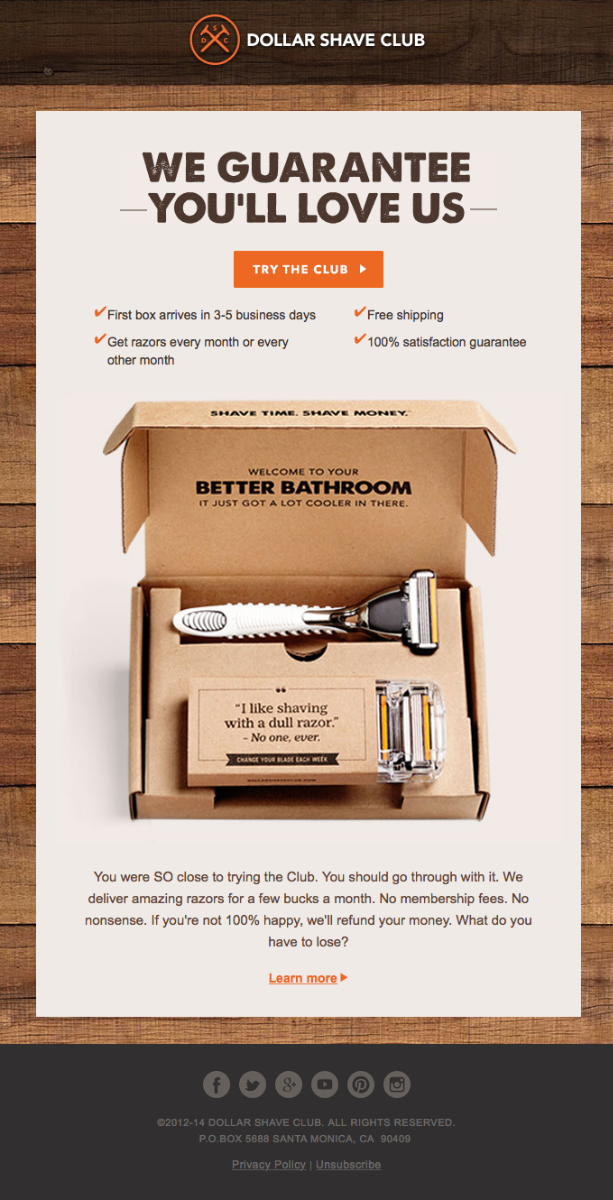
10. The Benefit-Led Reminder (Dollar Shave Club-style)
Subject line: "Where did you go?"
What it does: Rather than showing just the abandoned product and a CTA, this Email 2 format leads with a concise, scannable list of the product's core benefits — why it's worth buying — before getting to the cart link. The product image shows the full unboxed contents so the shopper understands exactly what they're getting. A money-back guarantee closes the email as a final risk-removal signal.
Source: Really Good Emails
Why it works: Some abandoners left not because of cost or distraction, but because they weren't fully convinced the product was right for them. A standard reminder email — "you left this behind, here's the link" — doesn't address that hesitation at all. Leading with bulleted benefits re-sells the product at the moment the shopper is being asked to return. It answers the implicit question: why should I go back?
Dollar Shave Club's casual, conversational tone makes the email feel like a message from a friend rather than a promotional broadcast. The subject line is short and curiosity-driven without being clickbait — it simply acknowledges the gap between the visit and now.
Copy approach: Short subject. One or two lines of friendly copy. A tight benefit list — three to five points maximum, each one sentence. Product image showing what's actually in the box. A single CTA. Guarantee or risk-reversal statement at the bottom. Nothing else.
Key takeaway: This format works especially well for subscription products or items with non-obvious value propositions — where the shopper added to cart based on initial interest but may not have fully understood what they were getting. Restating the "why buy" in a skimmable format at Email 2 addresses hesitation without pressure and without a discount.
Subject Lines That Get Opened
The subject line is the only thing that determines whether everything else you wrote gets read. Based on data from Klaviyo's analysis of abandoned cart flows across 183,000+ brands, abandoned cart emails average 50.5% open rates - roughly double the rate of standard promotional campaigns. But averages hide a wide range.
What consistently outperforms:
First-name personalization. Not a trick - it consistently lifts open rates because it signals the email is specifically for this person, not a broadcast. "[Name], you left something behind" outperforms "You left something behind" meaningfully across studies.
Product specificity. "Your Blue Oxford Shirt is waiting" outperforms "Items in your cart are waiting." The specificity triggers the memory of the product and the desire associated with it.
Specific urgency. "Only 2 left in your size" outperforms "Items selling fast." The first is verifiable. The second is noise.
Curiosity and humor for Email 3. "Is it something we said?" or "We need to talk about your cart" cuts through inbox fatigue after two reminder emails. This only works if it matches the brand tone.
What to avoid:
"Did you forget something?" - So overused that open rates for this subject line have declined to near-baseline across most platforms.
Offering a discount in the Email 1 subject line. It works short-term and trains long-term abandonment behavior.
ALL CAPS urgency. It reads as spam and is flagged by spam filters.
Don't neglect preview text. Most email clients show 40–85 characters of preview text after the subject line. It's the second line in the inbox and functions as "Email 1.5." It should extend the subject, not repeat it.
Example: Subject: "Your cart is still saved, [Name]" → Preview text: "Free shipping on orders over $75 - yours qualifies."
7 Best Practices That Actually Move the Needle in 2026
Here the 7 abandoned cart email best practices to recover lost sales in 2026.
1. Never lead Email 1 with a discount.
This is the most counterintuitive and most important practice on this list. Training shoppers to abandon carts deliberately - because they know a discount email is coming - is a documented problem that compounds over time. An email from Klaviyo's own guidance: "Discounts can work against you by training shoppers to wait for a discount before buying." Reserve incentives for Email 3. Email 1 should be a straight, helpful reminder.
2. Segment by cart value.
A $14 cart and a $340 cart need completely different emails. High-AOV carts justify more investment in the sequence: more social proof, stronger risk-reversal language, longer timing, and potentially a more significant incentive in Email 3. Low-AOV carts need speed and simplicity - the shopper's hesitation is less about conviction and more about whether they feel like completing the transaction right now.
3. Show the product image high in the email.
Product imagery is the single most direct memory trigger for an abandoned cart. The shopper saw and liked the item. Showing it again in the email re-activates that desire. The product image should appear in the top half of every recovery email, before any copy about policies, shipping, or incentives.
4. One CTA per email.
Every recovery email should have a single, clear call-to-action that returns the shopper to their exact cart. Multiple CTAs (shop new arrivals, browse the sale, follow us on Instagram) dilute the primary conversion goal. The email has one job: get the shopper back to checkout. Every other link is a distraction.
5. Design for mobile first - not as an afterthought.
Mobile cart abandonment rates sit at 75.5% according to SellersCommerce (2025) - significantly higher than desktop. Your recovery emails are predominantly opened on phones. Single-column layout. Minimum 16px body text. CTA buttons with a minimum 44px tap target, clearly spaced from other elements. Test every email on iOS and Android before activating the flow.
6. Suppress recent purchasers and active sessions immediately.
If a shopper completed their purchase on a different device, through a different browser, or after receiving Email 1 - remove them from the remaining sequence immediately. Sending cart recovery emails to customers who have already bought is a UX failure that damages brand trust. This should be handled automatically by any serious email platform, but verify that your suppression logic is configured correctly.
7. A/B test subject lines within flows, not just campaigns.
Most merchants test campaign emails. Far fewer run A/B tests on their automation flows. The subject line of your abandoned cart Email 1 gets more impressions than almost any campaign you'll send. Running a subject line test on your flow - first name personalization vs. product name, urgency vs. curiosity - and letting the winner auto-select is one of the lowest-effort, highest-ROI optimizations available.
Common Mistakes That Hurt Recovery Rates
Waiting more than 4 hours to send Email 1. Recovery rates drop sharply as time passes. Intent cools, and the shoppper moves on to alternatives. The first email's job is to reach the shopper while their desire is still warm.
Sending more than 3 emails for standard products. Diminishing returns are steep. Email 4 and beyond rarely recover meaningful revenue and carry real risk of unsubscribes and spam reports.
Using a no-reply sender address. It signals automation, not a person. Use a real name and a monitored reply address - or at least one that looks human (sarah@[brand].com). Replies to cart emails are often purchase intent signals.
Putting your full newsletter inside the recovery email. Cart recovery emails should have one job. Navigation links, blog content, promotional banners, and social media feeds dilute the message and reduce click-through to checkout.
Including filter pages or session-start abandoners in the same flow as checkout-initiated abandoners. Someone who added to cart and started entering their shipping address has meaningfully higher intent than someone who added to cart and immediately closed the tab. These are different people and warrant different approaches.
Sending recovery emails without checking your email deliverability. If your recovery emails are landing in Promotions or spam, your 50%+ open rate benchmark is theoretical. Klaviyo's benchmark data shows that top 10% performers achieve 65.34% open rates - inbox placement is part of what separates average from elite performance.
Tools That Power Abandoned Cart Emails
A brief practical overview rather than a comprehensive comparison:
Klaviyo is the most widely used platform for Shopify and Magento stores running serious abandoned cart automation. Native flow builder, AI product recommendations, per-flow analytics, and the benchmark data cited throughout this article. Their Magento 2 integration handles event tracking natively.
Omnisend is strong for multi-channel flows - email, SMS, and web push in a single sequence builder. Their annual research data, cited in this article, is among the most transparent industry benchmarks available.
Brevo (formerly Sendinblue) is a more affordable entry point for stores under 10,000 subscribers with simpler automation needs.
Shopify Email is built into Shopify admin and adequate for basic single-email sequences. Limited segmentation capability compared to dedicated platforms.
For Magento 2 stores: Abandoned cart email automation requires either a dedicated extension or integration with one of the platforms above. If you're running Magento 2 want to have abandoned cart email functionality on your website you can check out MageDelight's Abandoned Cart Email for Magento 2 Extension.
Also read: Best Magento 2 Abandoned Cart Extensions
FAQ
Here are the common questions and its answer you might have abandoned cart email.
1. What is an Abandoned Cart Email?
An abandoned cart email is an automated message sent to a shopper who added items to an online cart but left the site without completing the purchase. The email reminds them of the items they left and provides a direct link back to their cart.
2. What is a Good Open Rate for Abandoned Cart Emails?
According to Klaviyo's analysis of 143,000+ abandoned cart flows, the average open rate is 50.5%. Top 10% of performers reach 65.34%. Both figures significantly exceed standard promotional email benchmarks, which average around 22–29% across most ecommerce industries.
3. How Many Abandoned Cart Emails Should I Send?
Three emails is the standard for most ecommerce stores: one at 1–4 hours, one at 24 hours, and one at 72 hours. For luxury or high-AOV products with longer consideration periods, a 5–7 day sequence is appropriate. Beyond 3 emails for standard products, recovery rates drop sharply and unsubscribe risk increases.
4. When Should I Send the First Abandoned Cart Email?
Within 1–4 hours of abandonment for most stores. For impulse purchases under $50, lean toward 1 hour. For considered purchases over $150, 3–4 hours gives the shopper time to complete their research without your email arriving while they're still actively comparing.
5. Should I Offer a Discount in My Abandoned Cart Email?
Not in Email 1. Klaviyo's guidance is explicit on this: leading with discounts trains shoppers to abandon carts deliberately to wait for the offer. Reserve discounts for Email 3, behind a time limit. Not every shopper needs an incentive to convert - many need only a reminder.
6. How Much Revenue Can Abandoned Cart Emails Recover?
Recovery rates vary by store, but Klaviyo's data shows an average placed order rate of 3.33% across abandoned cart flows, with top performers reaching 7.69%. Baymard Institute estimates that $260 billion in lost orders are theoretically recoverable annually through improved checkout and recovery tactics.
7. Do Abandoned Cart Emails Work on Mobile?
Yes - and they have to, because mobile abandonment rates are 75.5% (SellersCommerce, 2025), meaning the majority of the recovery opportunity is on phones. Single-column layouts, large tap targets, fast-loading product images, and short subject lines (under 40 characters) are non-negotiable for mobile-first recovery email design.
The Bottom Line
Cart abandonment at 70% is a structural reality of ecommerce - it isn't going away, and it isn't caused by anything you can fully control. What you can control is how much of the recoverable 27–30% you actually get back.
The difference between a 3% recovery rate and a 15%+ rate comes down almost entirely to execution: sending Email 1 within the right window, matching email content to the likely reason for abandonment, never leading with a discount, designing for the phone in the shopper's hand, and running a 3-email sequence instead of a single shot.
Set it up properly once, and a well-structured abandoned cart flow generates revenue every day without ongoing effort - which is why Klaviyo's benchmark data puts it as the highest RPR automation available, at $3.65 per recipient on average and $28.89 for top performers.
If you're running a Magento 2 store and want to understand the full technical stack behind an optimized ecommerce operation - from SEO extensions that handle structured data and canonical URLs, to layered navigation settings that protect crawl budget, to site speed that keeps the checkout experience fast enough to reduce abandonment in the first place - those guides are in our Magento SEO and optimization cluster.
