


If you are running a Magento store with a growing catalog, you have likely hit the same wall most merchants hit: the content, SEO, and search visibility work never stops growing, but the team and budget do not grow with it.
This guide breaks down how AI solves that problem - and how it strengthens your visibility not just on Google, but across the AI-powered search platforms that are quietly reshaping how products get discovered online.
Also Read: AI-Powered Commerce for Magento 2: A Merchant’s Guide
Why Magento Stores Need AI Now?
Search has changed more in the last two years than in the previous decade. Google AI Overviews, ChatGPT browsing, Perplexity, and Microsoft Copilot are now active discovery surfaces for eCommerce. These platforms do not rank pages the way Google traditionally does - they consume structured, context-rich content and cite sources that answer buyer questions clearly and completely.
For Magento merchants, this creates a new layer of urgency. Your product pages now need to work for three audiences simultaneously: human shoppers, traditional search crawlers, and AI language models. If your content is incomplete, inconsistent, or poorly structured, you are invisible to at least one of those audiences - and increasingly, to all three.
The business case is straightforward. According to McKinsey research, businesses investing in AI are seeing revenue uplifts of 3 to 15 percent and sales ROI uplifts of 10 to 20 percent. Salesforce data shows that 84% of businesses believe AI gives them a meaningful competitive advantage. This is not a future trend to monitor - it is a current operational gap to close.
Also Read: How AI is Changing the Magento 2 Store Optimization?
The Real Problem: Where Manual Magento Operations Break Down
Before looking at the solution, it helps to name the failure points clearly. Most Magento merchants experience the same four breakdowns as their catalog grows.
1. Content Bottlenecks Slow Catalog Growth
The first is content that cannot keep pace with catalog growth. Writing and updating product descriptions manually does not scale. New SKUs pile up waiting for copywriters, which means new products launch with incomplete pages, thin content, and no SEO value on day one.
2. Inconsistent SEO Across Thousands of Pages
The second is inconsistent SEO across thousands of product pages. When content is produced manually, quality varies. Top-selling products get attention. Long-tail SKUs get whatever is left. Meta titles are missing. Descriptions are duplicated. The result is a catalog where a fraction of pages do real SEO work and the rest drag performance down.
3. Translation Delays Kill International Revenue
The third is the cost and delay of translation. According to CSA Research, 76% of online shoppers prefer buying in their native language. Yet most Magento stores treat translation as a slow, expensive, low-priority project. Entering a new market means re-translating thousands of product fields - a process that typically takes months and delays international revenue significantly.
4. Customer Review Intelligence Goes Unextracted
The fourth is review data that goes unread. Customer reviews contain product intelligence that most merchants never extract. At scale, manually reading thousands of reviews to find patterns, identify product issues, or surface messaging opportunities simply is not practical. That data sits unused while competitors who do use it get smarter about their products and their customers.
The common thread across all four is throughput. The limiting factor is not strategy or budget - it is the capacity to execute. AI removes that ceiling.
Four Ways AI Transforms Magento Content and Discoverability
For Magento merchants, this advantage translates into four concrete operational shifts that change how content is created, localised, analysed, and discovered.
1. Automate Product Content at Scale
The challenge: Maintaining complete, consistent, SEO-optimised content across hundreds or thousands of product pages is beyond the capacity of any manual content team.
The AI solution: AI content generation uses your existing product catalog data - attributes, specifications, categories - to produce unique, structured product descriptions, meta titles, and metadata. According to HubSpot research, 74% of new web content now involves AI assistance.
Business impact:
- Faster catalog expansion without content bottlenecks
- Consistent tone, formatting, and keyword coverage across all SKUs
- Every product page optimised, including long-tail SKUs that manually-managed operations neglect
Recommended extension:
AI Product Content Generator for Magento 2
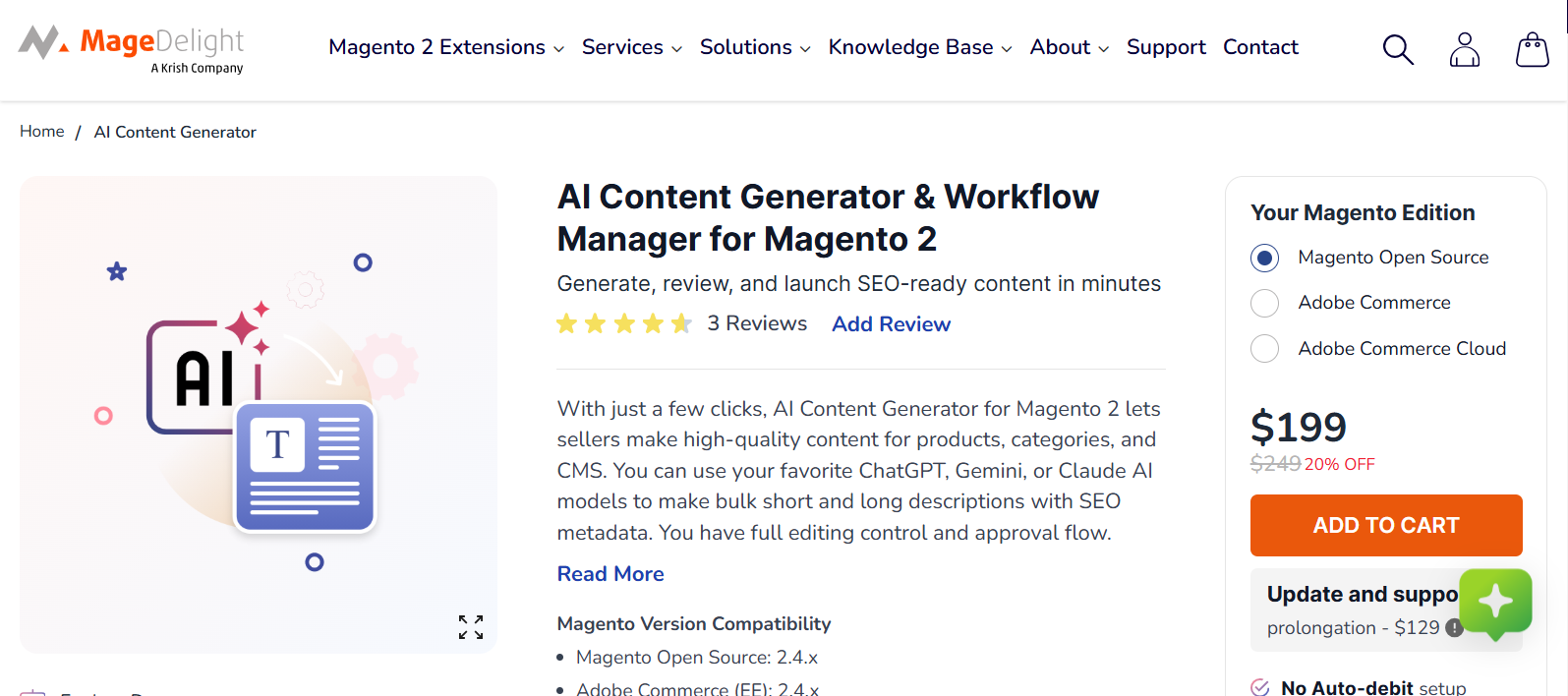
Generates complete product descriptions, meta titles, meta descriptions, and keyword-aligned attributes directly from your catalog data.
Key features:
- Auto-generates descriptions, meta titles, and meta descriptions for every SKU
- Maintains consistent brand tone and formatting across the catalog
- Keyword-aware output supports Magento AI SEO best practices
- Scales without slowdown as catalog size increases
2. Localise Content for Every Global Market
The challenge: Manual translation of product content for international store views is slow, error-prone, and expensive. Each new market means re-translating thousands of fields - a process that takes months.
The AI solution: AI-powered translation processes your entire catalog - product descriptions, attributes, metadata - across multiple languages simultaneously, with context-aware accuracy that goes beyond literal word-for-word translation.
Business impact:
- Launch global storefronts in days, not months
- Consistent brand messaging across all language versions
- Localised keyword alignment that strengthens regional SEO performance in each target market
Recommended extension:
AI-Powered Multilingual Content Translator for Magento 2
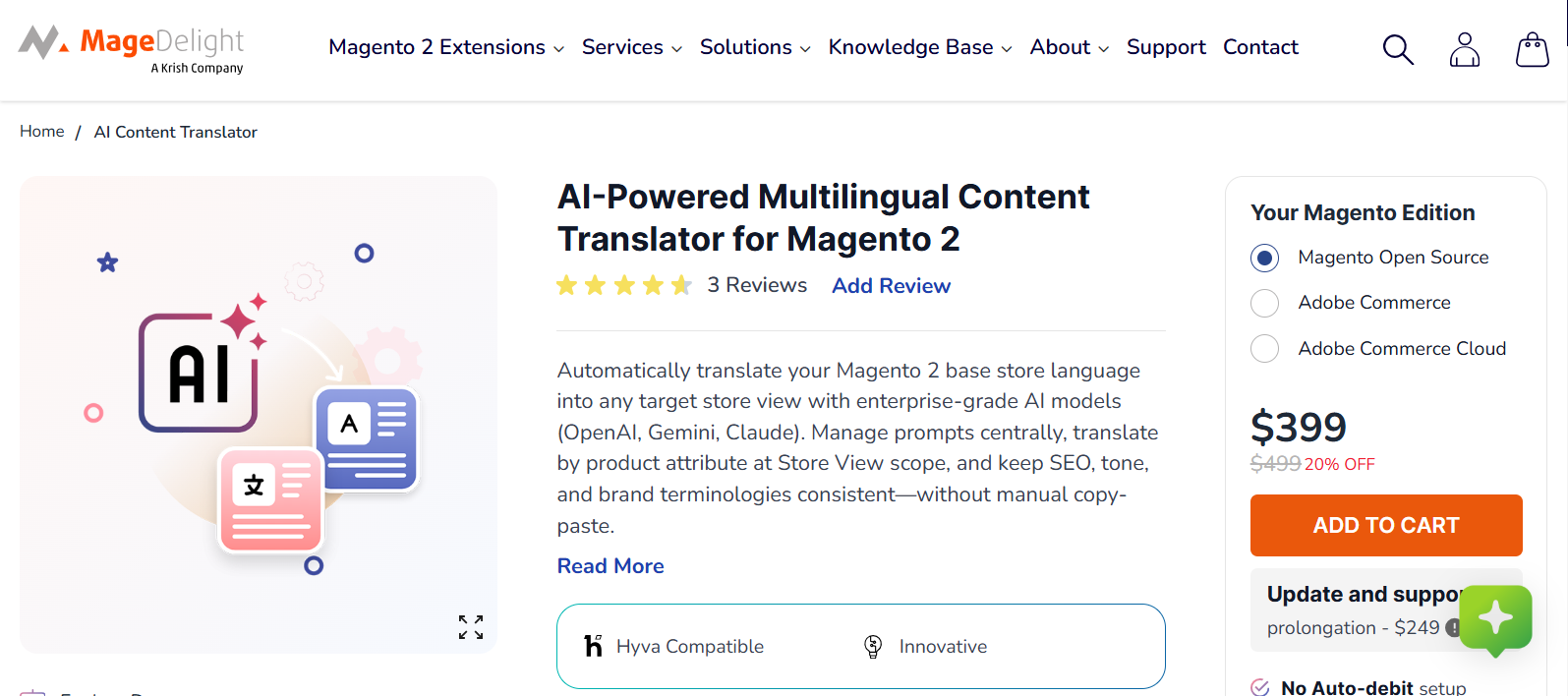
Automates translation of product descriptions, attributes, and metadata across all Magento store views.
Key features:
- Automated, context-aware translation across multiple languages
- Covers product descriptions, attributes, and all metadata fields
- Localised keyword alignment for improved regional search visibility
- Consistent brand voice maintained across all language versions
3. Turn Customer Reviews into Product Intelligence
The challenge: Customer reviews contain valuable product insights - but reading and analysing thousands of reviews manually to surface patterns is not practical at scale. Important signals go unaddressed.
The AI solution: AI review summarisation processes large volumes of customer reviews and surfaces concise, structured summaries of key themes, positive sentiment, and concerns - displayed directly on product pages.
Business impact:
- Products with customer reviews have up to 270% higher purchase likelihood, according to Spiegel Research Center data
- User-generated insights directly improve product page messaging
- Review summaries add content depth that strengthens both trust and search relevance
Recommended extension:
AI Product Review Summarizer for Magento 2
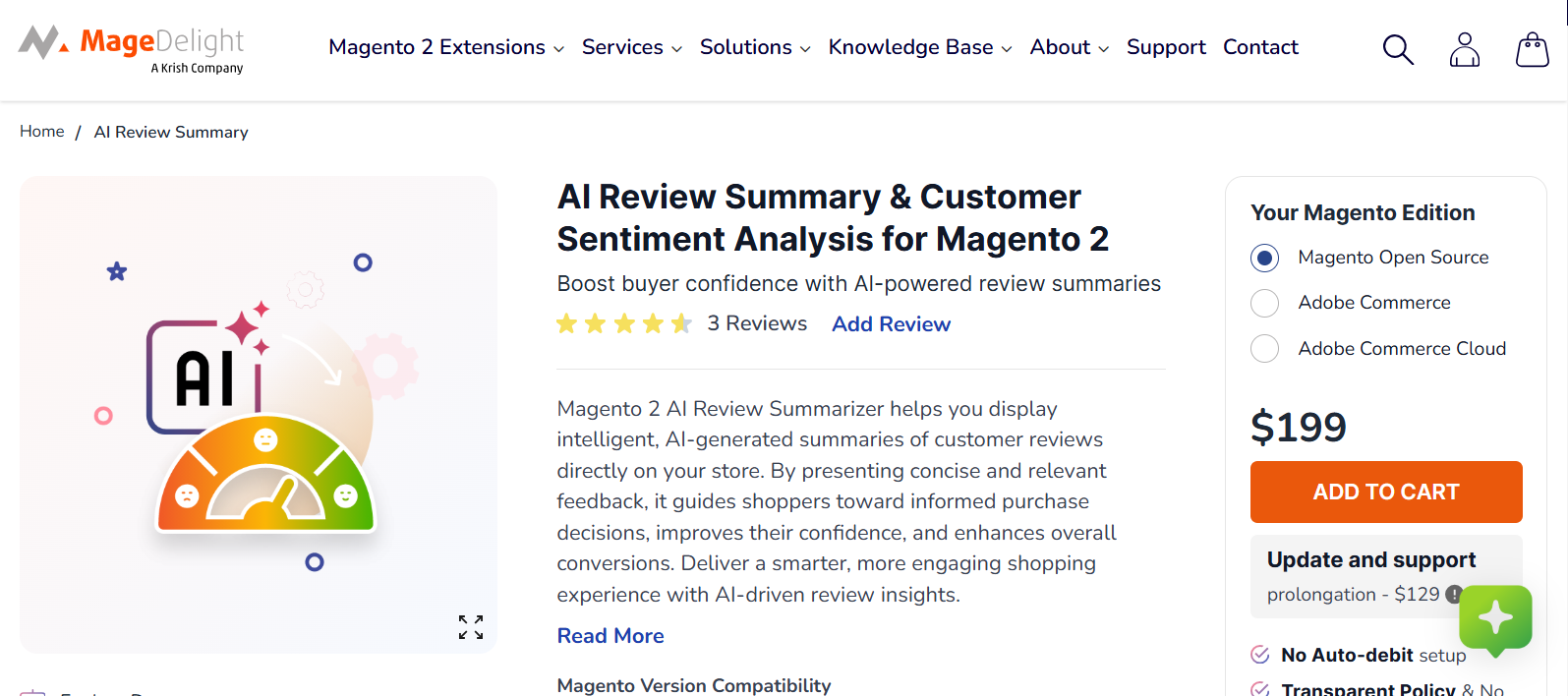
Analyses and summarises customer reviews at scale, making key insights visible on product pages.
Key features:
- Summarises hundreds of reviews into clear, shopper-facing insights
- Highlights positive themes, product concerns, and standout attributes
- Displays summaries directly on product pages to accelerate purchase decisions
- Surfaces messaging angles that can be used across copy and advertising
4. Make Your Catalog Readable by AI Search Engines
The challenge: AI-powered discovery platforms - including ChatGPT, Perplexity, Google AI Overviews, and Microsoft Copilot - do not crawl pages the way traditional search engines do. They consume structured, machine-readable content. Without this, your catalog is invisible to these platforms.
The AI solution: Generating a structured LLMs.txt file organises your product information, metadata, and catalog content in a format that AI language models can accurately parse, understand, and cite.
Business impact:
- Improved visibility across AI-driven discovery and recommendation systems
- Full control over how and what AI models consume from your store
- Consistent structured data that positions your catalog for both current and emerging search surfaces
Recommended extension:
LLMs.txt File Generator for Magento 2
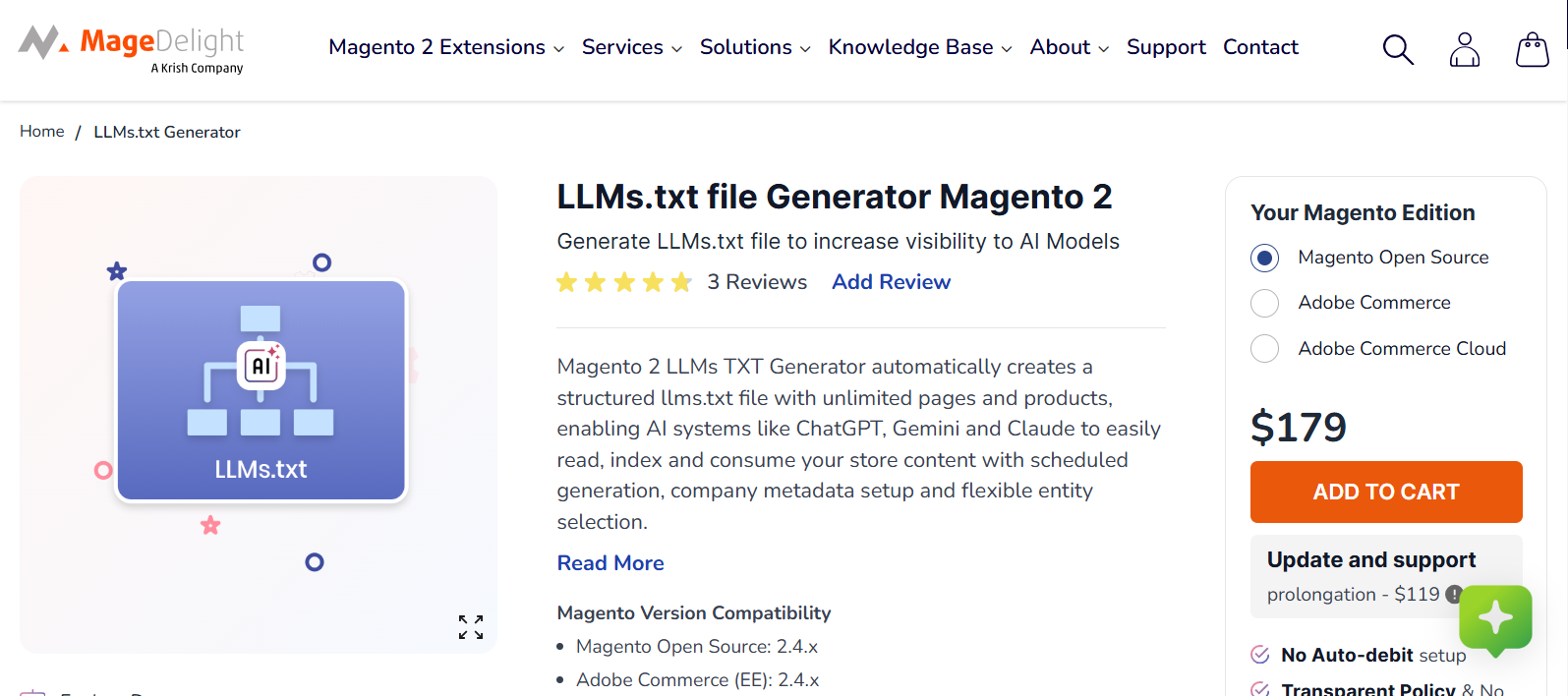
Automatically generates structured LLMs.txt files that make your Magento catalog readable and citable by AI search platforms.
Key features:
- Generates LLMs.txt that AI crawlers can accurately parse and reference
- Full control over which content AI systems can access
- Works alongside existing sitemap and schema markup
- Future-proofs catalog visibility as AI-powered search scales
How AI Strengthens SEO Across Traditional and AI-Driven Search
These four capabilities do not operate in isolation. Together, they create a compounding SEO and GEO (Generative Engine Optimisation) advantage that strengthens your Magento store's visibility across every major discovery surface.
|
AI Capability |
Primary Function |
SEO/GEO Impact |
|
AI Content Generation |
Auto-create product descriptions and metadata |
Complete on-page SEO for every SKU |
|
AI Translation |
Convert catalog across all store views |
Regional keyword alignment and local SEO |
|
Review Summarisation |
Analyse and surface customer feedback |
Trust signals and content depth |
|
LLMs.txt Structured Data |
Organise content for AI model consumption |
Visibility in AI-powered search and discovery |
What Each Layer Actually Does for Your Search Performance?
Most SEO guides treat content, translation, reviews, and structured data as separate workstreams. For Magento stores, they are not. Each one builds on the last, and together they close the gaps that keep product pages from ranking, on Google and on the AI platforms that are increasingly driving commercial discovery.
Every Product Page Pulls Its Weight
Most stores optimise their top sellers and leave the rest to chance. AI changes that by ensuring every SKU has complete meta titles, descriptions, and keyword-rich content, so your entire catalog contributes to organic traffic, not just a fraction of it.
You Show Up for Buyers Who Know Exactly What They Want
Long-tail search queries - the specific, descriptive ones buyers use when they are ready to purchase, are where conversion rates are highest. AI-generated content is naturally aligned to these queries, capturing traffic that broad category pages miss entirely.
Search Engines Can Read and Index Your Catalog Correctly
Well-structured, consistently formatted content removes ambiguity for both traditional search crawlers and AI models. When your pages are easy to parse, they are easier to index, and easier to rank.
You Become Visible on ChatGPT, Perplexity, and Google AI Overviews
AI-powered search platforms favour content that is clean, complete, and contextually rich. The combination of full product descriptions, localised content, review summaries, and LLMs.txt gives these platforms exactly what they need to cite your store confidently.
Each Language Market Becomes Its Own SEO Asset
A translated store view with localised keyword alignment does not just reach more people, it competes independently in its own market's search results. Every regional store view you launch multiplies your total search surface area.
Real Customer Language Strengthens Your Rankings
Review summaries add something no internally written content can replicate: the words real buyers use to describe your products. That language builds trust with shoppers and adds the kind of contextual depth that search algorithms and AI models use to evaluate page quality.
What AI Actually Delivers for Magento Merchants?
AI-driven content workflows do not just save time, they produce measurable improvements across the operations that directly affect revenue, search performance, and market reach. Here is what that looks like in practice.
Your Team Stops Doing Work That Should Be Automated
Content that previously required hours of manual work per SKU is generated in seconds. That is not just a cost saving, it frees your team to focus on strategy, merchandising, and growth instead of production tasks that add no competitive advantage.
New Products Go Live Fully Optimised From Day One
With manual workflows, new SKUs wait days or weeks for content before they can be published properly. AI eliminates that queue. Products go live with complete, optimised descriptions, meta titles, and attributes on the day they are added, which means they start generating organic traffic immediately.
More Pages Rank, More Traffic Arrives
Complete, consistent, keyword-aligned content across every product page increases the number of pages that actively contribute to organic search traffic. Instead of a small percentage of your catalog doing all the SEO work, the entire catalog pulls its weight.
International Markets Open in Days, Not Months
AI translation reduces the time to launch a new regional store view from months to days. For merchants with international ambitions, that speed advantage compounds quickly, more markets live sooner means more revenue generating sooner.
Your Review Data Becomes a Business Asset
Review summaries do more than improve product pages. The insights they surface - what customers love, what disappoints them, what they compare you against can inform merchandising decisions, product development priorities, and marketing messaging across every channel.
Frequently Asked Questions
Here are the common questions that can help you decide to invest in AI Extensions.
1. What is AI Search Visibility for Magento Stores?
AI search visibility refers to how well a Magento store's product pages appear in AI-powered discovery platforms such as ChatGPT, Perplexity, Google AI Overviews, and Microsoft Copilot. Unlike traditional search, these platforms cite structured, context-rich content rather than ranking pages. Optimising for AI search visibility - sometimes called Generative Engine Optimisation (GEO) - means creating complete, well-structured, machine-readable content that AI models can accurately summarise and reference.
2. How Does AI Content Generation Improve Magento Seo?
AI content generation improves Magento SEO by ensuring every product page has complete, keyword-aligned descriptions, meta titles, and meta descriptions - including long-tail SKUs that manual workflows typically neglect. According to HubSpot, 74% of new web content now involves AI assistance. By removing the content production bottleneck, AI enables consistent on-page SEO coverage at catalog scale.
3. What is an LLMs.txt File and Why Does a Magento Store Need One?
An LLMs.txt file is a structured document that organises a website's content - product information, metadata, and catalog data - in a format that AI language models can accurately read, parse, and cite. For Magento stores, it functions similarly to a sitemap but for AI crawlers rather than traditional search bots. As platforms like ChatGPT, Perplexity, and Google AI Overviews account for a growing share of commercial discovery traffic, having an LLMs.txt ensures your catalog is visible and citable on these platforms.
4. How Does Multilingual Ai Translation Affect International SEO?
Multilingual AI translation affects international SEO by producing localised content - not just translated content - across each regional store view. Context-aware AI translation preserves meaning and adapts keyword usage to match how buyers in each language market actually search, rather than producing literal translations that miss regional search intent. This localised keyword alignment allows each store view to compete independently in its target market's search results.
5. Can AI Review Summarisation Improve Search Rankings?
Yes. AI review summarisation help in improving search rankings in two ways. First, it adds content depth to product pages through user-generated language that reflects real buyer intent - the same natural language that search engines use to evaluate topical relevance. Second, review summaries increase on-page trust signals and dwell time, both of which are positive engagement factors for search algorithms. Products with visible customer reviews are also 270% more likely to convert, which further strengthens commercial performance.
6. What is Generative Engine Optimisation (GEO) for Magento?
Generative Engine Optimisation (GEO) is the practice of structuring and formatting web content so that it is accurately consumed, summarised, and cited by AI-powered search engines. For Magento stores, GEO means creating complete product descriptions, structured metadata, localised content, and machine-readable files (such as LLMs.txt) that make the catalog accessible and citable across platforms like ChatGPT, Perplexity, Google AI Overviews, and Microsoft Copilot.
The Magedelight AI Extension Stack for Magento 2
|
Extension |
Core Function |
Best For |
|
Auto-generate descriptions, meta titles, and attributes |
Stores with large or fast-growing catalogs |
|
|
Translate catalog across all store views |
Multi-market and international stores |
|
|
Summarise and display customer review insights |
High-volume review catalogs |
|
|
Structure catalog data for AI model consumption |
All stores targeting AI search visibility |
Also Read: Top AI Extensions for Magento 2 to Grow Sales & Personalization
Conclusion: Building a Scalable, AI-Ready Magento Operation
As Magento catalogs grow, the disadvantages of managing content, SEO, and search visibility manually become increasingly costly - not just in time, but in organic traffic, international revenue, and competitive position.
AI solves this by introducing consistency, speed, and structural completeness to the core operations that drive search performance. Whether generating product content, adapting it for global markets, extracting intelligence from reviews, or ensuring visibility across AI-powered discovery platforms, AI gives Magento merchants the operational leverage to grow without proportionally growing their teams.
More importantly, AI-optimised content creates a stronger long-term foundation for search performance. Complete, context-rich, and machine-readable product pages are no longer a best practice - they are a baseline requirement for both traditional search engines and the AI-powered platforms that are reshaping how products are discovered online.
For Magento merchants ready to scale, the priority is clear: implement AI at the content and structure layer to reduce manual effort, improve coverage, and strengthen discoverability - across Google, AI Overviews, ChatGPT, Perplexity, and every discovery surface that follows.
