


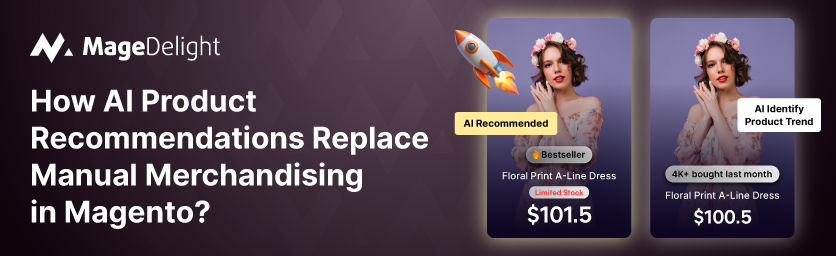
As Magento stores scale, merchandising shifts from a creative exercise to a systems-level challenge. Expanding catalogs, multi-store configurations, layered navigation, configurable products, and regional pricing structures introduce operational complexity that manual workflows are not designed to manage. The task of selecting products to feature together becomes a process of constantly prioritizing products.
Manual Magento merchandising operates on static logic, fixed related products, rule-based category sorting, and pre-configured upsell associations. Although very effective at a small scale, this approach fails as the number of SKUs increases and the shopping behavior becomes non-linear. Today’s consumers engage with the website through search, filters, wishlists, and repeat visits, creating behavioral data that cannot be interpreted or acted upon in real-time by traditional merchandising strategies.
The impact is not limited to operational pressure. It also affects the growth strategy. Merchandising teams spend more time updating product links and rules than improving performance. Without shopper insights and dynamic recommendations, scaling Magento stores face the challenge of remaining relevant, overcoming decision fatigue, and unlocking revenue potential.
In this article, we will discover how AI-driven product recommendations and Magento automation solve scaling issues, optimize merchandising, and overcome decision fatigue in scaling Magento stores.
The Scaling Problem in Magento Merchandising
Magento is architecturally flexible. It supports configurable products, layered navigation, complex attributes, and multi-store environments. But flexibility without intelligent automation creates three core scaling challenges:
1. Catalog Growth Outpaces Human Curation
Manual merchandising typically involves:
- Configuring related, cross-sell, and upsell products
- Creating category-based rules
- Reordering product listings
- Managing seasonal promotions
- Updating bundles
At 5,000 SKUs, this may still be manageable. At 50,000+ SKUs across multiple categories and store views, it becomes unsustainable.
Each new product introduction requires:
- Attribute mapping
- Placement logic
- Complementary product identification
- Visibility optimization
Manual updates cannot keep pace with daily inventory shifts, pricing changes, or seasonal demand spikes.
2. Static Rules Don’t Reflect Real-Time Intent
Magento’s native related product system is largely rule-based or manually configured. While useful, it does not significantly adapt to:
- User browsing behavior
- Wishlist signals
- Purchase history
- Real-time session intent
Static rules treat every visitor the same. But returning customers and first-time guests have very different intent profiles.
This disconnect increases cognitive load. When shoppers see irrelevant suggestions, they must filter mentally. Over time, this leads to decision fatigue and abandonment.
3. Manual Merchandising Creates Operational Overhead
From a business perspective, manual merchandising introduces:
- High labour costs
- Delayed campaign launches
- Limited testing capability
- Minimal revenue attribution
Most teams do not have visibility into which product blocks are driving the revenue. The merchandising becomes a reactive process.
As the number of stores increases, the merchandising becomes more of maintenance work.
How AI Product Recommendations Transform Magento Merchandising?
AI Product Recommendations transform Magento merchandising by replacing static product assignment with dynamic product suggestions driven by behavior and attributes. Rather than manually assigning products, these tools use product information and consumer data to determine the most relevant products in real-time.
An AI Product Recommendations solution built for Magento 2 integrates directly with Magento Open Source, Adobe Commerce, and Adobe Commerce Cloud (2.4.x environments). It works within Magento’s indexing framework and caching systems to maintain performance integrity.
The system uses embedding techniques to analyze product titles, SKUs, attributes, meta tags, and descriptions. Products are represented in a structured way that enables similarity scoring beyond simple rule matching.
Behavioral signals are layered on top of this semantic foundation.
Intelligent Recommendations in Practice
Modern eCommerce shoppers expect product recommendations that feel timely, relevant, and personalized to their intent. Instead of relying on static “related products,” AI-powered recommendation systems analyze multiple behavioral signals—such as browsing activity, purchase history, wishlists, and product context—to surface products that genuinely match customer interests. By combining real-time session data with long-term preference patterns, these systems deliver intelligent suggestions throughout the shopping journey, helping customers discover the right products faster while improving engagement and conversion rates.
1. Browsing-Based Recommendations
Browsing activity provides strong real-time intent signals. Pages viewed, time spent, filters applied, and navigation paths reveal current interest.
AI continuously updates session-level affinity profiles and surfaces products aligned with immediate behavior. As the session evolves, so do the recommendations.
This dynamic adaptation reduces unnecessary navigation and shortens time-to-cart.
2. Purchase-Based Recommendations
Purchase history shows long-term preferences. AI examines brand preference, price sensitivity, replenishment rates, and compatibility requirements.
Rather than generic suggestions, customers get recommendations that follow logically from previous purchases. Suppression rules block repeated suggestions for items already owned or recently returned.
This improves repeat purchase rates while maintaining relevance.
3. Wishlist-Driven Recommendations
Wishlists indicate strong purchase intent. AI analyzes saved items to suggest similar alternatives, accessories, or variations that are back in stock.
If a product goes out of stock, the engine suggests very similar alternatives based on attribute similarity. This avoids dead ends in the purchasing process.
4. Context-Aware Product Page Recommendations
On product detail pages, AI evaluates the current product’s attributes and embedding profile to suggest complementary or similar items.
Store administrators retain control over display positions, titles, and product limits. Automation enhances merchandising rather than replacing oversight.
Administrative Control Without Operational Burden
Automation does not eliminate control. Within the Magento admin panel, teams can:
- Adjust recommendation accuracy thresholds
- Configure product limits
- Enable debug mode to review similarity scores
- Customize titles and placement
- Monitor performance metrics
Revenue attribution dashboards provide visibility into which recommendation blocks generate measurable results.
This shifts merchandising from manual execution to data-driven optimization.
Architectural Alignment with Magento
For CTOs and technical decision-makers, integration quality is critical. AI recommendation systems designed specifically for Magento 2 align with:
- Magento indexing mechanisms
- Full-page cache strategies
- API layers
- Attribute frameworks
Cache-safe rendering ensures personalization does not degrade performance. Session-level data is processed efficiently to maintain page speed.
Hyvä compatibility further supports performance-focused frontend architectures.
Scalability is achieved without compromising infrastructure stability.
Comparative Overview: Manual Merchandising vs AI Product Recommendations
|
Dimension |
Manual Merchandising |
AI Product Recommendations |
|
Product Relationships |
Static, manually assigned |
Dynamic, behavior- and attribute-based suggestions |
|
Scalability |
Labor-intensive; becomes unsustainable as SKUs grow |
Automatically scalable; handles thousands of SKUs across multiple stores |
|
Personalization |
Generic; same suggestions for all users |
Session- and user-level personalization based on browsing, purchase, and wishlist signals |
|
Adaptability |
Requires manual updates for every change |
Real-time adjustment; updates recommendations based on user intent and inventory changes |
|
Attribution |
Minimal visibility; hard to measure impact |
Clear revenue attribution; dashboards track which recommendation blocks drive conversions |
|
Operational Cost |
Increases proportionally with SKU count |
Stabilizes after implementation; reduces manual workload while improving efficiency |
Business Impact: Measurable and Structural
The business impact of AI-driven recommendation engines is measurable and structural. When implemented in the Magento framework, the results are likely to be measurable and sustainable:
- Significant improvement in conversion rates due to better intent alignment
- Higher average order value (AOV) through intelligent cross-sell and complementary suggestions
- Reduced bounce rates as customers see relevant products earlier in the session
- Faster product discovery, shortening time-to-cart
- Improved visibility for new and slow-moving inventory through dynamic ranking
- Lower manual merchandising workload, freeing teams from repetitive product assignments
- Clear revenue attribution for recommendation blocks and placements
- Scalable personalization for both guests and registered users
In addition to the incremental improvements, the strategic benefit is in the automation. The merchandising process changes from manual maintenance to optimization.
Conclusion: From Manual Effort to Intelligent Merchandising
Manual merchandising is applicable to early Magento stores with small product sets and predictable user behavior. However, as the stores grow, there will be variability in the inventory, user intent, traffic sources, and promotional patterns.
Static rules cannot adapt at the speed required for growth.
Magento automation AI systems use AI technology to create an automated merchandising system that operates as a dynamic ranking engine that works within Magento's system architecture. The system handles operational tasks through automated product relationship management while delivering strategic optimization insights through its measurement capabilities.
For growing Magento businesses, the question is no longer whether to personalize. The real question is whether manual merchandising can support long-term scale.
In most scaling scenarios, intelligent automation will no longer be an improvement but a requirement.
Enhance your merchandising plan today with our AI-Powered Magento extension and experience scalable, intelligent, and data-driven growth.
With this solution, your store will be able to automate product sorting, increase conversions, and remain competitive in the ever-changing eCommerce landscape.
