


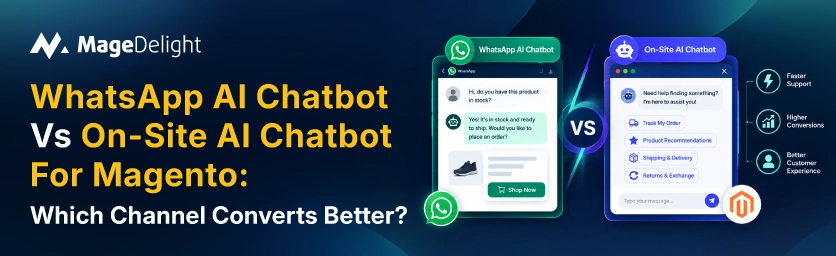
WhatsApp messages get read within three minutes 90 percent of the time. Email, on the other hand, has an open rate between 15 and 25 percent. That single difference is why WhatsApp chatbots have gone from being an afterthought to a sales channel for online stores. It doesn't mean WhatsApp is always better than an on-site chatbot for a Magento store. The two channels handle issues, reach customers at different times, and are measured in ways that make a simple comparison confusing if you aren't careful about what you are actually tracking.
This breakdown explains what the 2026 data shows about each channel, where the comparison goes wrong, and how to actually tell which one is bringing in sales on your Magento store instead of just guessing based on numbers that don't mean much.
Why This Comparison Is Trickier Than It Looks
The mistake people make is comparing a chatbot's conversion rate with a human agent's on its own. They might say, "The bot converts at 4 percent. The human at 6 percent. The human is better." That framing misses the actual business question. The correct comparison is unit cost per sale, and a bot running 24/7 at near-zero marginal cost per conversation wins by an order of magnitude in any store with reasonable volume, even at a lower raw conversion rate. The same trap applies to channel comparisons: WhatsApp's 90-plus percent read rate looks like an obvious win until you account for the fact that a shopper already on your site, actively evaluating a product, is a fundamentally different intent signal than someone reading a broadcast message.
What On-Site Chatbots Actually Deliver
Ecommerce chatbots have a 12.3 percent conversion rate for shoppers who actually use them. For visitors who don't even interact with the chat widget, the rate is 3.1 percent. That difference is the reason on-site chat matters. It's not that everyone converts better. It's that the people who ask a question are already closer to buying. Answering their question helps them move from hesitation to checkout. Also, AI chatbots have been shown to boost site conversions by 20 to 35 percent when set up right with quick responses and proactive messages. One study found a 23 percent increase in conversions from adding an AI chatbot to a website.
The idea is simple: a shopper in the middle of checkout with a question. About size, compatibility, or shipping. Is just one doubt away from leaving. On-site chat solves that problem without asking the person to leave the page, open another app, or wait for an email.
What WhatsApp Chatbots Actually Deliver
WhatsApp's benefit isn't about how many people convert. It's about how many people see the message. With over 3 billion users and a read rate above 90 percent in minutes, it's the channel for urgent messages that customers might miss otherwise. These include flash sale alerts, items coming back in stock, and reminders for abandoned carts. The best brands in 2026 have used WhatsApp not for support but as a full conversation-based shopping flow. A customer can ask about size, get a suggestion, and complete a purchase all in the conversation without leaving the app.
The problem is tracking where the sale actually came from. Meta adds an identifier, called ctwa_clid, when someone clicks on a WhatsApp ad. Capturing that and linking it to the chat conversation and the final sale through the Conversions API closes the tracking loop. When done right, this tracking has been reported to cut the cost per acquisition by 60 to 90 percent, not because the sales changed. Because they were finally connected to the right channel instead of showing up as unattributed traffic.
Side-by-Side Comparison
|
|
On-Site AI Chatbot |
WhatsApp AI Chatbot |
|
Message/open rate |
Depends on visit; no "open rate" concept |
90%+ read within 3 minutes |
|
Reach model |
Only shoppers currently on your site |
Reaches shoppers wherever they already are, 3B+ MAU |
|
Best use case |
In-session product Q&A, spec questions |
Cart recovery, back-in-stock, time-sensitive offers |
|
Attribution difficulty |
Lower; session tied to on-site analytics natively |
Higher; requires click ID capture and event mapping |
|
Typical engaged conversion |
12.3% for engaged users vs. 3.1% passive (site avg) |
Conversational commerce; varies by flow design |
|
Cost structure |
Usually flat platform fee or per-resolution |
Often per-conversation via WhatsApp Business API |
The Real Answer: Different Jobs, Not a Single Winner
Confusing an FAQ chatbot with a genuine ecommerce sales chatbot is one of the most common missteps in this space, and it applies equally to channel choice. On-site chat is naturally suited to in-session product questions, since the shopper is already there, already looking at the specific product, and the bot has full context of what page they're on.WhatsApp is great for bringing people back. A customer who left without buying an item that's back in stock or a flash sale they need to know about is better reached via WhatsApp than through an email they might not see for days.
• Use on-site chat to fix problems that happen then: questions about size, product details, or shipping time. These are the things that make a customer leave the cart.
• Use WhatsApp for messages that need to be seen, recovering abandoned carts, letting people know when an item is back in stock, and promoting flash sales. The high read rate makes it better than email or on-site messages.
• Track cart recovery rate and how happy customers are after buying. These are the important numbers for both channels. Other numbers, like how many messages are sent or how fast they are answered, are just basic checks, not real business signs.
• Don't use both channels without a way to track what's happening. If you don't have a way to see which channel led to a sale, you can't tell if it came from a question asked on-site, a message on WhatsApp, or just a random visit that happened to turn into a sale.
Solving the Attribution Problem on Magento
The hardest part of this comparison in practice isn't choosing a channel. It's proving which one actually helped a sale happen when both are in use. A customer might get a WhatsApp message about an item being back in stock, click through, look around for a bit, ask a sizing question on the on-site chat, and then buy an hour later. Without tracking that journey using UTM links and the right identifiers, the sale looks like regular traffic in your reports. Neither channel gets the credit it deserves.
MageDelight's Campaign Performance Tracker extension addresses exactly this gap for Magento stores, automating performance tracking from order sources through to completed sales, and letting you track multiple campaigns, WhatsApp broadcasts, on-site chat prompts, or both, simultaneously with exportable reports on conversion rates and revenue by source. Rather than guessing which channel deserves credit, you can see the actual attribution path from the UTM-tagged entry point to the order.
Measure the Full Path, Not Just the Channel
Neither WhatsApp nor on-site chat is always better for a Magento store. Most of the brands that are doing well in 2026 use both. They assign each to the task it does best. The bigger risk isn't choosing the channel. It's using. Without a way to see which one or which mix actually helped with a sale. Get that tracking in place before you spend more on either channel.
If your store is running chatbot campaigns across multiple channels without a clear view of which one converts, MageDelight's Campaign Performance Tracker is built to close exactly that visibility gap on Magento.
Frequently Asked Questions
Should a Magento store run both WhatsApp and on-site chatbots?
In some cases, yes. The two channels work for parts of the customer journey. On-site chat solves problems that happen while the customer is still on the site. WhatsApp brings people back after they have already left. Running both without a way to track which one actually helped is tricky. You might not know if the sale came from a question answered on-site, a message on WhatsApp, or just a random visit.
Is WhatsApp's 90% read rate the same as a 90% conversion rate?
No. That number is about how quickly messages are opened, not how many people end up buying. Read rate shows how many people see the message. Conversion rate shows how many people actually buy. These are two things and should be tracked separately.
Why does attribution matter more for WhatsApp than for on-site chat?
On-site chat happens during a session that your analytics tool already follows. So linking a chat to a sale is easier. WhatsApp chats often start from an ad or message outside your website. Without tracking the identifier and reporting the sale back to the ad platform, the sale might look like just direct traffic instead of being linked to the right channel.
Which channel is cheaper to run at scale?
It depends on the pricing model. How much traffic you get. On-site chatbots usually have a fee or a cost per interaction. That stays the same when traffic goes up. WhatsApp chatbots often charge per conversation through the WhatsApp Business API. That cost can go up during peak times. So it's important to look at both options based on your expected peak traffic, not average traffic.
