


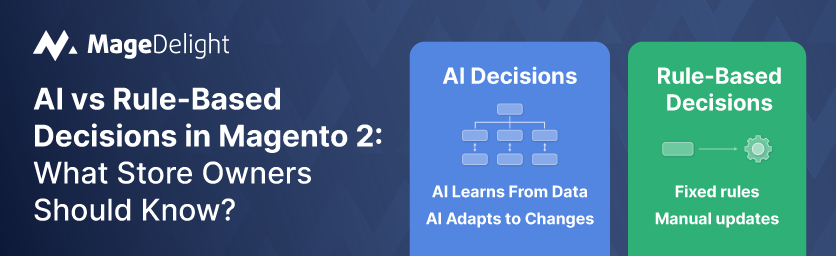
eCommerce has always had a discovery problem. A shopper visits an online Magento store, looks through a few pages, finds nothing that seems relevant, and leaves. No issues, no mistakes, just silent indifference. And indifference does not show up in error logs.
IRP Commerce data put the average eCommerce conversion rate as 1.65%, meaning roughly 98 out of every 100 visitors leave without making a purchase. Stores have been treating this as a traffic problem for years, pouring budget into acquisition while the merchandising layer underneath stays unchanged.
The merchandising layer is where the actual problem lives. Specifically, the gap between what rule-based systems can deliver and what shoppers actually need to convert. This blog examines that gap through the lens of revenue and conversion, where rule-based logic in Magento holds up, where it breaks down, and what AI-driven Magento personalization changes about the commercial outcome.
How Rule-Based Merchandising Works in a Magento Store?
Magento gives store teams a robust set of rule-based tools out of the box. Catalog price rules, cart price rules, manually assigned related products, and upsell configurations all operate on conditions set by the store team at a point in time. A developer configures the conditions, assigns the outputs, and the store runs itself in a clean, predictable manner.
For certain decisions, this model works exactly as intended. Pairing a camera with a memory card is always a relevant recommendation. A cart discount above a fixed threshold reliably increases order size for price-sensitive shoppers. Tax rules, regional pricing floors, and inventory visibility constraints must behave exactly as configured, regardless of who is shopping, and rule-based logic handles these without ambiguity.
The limitations become visible as the catalog grows and the customer base diversifies.
Consider a store running 400 SKUs across five categories. The merchandising team writes rules for correlated products at the category level, assigns manual upsells for the top 30 bestsellers, and sets a homepage block to display trending items. For a new visitor, the experience will feel curated. Whereas, for a returning customer who has already purchased from three of those categories and owns two of the trending items, every recommendation on that page is already irrelevant before the session even begins.
Rules apply uniformly because they have no memory and no session awareness. As catalog size increases, the interdependencies between rules multiply faster than the rules themselves. Seasonal shifts require manual updates across multiple rule sets. New product introductions require deliberate inclusion. The store team ends up managing logic rather than strategy, and the catalog still shows the same recommendations to everyone. The AI vs rule-based Magento debate starts here, at exactly the point where uniform logic stops serving a diverse customer base.
What Magento Personalization with AI Actually Changes?
A rule-based system applies predefined conditions. AI personalization in Magento reads behavioral signals in real time and makes decisions based on what those signals indicate about the current shopper's intent. Browsing patterns, purchase history, wishlist activity, and session context. The AI engine continuously processes these and surfaces products specific to that visitor, at that moment, without a merchandiser having to anticipate every possible scenario.
The practical difference is straightforward. Rule-based merchandising is driven by what the store team believes customers will want. AI-driven Magento personalization is based on what each customer's behavior reveals they want. For a store with thousands of SKUs and a diverse customer base, this has a direct and measurable impact on revenue. This is exactly where AI vs rule-based Magento decisions shift from architectural to commercial.
What the Data Says?
Barilliance analyzed data from 300+ ecommerce stores and found that visitors engaging with product recommendations converted at 4.5x the rate of non-engaged visitors. Recommendations made up to 31% of revenue in high-performing stores, averaging 12%. Sessions with at least one recommendation interaction showed an AOV increase of 369% compared to sessions with none.
McKinsey's study shows that personalization most often drives 10 -15% revenue lift (with company-specific lift spanning 5-25%, driven by sector and ability to execute. Netflix's own product leadership paper documents that over 75% of content watched comes from recommendations rather than active search, saving the company an estimated $1 billion annually through reduced churn.
Both cases show that personalized recommendations accumulate over time. The more behavioral data the system processes, the higher its prediction accuracy becomes, and the more revenue is directed toward personalized sessions.
Where Rule-Based and AI-Driven Logic Should Work Together
Replacing rule-based logic entirely is not the right approach. When evaluating AI vs rule-based Magento merchandising, the more effective architecture uses both in distinct roles:
- Rule-based logic handles operational constraints: price floors, stock visibility rules, tax configurations, and promotional guardrails. These run as the foundation and should not be overridden by any model.
- Magento personalization AI operates within those boundaries, dynamically determining what gets surfaced to which customer based on live behavioral signals.
- The compounding benefit comes from neither layer working in isolation. The rule governs what can be shown. The AI optimizes what should be shown to each specific visitor.
Stores that treat this as an either-or decision tend to end up with one of two outcomes. They either over-engineer manual rules to compensate for the absence of personalization or deploy AI without the operational guardrails. The revenue opportunity sits squarely in the middle.
Bringing AI-Driven Personalization Into Magento
For mid-market Magento operators, the practical barrier to AI-driven Magento personalization has historically been integration complexity and cost. Enterprise personalization tools require data science resources and budgets that most store teams do not have.
MageDelight's AI Product Recommendations for Magento 2 is built specifically to close that gap. The extension uses AI embedding techniques to analyze product names, SKUs, meta tags, attributes, and descriptions, then combines this with live behavioral data to generate recommendations specific to each visitor in real time.
Read more: Top AI Extensions for Magento 2 to Grow Sales & Personalization
Four recommendation surfaces come out of the box:
Here are the 4 recommendation surfaces come out of the box.
Browsing Patterns
The engine tracks pages visited, dwell time, scroll depth, and filters applied within the session, updating the recommendation block as the session evolves to reflect current intent.
Past Purchases
Order history informs brand affinity, size preferences, replenishment cycles, and complementary product logic. Products the customer already owns are suppressed automatically.
Wishlist Activity
Wishlisted items signal strong purchase intent. The engine prioritizes restocks, surfaces near-identical alternatives when items go out of stock, and recommends accessories relevant to saved items.
Unified Recommendations Feed
All behavioral signals combine into a single ranked feed scoring products by purchase likelihood, with diversity rules preventing repetition across the block.
Every recommendation surface is configurable from the Magento backend. Display position, titles, product count, and accuracy thresholds are all admin-controlled. Debug mode exposes match percentages, making the engine's reasoning visible and auditable rather than opaque. The extension is compatible with Magento Open Source, Adobe Commerce, and Adobe Commerce Cloud across all 2.4. x versions, with Hyva theme support included.
Read more: AI-Powered Commerce for Magento 2: A Merchant’s Guide
Conclusion
Every Magento store runs on decisions. Which products get shown, to whom, and when — those decisions either move a shopper toward checkout or past it. Rule-based logic makes those decisions consistently. AI-driven personalization makes them correct.
The difference between the two is not a technical debate. It shows up in the revenue report at the end of every quarter, broken down by sessions that converted and those that didn't. A store that serves the same recommendations to every visitor is not leaving money on the table by accident. It is doing so by design.
The data from Barilliance, McKinsey, and Netflix all point to the same verdict. Stores pulling disproportionate revenue from personalized sessions are not doing anything exotic. They are simply making better decisions with the traffic they already have.
That is the only question worth asking about your current merchandising setup.
