


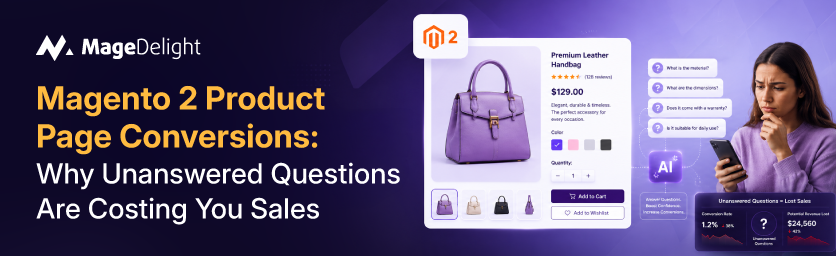
Fifty-five percent of US online adults abandon a purchase when they can't find a quick answer to their question. That stat comes directly from Forrester's Consumer Technographics survey, not a CRO blog or a recycled stat roundup. Run the math on your own traffic: if 10,000 shoppers visit your product pages in a month, around 5,500 leave empty-handed before your checkout even comes into the picture.
The reason isn't your price. It isn't a bad product. It's a question that went unanswered.
The data from 2024 makes it worse. Syndigo's State of Product Content report, released in June 2024 from a global consumer survey, found that 83% of shoppers would leave a site that lacked comprehensive product content, and 73% said they'd think less of a brand over incomplete or inaccurate product information: up 11 points from the year before. Salsify's 2024 Consumer Research, which surveyed 2,700 shoppers across the US and UK, found 42% abandon carts specifically because product titles or descriptions are incomplete or poorly written.
That's a revenue problem with a content quality cause. And there's now a faster fix than rewriting every product description by hand.
This guide walks through what types of questions kill conversions on Magento 2 product pages, why the default platform setup creates the gap, and how MageDelight's AI Product Q&A Chatbot closes it automatically, by pulling answers directly from your existing product data.
The Hidden Revenue Leak: What Unanswered Questions Actually Cost
Most Magento merchants doing CRO work focus on checkout: shorter forms, one-page checkout, faster load times. Those are real wins. But they address friction that only appears after a shopper has already decided to buy.
The purchase decision happens on the product detail page. Win or lose there.
The Abandonment Chain Starts Before Checkout
Nielsen Norman Group's ecommerce product page research covers more than 20 years of usability studies across 350+ websites. Their conclusion is blunt: according to their published findings, "Many sites offered insufficient product information, which left users with unanswered questions and not enough information to make purchase decisions." Shoppers aren't bouncing because the product is wrong for them. They're bouncing because they can't confirm it's right.
The damage runs past the lost sale. Syndigo's 2024 data show that 35% of shoppers who completed a purchase returned the item because it didn't match the product content they reviewed beforehand. Salsify's 2025 Consumer Research pushed that to 71% of shoppers reporting returns tied to incorrect product content, according to Cahoot's analysis of the data. NRF puts the overall online return rate at 16.9% of annual sales. A meaningful chunk of that traces back to content rather than logistics.
The Q&A Conversion Signal Most Stores Miss
PowerReviews tracked purchase behavior across thousands of product pages and published the results in their UGC Conversion Impact Analysis. When shoppers interacted with Q&A content on a product page, conversions increased by 194.2% compared to visitors who didn't interact with it. Even with Q&A present but no interaction, conversion still lifted by 51.2%. Q&A outperformed ratings, reviews, and user imagery as the highest-impact form of user-generated content on purchase decisions.
A separate PowerReviews consumer survey of 7,528 US shoppers, published in August 2021, found 1 in 4 shoppers (26%) grow suspicious of product or brand quality when a product page has no Q&A at all. Among Gen Z, that rises to 33% saying they're less likely to buy without one. These aren't soft preferences. They're silent purchase blockers in your bounce data.
Why Magento 2's Default Product Page Falls Short?
Magento 2's out-of-the-box product detail page does the basics: product name, images, short description, long description, attributes, and Add to Cart. For a catalog of commodity products where shoppers already know what they want, that works well. Anything that requires actual purchase consideration creates friction at exactly the wrong moment.
No Way for Shoppers to Get Instant Answers
The native Magento 2 PDP has no mechanism for shoppers to ask a question and get an immediate answer. When a customer submits a support ticket asking whether a product works with a specific voltage, that exchange disappears from the product page. The next shopper with the exact same question hits the same wall. In a physical store, they'd ask someone on the floor. On your product page, they get silence, and then they leave.
Descriptions Are Often the Wrong Format
Magento 2 gives merchants two text areas per product: a short description above the fold, and a full description in a tab below. In practice, most stores copy the manufacturer's spec sheet, write one generic paragraph that addresses neither dimensions nor use case, or leave one field empty. Nielsen Norman Group's product description guidelines are direct on what happens: "A user cannot decide if the product meets their requirements and so abandons the purchase." Static text fields can't anticipate every question a specific shopper will have. That's not a copywriting failure. It's a format limitation.
Attributes Give Data, Not Answers
Magento 2 has a capable attribute system, but raw attributes without context create confusion rather than confidence. "Material: 304 Stainless Steel" tells a procurement manager exactly what they need. It tells a home cook nothing. Neither version answers the real follow-up: "What does that mean for how I'd actually use this?" Attributes are structured data. Answering that question requires a more conversational approach.
The Five Questions That Decide Whether a Shopper Buys
Based on Baymard Institute's product page usability research and NNGroup's findings across 350+ sites, five categories of questions account for most PDP-stage abandonment. A product page that handles all five conversions. One that leaves any of them open has a leak.
1. Fit and Compatibility
"Will this work with what I already have?" Decisive in electronics, hardware, appliances, and B2B. A shopper buying a Magento-compatible integration, a replacement part, or industrial equipment needs compatibility confirmed before anything else. If the product page doesn't address it, they either contact support (friction), search elsewhere (lost sale), or buy the wrong thing (return).
2. Sizing, Dimensions, and Specifications
"Will this physically fit?" For apparel, furniture, equipment, and packaging, dimensions are the deciding factor. "One size fits most" is not a specification. Salsify's 2024 Consumer Research identified dimension and sizing gaps as among the most common content failures behind the 45% return rate attributed to incorrect product details.
3. Materials, Quality, and Durability
"Is this built to last?" Shoppers at higher price points want to know what the product is made of and what that implies about longevity. "High-Quality Metal Construction" is a claim with nothing behind it. PowerReviews' data shows shoppers go directly to Q&A to get real answers, including from previous customers, when the description doesn't deliver them.
4. Use-Case Confirmation
"Is this the right product for my specific situation?" A shopper looking for a Magento 2 product questions extension isn't asking what the module does in the abstract. They're asking whether it will solve their specific problem. A description that explains features without addressing specific use cases leaves that question open. Open questions become exits.
5. Post-Purchase Confidence
"What happens if this doesn't work out?" Return policy, warranty visibility, and customer support clarity are the last blockers before a purchase is committed. Baymard Institute's research consistently identifies trust and uncertainty as significant contributors to abandonment. A product page that answers these questions directly converts better than one that hides the information in a footer link.
The Faster Fix: MageDelight AI Product Q&A Chatbot
Rewriting product descriptions is the right long-term move, but it's slow and never complete. Shoppers will always have questions that no static description can anticipate. MageDelight's AI Product Q&A Chatbot for Magento 2 handles that gap in real time, by reading your existing product content and answering shopper questions instantly, without a support agent, without a ticket, and without the shopper leaving the page.
The core mechanic is important to understand: the AI doesn't pull answers from a generic knowledge base. It extracts them directly from your product data, descriptions, attributes, specifications, and any content already on the page. That means the answers are accurate to your specific products, not generic ecommerce responses.
What Does it Do on the Product Page?
When a shopper lands on a product page and has a question, they type it into the chatbot interface. The AI reads the product content and returns a direct, contextual answer for that specific product in seconds. A shopper asking "Is this compatible with a 240V power supply?" on an electronics page gets a specific answer pulled from the product specs, not a "please contact support" redirect.
This handles all five question categories without requiring any additional content work. Fit and compatibility, dimensions, materials, use cases, return policy: if the information exists somewhere in your product content, the AI surfaces it on demand.
Key Features
Here are the key features of MageDelight's AI Product Q&A Chatbot for Magento 2.
- AI reads and interprets your existing product data: descriptions, attributes, specs
- Instant answers on the product page, no page navigation required
- Handles natural language questions, not just keyword matching
- Works across configurable, bundled, and simple product types
- No human moderation required for answers pulled from product content
- Reduces support ticket volume by resolving questions at the product page stage
- Priced at $79, with free professional installation included
For stores with complex catalogs, products with many variants, or B2B buyers who need technical confirmation before purchasing, this extension directly addresses the 55% abandonment rate that static descriptions can't fully solve. The MageDelight AI Product Q&A Chatbot is available for $79 and can be recovered in a fraction of a percentage point of conversion improvement at any meaningful traffic volume.
AI Q&A vs. Other Approaches: What Actually Answers Shoppers Instantly?
There are several ways to address unanswered product questions. Here's how they compare on the dimensions that matter most for a Magento 2 store.
|
Approach |
Instant Answers |
AI-Powered |
Self-Updating |
Requires Admin |
Pricing |
|
MageDelight AI Q&A Chatbot |
Yes |
Yes |
Yes (from product data) |
No |
$79 |
|
Static FAQ Extension |
No |
No |
Manual only |
Yes |
$149+ |
|
Live Chat (human) |
No |
No |
N/A |
Yes (staff) |
Ongoing cost |
|
Product Description only |
No |
No |
Manual only |
Yes |
Dev time |
|
Support Email/Ticket |
No |
No |
N/A |
Yes (staff) |
Ongoing cost |
The key difference between an AI chatbot and a static FAQ extension is that it doesn't require someone to anticipate and pre-write every question. If a shopper asks something new, the AI tries to answer from existing product data rather than returning a dead end. Static FAQ sections only answer questions someone thought to add. AI Q&A answers questions shoppers actually have.
For Stores That Want Moderated Community Q&A: The Static Option
If your store's needs include a curated, community-driven Q&A section where previous customers can answer questions alongside your team, MageDelight's FAQ and Product Questions extension handles that use case well. It adds a structured Q&A tab to the product page, generates FAQPage JSON-LD schema markup for SERP rich results, and includes a full moderation workflow.
The trade-off is clear: it requires manual question seeding and admin attention to stay current. Shoppers get answers to the questions you've already anticipated. They don't get instant answers to new questions. For stores where community trust signals and user-generated Q&A content are priorities, it complements the AI chatbot well. For stores that want the unanswered-question problem solved without ongoing content work, the AI chatbot is the right starting point.
The static FAQ extension starts at $149/year. A comparison of both options is available on MageDelight's Magento 2 extensions page.
Implementation Checklist: Closing the Information Gap on Your Magento 2 Store
Work through this in traffic-priority order, starting with the product pages that get the most visits and have the lowest add-to-cart rates.
- Install the AI Q&A Chatbot. Get it live on your highest-traffic product pages first. The extension reads your existing product data, so there's no content work required to get started.
- Run a description audit. Pull your top 50 product pages by traffic. For each one, check whether the content covers fit, dimensions, materials, use case, and post-purchase policy. The AI can answer questions from sparse content, but richer content produces better answers.
- Check your attribute data. The chatbot pulls from product attributes and descriptions. Incomplete or missing attributes reduce the quality of AI answers. Review attributes for completeness on your key products.
- Monitor chatbot interactions. Review the questions shoppers are asking. Any question the AI struggles to answer from your product content is a signal that the content needs improving in that area.
- Add FAQ schema for SEO. If you also install the static FAQ extension, ensure it generates FAQPage JSON-LD and validate it with Google's Rich Results Test. This earns collapsible FAQ snippets in the SERP, which increase click-through for informational queries.
- Measure. Track product page conversion rate, add-to-cart rate, and return rate for the pages you update. The direction the data moves will be consistent with what Forrester, PowerReviews, Syndigo, and Salsify all document. The magnitude depends on your specific catalog and traffic.
Frequently Asked Questions
Here are the common questions store owners ask before getting started.
1. What Does the Magedelight AI Product Q&A Chatbot Actually Do?
It adds a conversational chatbot to your Magento 2 product pages that reads your existing product data and answers shopper questions in real time. A shopper types a natural-language question and receives a specific answer from your product descriptions, attributes, and specifications. No human agent is required. It's available from MageDelight at $79 with free professional installation.
2. How is This Different From a Regular FAQ Extension?
A static FAQ extension (like MageDelight's FAQ and Product Questions module) requires you to pre-write and moderate every question and answer. It only answers questions you've anticipated. The AI chatbot answers questions that shoppers actually ask, in real time, using your existing product content. It handles questions no one thought to pre-write, which is where most abandonment happens.
3. Does Magento 2 Have Built-in Q&A for Product Pages?
No. Magento 2's native product detail page has no mechanism for shoppers to ask questions and see answers. The platform provides description fields and product attributes, but nothing conversational. Both the AI chatbot and the static FAQ extension are third-party modules.
4. What is the Most Common Reason Shoppers Abandon Magento 2 Product Pages?
According to Forrester's Consumer Technographics research, 55% of US online adults are likely to abandon a purchase when they can't find a quick answer to their question. Incomplete descriptions, missing specs, and the lack of a way to ask a question are the primary content-level causes. Checkout friction adds to abandonment, too, but that happens later in the funnel.
5. How Do I Identify Which Product Pages Have the Worst Information Gaps?
Three data sources already in your stack. Product pages with high traffic but low add-to-cart rates signal information friction. Your support inbox: every product-specific question in there is a description gap. Return reasons in your OMS: returns tagged "product not as described" or "wrong size/fit" tell you exactly which pages need work first.
6. Will Adding Q&A to Product Pages Help With SEO?
Yes, two ways. The AI chatbot interaction itself doesn't generate indexable content, but the questions and answers from a static FAQ extension do: unique, keyword-rich text that search engines index. Second, FAQ extensions that generate FAQPage JSON-LD schema qualify product pages for rich results in Google, displaying collapsible Q&A directly in the SERP. That increases click-through rate and pre-qualifies shoppers before they land.
Silence is Expensive
Most product page abandonment from information gaps doesn't show up as a clear line item anywhere. It shows up as a bounce, a missing conversion, a return with no obvious cause. 5,500 people are leaving per 10,000 product page visits, none of them with a reason attached.
The straightforward fix used to mean rewriting descriptions, then hiring someone to monitor a Q&A inbox, then manually adding FAQ schema. MageDelight's AI Product Q&A Chatbot compresses that into a single $79 extension: it reads your product data, answers shoppers in real time, and reduces the support burden without additional content work.
Start with your highest-traffic, lowest-converting product pages. Install the chatbot, watch what shoppers ask, and use that to improve descriptions where answers are thin. The PowerReviews, Forrester, Syndigo, and Salsify data all point in the same direction. Shoppers who get their questions answered buy. The ones who don't find somewhere else that answers them.
