


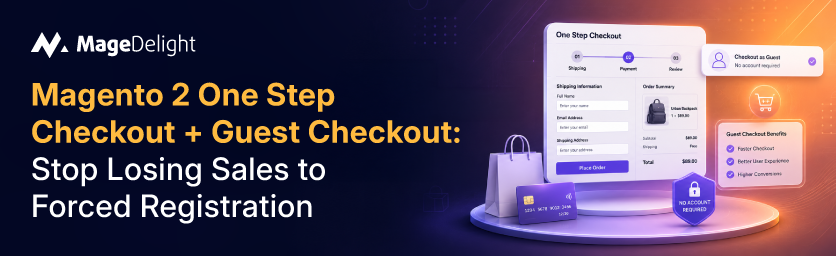
One in four shoppers who reach your Magento 2 checkout and abandon it do so for a single reason: you asked them to create an account. Not because of your price. Not because of shipping. Because of a registration form. That is the finding from the Baymard Institute's large-scale checkout usability research, and it is one of the most fixable conversion problems in ecommerce.
The 70.22% average cart abandonment rate (Baymard, meta-analysis of 50 studies) gets cited constantly. The 26% forced-registration slice of that number is cited far less often, which is strange because it is the most actionable piece of data in the whole report. You cannot fix browsing behavior. You can fix a configuration toggle.
This guide covers two things: how to enable guest checkout in Magento 2 through the admin panel (a five-minute task), and which one step checkout extension to use if you want to clear out the rest of the friction while you're at it.
Why Forcing Registration Is a Revenue Leak, Not a Data Strategy?
Merchants who disable guest checkout usually have a reasonable-sounding goal: build a registered customer base, track order history, and enable retargeting. The problem with that logic is its sequencing. You cannot collect data from a customer who has left.
The Baymard Institute's 2017 Checkout Optimization and Reducing Abandonments study, cited in Amazon Pay's own research summary, found three specific reasons shoppers refuse to create an account at checkout: they expect it to take longer, they already have too many ecommerce accounts, and they do not trust a new store with their personal data yet. That last one matters. The first purchase is when trust is lowest. It is exactly the wrong moment to ask for a long-term commitment.
The same research surfaced a detail most merchants overlook: 19% of returning customers with existing accounts still fail to complete checkout because they cannot remember their password. Account creation does not guarantee a smooth return experience. It just moves the friction point.
The actual fix is Delayed Account Creation.Magento 2 supports it natively. Let the customer buy. On the confirmation page, with their name, email, and address already in the system, offer account setup with a single field: set a password. Conversion rate on that post-purchase prompt is higher because you have already earned the sale.
How to Enable Guest Checkout in Magento 2?: Step-by-Step
Magento 2 ships with guest checkout on by default. It gets disabled in predictable ways: a developer turns it off during store setup, an extension overrides the setting, or it was toggled as part of a B2B or compliance configuration. Check it regardless of what you think the current state is.
Prerequisites
- Admin panel access with Store Configuration permissions
- Magento 2.4.x (any patch level, including current stable 2.4.8)
- Cache management access to flush after saving
Step 1: Go to Checkout Configuration
Log in to your Magento 2 admin panel. In the left sidebar: Stores, then Settings, then Configuration.
Step 2: Find Checkout Options
Expand the Sales section on the left menu, and click Checkout. The Checkout Options accordion appears at the top of the page.
Step 3: Set Allow Guest Checkout to Yes
Find the Allow Guest Checkout field. If the "Use system value" checkbox is ticked, uncheck it first to unlock the dropdown. Set it to Yes. That is the change.
Step 4: Save and Flush Cache
Click Save Config. Then go to System, select Cache Management, and click Flush Magento Cache. Checkout configuration is aggressively cached. Skipping the flush means the storefront will not pick up the change.
Step 5: Test in Incognito
Open an incognito window, add a product to the cart, and go to checkout. You should reach the address and payment fields without any registration prompt. If a prompt still appears, check whether a third-party extension has its own guest checkout setting overriding the core config.
The official Adobe Commerce documentation for this setting is on Experience League, including the SaaS-only guest order tracking option available in recent releases.
What One Step Checkout Actually Changes (Beyond Removing the Login Wall)?
Enabling guest checkout removes the registration barrier. It does not fix the form field problem.
The default Magento 2.4 checkout is a two-step layout: shipping address and method on step one, payment on step two. The customer cannot see both at once. Each step is a separate page state with its own load time and its own moment to reconsider.
Baymard's research puts the ideal checkout at 12 to 14 form elements, with 7 to 8 actual input fields. The average US ecommerce checkout has 23.48 form elements. That is nearly double the optimal number. Every extra field is a small friction tax. Stack enough of them, and the tax becomes a dealbreaker.
A one step checkout extension puts everything on a single screen: shipping address, delivery method, payment details, and order summary together. The customer can see the full picture before committing. They can edit quantities without going back a page. Baymard's usability data is direct: better checkout design delivers a 35.26% improvement in conversion rate for large ecommerce sites.
A note on terminology: "one step" and "one page" checkout are used interchangeably across the extension market. What matters more than the label is the layout. Fully expanded (all fields visible at once) consistently outperforms accordion-style (sections collapse as they complete) for new customers who want to preview the full process before entering their card number.
Top Magento 2 One Step Checkout Extensions: 2026 Comparison
The table below compares the five most widely deployed one step checkout extensions for Magento 2. Pricing reflects publicly listed rates at the time of writing; verify current pricing on each vendor's site before purchasing.
|
Extension |
Price |
Hyvä Ready |
Guest Checkout |
Best For |
|
Starting from $179 |
Yes (free) |
Built-in |
Stores on Hyvä or migrating to it; clean single-page UX, Delayed Account Creation built in, zero extra compatibility cost |
|
|
Starting from $289 |
Yes |
Built-in |
Stores running active checkout optimization that need per-field abandonment data and A/B testing |
|
|
Starting from $259 |
Yes |
Built-in |
Stores want abandoned cart recovery emails and trust badges bundled with checkout in one purchase |
|
|
Starting from $349 |
Partial |
Built-in |
Complex shipping workflows: in-store pickup, delivery date selection alongside the one-page layout |
|
|
Starting from $149 |
Yes |
Built-in |
Small-to-medium stores on a tight budget; clean 3-column layout, one year of updates and support included |
MageDelight One Step Checkout: A Closer Look
The MageDelight One Step Checkout starts at $179 for the first year, with annual renewals at $119. The pricing is straightforward because the Hyvä compatibility is included at no extra cost. That last part matters more than it sounds.
Hyvä is the performance-first Magento 2 frontend replacing the legacy Luma theme across stores of every size. Many extensions charge an additional compatibility fee for Hyvä support, or ship a compatibility module that lags behind the core product. If you are on Hyvä or planning to get there, that gap poses a real integration risk at the exact layer of your stack that processes payments. MageDelight removes that variable.
The extension puts shipping, delivery, payment, and order summary on a single page. Cart quantity editing works inline. Coupon codes apply without a page reload. Google address autocomplete fills the shipping address based on a partial entry, reducing both checkout time and address-related delivery failures.
Guest checkout is on by default and prominently placed. The confirmation page supports the Delayed Account Creation flow: after the order completes, the customer sees a one-click account setup prompt requiring only a password, since everything else is already in the order record. This is the pattern Baymard Institute recommends for capturing registrations without blocking the sale.
If you want to extend the post-checkout experience further, MageDelight's catalog is built to work together: Mobile OTP Login for passwordless return authentication, Subscribe Now Pro for subscription products, and Advanced Promotions for cart-level discount rules. The compatibility is built in, which matters because checkout is where extension conflicts are most expensive.
Guest Checkout vs. Registered Checkout: What the Data Actually Supports
The worry about losing customer data by enabling guest checkout is real, but backward. The data you lose to a completed guest purchase is recoverable on the confirmation page. The data you lose to an abandoned registration-blocked checkout is gone.
A guest who completes a purchase and sees a clear, low-friction account-creation prompt on the confirmation page is in a better mental state to register than a first-time visitor who hits a wall before entering their card number. You have the sale. You have their trust. Creating an account is now a benefit to them (order tracking, faster next checkout), not a toll you are collecting.
There is also a middle path that most Magento 2 stores do not use: social login or magic-link authentication. One click through Google, or a passwordless link sent to the email the customer already entered, ties the purchase to an account without requiring a new password. It captures the data without the friction. Most one step checkout extensions support this via a separate authentication module.
The practical flow: enable guest checkout today, install a one-step checkout extension, configure the confirmation page to offer account creation, and track confirmation page registration rate separately from checkout conversion. That gives you visibility into the full funnel without artificially inflating either metric.
Configuration Mistakes That Reintroduce Friction After You Fix the Big Ones
Enabling guest checkout and a one step checkout extension handles the structural problems. These four configuration decisions quietly undo some of that progress.
Leaving the Coupon Code Field Visible and Open
A coupon code field sitting in plain view at checkout makes every customer without a code feel like they are paying too much. A meaningful share will pause checkout, open a new tab to search for a promo code, and not come back. Baymard recommends hiding this behind a toggle ("Have a promo code?"). It is a one-line configuration change in most one step checkout extensions.
Marking Phone Number as Required
Phone number is almost never needed to fulfill a digital order. It raises privacy concerns and adds a field that helps no one complete the purchase. Make it optional, or remove it from the form entirely.
Keeping First and Last Name as Separate Fields
The default Magento 2 checkout splits the name fields. Combining them into a single Full Name field removes one form element and speeds up mobile entry. Available as a configuration option in most one step checkout extensions.
Running Address Validation on Keystroke Instead of On Blur
Google address autocomplete is valuable. Address validation that fires while the customer is still typing is not. It creates error states mid-entry, which looks like something went wrong when the customer is just mid-word. Set validation to trigger on blur (when the field loses focus), not on keystroke. This is a configuration setting, not a code change.
Which Setup Fits Your Store?
Here are some tips to help you decide which setup fits your store.
- Guest checkout only, no other changes: Stores > Configuration > Sales > Checkout, set Allow Guest Checkout to Yes. Five minutes. No cost.
- Guest checkout plus a one-page flow on Hyvä: MageDelight One Step Checkout. Hyvä compatible at no extra cost, Delayed Account Creation built in.
- Guest checkout plus per-field abandonment analytics: Amasty One Step Checkout. The most granular checkout behavior reporting in the Magento extension market. Higher price point ($279 + $13.99/mo) but the data justifies it for stores running active optimization.
- Guest checkout plus bundled cart recovery emails: Mageplaza One Step Checkout ($299 one-time). Abandoned cart recovery is built in, no separate module needed.
- Complex shipping with pickup and delivery date selection: MageWorx One Page Checkout Suite. Handles in-store pickup and delivery scheduling inside the checkout flow.
- Tight budget, straightforward needs: BSS Commerce starts at $89, one year of updates and support included, clean 3-column layout.
Frequently Asked Questions
Here are the common questions and their answers you might have.
1. Does Magento 2 Have Guest Checkout Enabled by Default?
Yes. A fresh Magento 2 installation ships with Allow Guest Checkout set to Yes. It gets disabled during store configuration more often than most merchants realize. Check the setting directly at Stores > Configuration > Sales > Checkout instead of assuming it is on.
2. Will Enabling Guest Checkout Reduce My Registered Customer Count?
Not by as much as the fear suggests. The registration rate that matters is on the confirmation page, after the purchase. That conversion is higher than pre-purchase forced registration because the customer has already completed the sale and trusts you with their data. Track both rates separately.
3. Is One Step Checkout the Same as One Page Checkout?
The terms mean the same thing in the Magento extension market. What differs between products is the layout: fully expanded (all sections visible at once) versus accordion-style (sections collapse as you complete them). Both improve on the default two-step flow. Fully expanded tends to perform better for new customers.
4. How Much Conversion Rate Improvement Can I Actually Expect?
Baymard attributes 26% of all checkout abandonment to forced account creation. What that translates to for your specific store depends on what percentage of your abandonment comes from that trigger. If you currently require registration, the benefit of removing it is immediate and clear. If guest checkout is already on, but your flow is still multi-step and heavy on fields, the one-step checkout extension is where the next improvement comes from.
5. What is Delayed Account Creation in Magento 2?
It is the practice of letting a customer complete checkout as a guest, then offering account setup on the confirmation page. Magento 2 already has the name, email, and address from the order. Creating an account requires one additional field: a password. Magento 2 supports this natively. Most one step checkout extensions make the confirmation page prompt more prominent and easier to act on.
The Bottom Line
Forced registration is not a customer acquisition strategy. It is a friction tax that costs you a percentage of every campaign you run. The Baymard Institute has quantified it at 26% of checkout abandonments. That is not a rounding error.
The fix takes five minutes if guest checkout is the only problem. It takes a $179 extension to clear out the rest of the friction in the same pass. Either way, the cost is low. If your store does any meaningful volume, the lost revenue from abandoned registrations dwarfs the cost of fixing it.
Start with the admin panel. If you are on Hyvä or plan to move there, MageDelight's One Step Checkout removes the compatibility uncertainty at checkout. If you want data to optimize further, Amasty provides field-level reporting so you know exactly where customers are dropping off.
One change. Real money back.
