


According to Forrester, 55% of US online adults will abandon an online purchase if they cannot find a quick answer to their question. That is not a customer experience problem. It is a revenue problem, and it shows up on every product page that does not give shoppers a way to ask and get answered in the moment.
The data gets sharper when you look at what happens when Q&A is present. A PowerReviews study of 7,528 shoppers found a 157.1% lift in conversion for visitors who interact with Q&A on a product page. Not a 15% lift. Not 50%. More than double. The same research found that 68% of shoppers have left a question on a product page Q&A section at least once. The demand is real; most stores just aren't meeting it.
This guide explains exactly how the MageDelight AI Product Q&A Chatbot works under the hood: the architecture behind its zero-training approach, what categories of questions it handles well, what it intentionally declines to answer, and which store profiles see the biggest lift from deploying it.
Why Product Page Q&A Is a Conversion Problem Worth Solving?
Every product page has an information gap. No matter how thorough your descriptions are, shoppers arrive with questions your copywriter did not anticipate. Some want to know if a laptop bag fits a specific 16-inch model. Others need to know whether a supplement is safe to take alongside a medication. Others just want to confirm that a part fits their specific appliance model year. These are not questions that search engines answer well, nor are they questions that a static description handles reliably.
The traditional workaround has been a staff-moderated Q&A section: shoppers submit questions, a team member answers within 24 to 48 hours, and the exchange sits on the page for future visitors. That model works at low volume. It breaks when you are running thousands of SKUs, when your support team is time-constrained, or when a shopper needs an answer at 11 PM on a Sunday and your support inbox is closed.
The PowerReviews consumer research also found that 26% of shoppers become more suspicious of product quality when a product page has no Q&A section, and 33% of Gen Z shoppers say they are less likely to purchase without one. The absence of Q&A is not neutral. It signals something is missing, and shoppers notice.
AI changes this by removing the human bottleneck. Not by hallucinating answers from general internet knowledge, but by reading your actual product data and answering from that. That distinction matters more than almost any other design decision in this category.
What is the MageDelight AI Product Q&A Chatbot actually?
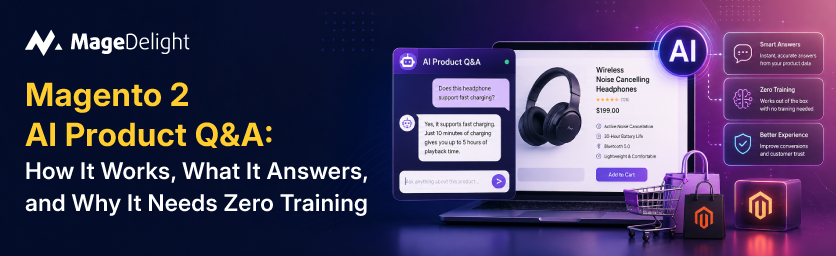
The MageDelight AI Product Q&A Chatbot is a Magento 2 extension priced at $79 that adds a conversational Q&A interface to your product detail pages. Shoppers type a question. The extension reads it, checks it against the relevant product's content, and returns an answer in seconds. No ticket is opened. No human is notified. No shopper waits until the next business day.
What separates this from a general-purpose shopping chatbot is scope. This is not a storefront-wide assistant that handles order tracking, refund requests, and shipping policy. It is specifically built for the product-page moment: the point where a shopper has found something they are interested in and has a question that is blocking the add-to-cart click. That narrower focus is intentional. A tool that does one thing well is more reliable than a tool that attempts everything.
The extension is part of MageDelight's growing AI-powered extension suite, which also includes tools for AI content generation, multilingual translation, product recommendations, and review summarization. But the Q&A Chatbot stands alone as a focused conversion tool for product discovery and pre-purchase confidence.
How It Works: The Architecture Behind Zero-Training AI
The phrase 'zero training' tends to raise eyebrows. AI tools are supposed to require setup, fine-tuning, custom datasets, and model evaluation loops. So what exactly is happening when no training is required? The answer is retrieval-augmented generation, commonly called RAG, applied specifically to your product catalog data.
Step 1: Content Ingestion from Product Data
When the extension is installed and configured, it reads from your Magento product catalog: descriptions, specifications, attributes, custom options, and any structured data already associated with the product. It does not pull from the open internet. It does not reference other stores. The knowledge base it draws from is built entirely from what you have already entered into Magento for that product.
This means there is no separate data pipeline to build, no spreadsheet to upload, and no knowledge base to manually maintain. Your existing product content is the training data. If you update a product attribute in Magento, the Q&A Chatbot answers from the updated version automatically.
Step 2: Semantic Understanding of the Shopper's Question
When a shopper types a question, the extension does not search for keyword matches. It uses a language model to understand the semantic intent behind the question. 'Does this come in a larger size?' is asking about sizing availability. 'Can I use this outdoors?' is asking about weather resistance or material durability. The model maps the intent to the relevant piece of product data, even when the shopper's phrasing does not match the exact terminology in your product content.
This matters because shoppers do not write specification sheets. They write the way they speak. A shopper asking 'is this machine washable?' is not going to use the phrase 'care instruction: machine wash cold' from your attribute field. The AI bridges that language gap.
Step 3: Answer Retrieval and Response Generation
Once the relevant product content is identified, the language model generates a response grounded in that content. The answer reads naturally rather than returning a raw attribute value. Instead of outputting 'material: 100% cotton, machine wash cold', the response would be something like: 'Yes, this item is 100% cotton and can be machine washed on a cold setting.'
Critically, if the product content does not contain information relevant to the question, the extension says so. It does not fabricate an answer. It does not pull from general AI knowledge about similar products. It returns an honest 'I don't have that information' response, which is far better than a confident wrong answer. That honesty is not a limitation; it is a design constraint that makes the tool trustworthy.
Q&A Approaches Compared
|
Approach |
Setup Time |
Accuracy |
Maintenance |
|
AI Product Q&A Chatbot (MageDelight) |
Minutes |
Grounded in product content |
Zero: syncs automatically |
|
Traditional trained chatbot |
Weeks to months |
Depends on training quality |
Ongoing retraining needed |
|
Static FAQ section |
Hours |
Only pre-written questions |
Manual updates required |
|
Live chat / support ticket |
Immediate (no setup) |
High, but human-dependent |
Scales with headcount only |
What Questions It Can Answer (and What It Won't Try To)
Understanding the boundaries of the Q&A Chatbot is just as important as understanding its capabilities. This is not a limitation of the extension; it is a direct consequence of its architecture.
Questions it handles well:
- Specifications: dimensions, weight, materials, compatibility details
- Availability-adjacent questions: size ranges, color options, configuration variants
- Usage and care: washing instructions, temperature limits, installation requirements
- Comparison questions: if the product content describes what it does or does not include, the AI can answer comparative questions from that content
- Feature clarification: explaining what a product attribute means in plain language
Questions it will not attempt to answer:
- Real-time stock availability: the extension reads static product content, not live inventory levels
- Shipping timelines: delivery estimates are logistics data, not product content
- Order status: this is account and fulfillment data, outside the product page scope
- Price negotiations or discount queries: pricing policy is not product content
- Questions about other products not currently being viewed
Stores with thinner product descriptions will see thinner answers. The quality of the Q&A output is directly a function of the quality of the product content it reads. This creates a productive pressure: merchants who want a better Q&A experience are also building a better product catalog, which improves SEO, reduces returns, and builds shopper confidence. The extension rewards good merchandising.
If your product content is sparse, MageDelight's AI Content Generator extension can bulk-produce product descriptions from your attributes before you deploy Q&A, giving the chatbot a richer content base to draw from from day one.
Why "Zero Training" Is a Feature, Not a Gap?
Most enterprise AI tools for eCommerce require a data preparation phase. You build a knowledge base, label examples, fine-tune a model, evaluate it against test queries, and iterate. That process can take weeks. It requires technical resources that most merchant teams do not have in-house. And after all that, you still need to retrain whenever your product catalog changes significantly.
The zero-training approach inverts this. Because the extension grounds its answers in your existing product content rather than a trained model, there is nothing to set up before going live. Install, configure an API key, and enable it on your product pages. That is the full process. There is no labeled dataset to prepare, no model to evaluate, and no retraining cycle to manage.
The trade-off is scope. A trained model could theoretically answer questions about your return policy, your company history, and your support hours. This extension answers questions about the specific product on the page it is deployed on. For the conversion moment that matters: a shopper who is close to buying and has one blocking question, that narrow scope is exactly right.
There is also a data security dimension to this architecture. Because the extension reads from your Magento product data rather than ingesting conversations into an external training pipeline, customer interactions are not used to train a shared model. What shoppers ask on your store stays in your store's context. For merchants in regulated industries or with strict data governance requirements, this is a meaningful operational benefit.
Who Benefits Most from This Extension?
Not every Magento store has the same Q&A problem. The extension's value scales with a few specific store characteristics.
High-SKU stores with consistent product data structures
If you are running thousands of products and your team cannot realistically field per-product questions manually, the AI Q&A layer handles the volume without proportional headcount growth. Fashion retailers, electronics merchants, and industrial supply stores are natural fits.
Stores selling technical or configurable products
Products with multiple specifications: compatibility tables, size guides, configuration options, and material grades. These generate more pre-purchase questions than simple, self-evident products. The Q&A Chatbot thrives when there is real technical depth in the product content for it to draw from.
Stores with meaningful after-hours traffic
Support teams are not available at midnight. But shoppers often are. If your analytics show a significant portion of product page traffic arriving outside business hours, you have a gap that no amount of staffing can close cost-effectively. Automated Q&A fills that gap without premium support hours.
Stores on the Hyvä theme
MageDelight's entire extension ecosystem, including the AI Product Q&A Chatbot, is Hyvä-compatible at no extra cost. Merchants running Hyvä for its performance advantages do not need to trade off theme compatibility to deploy this feature.
Smaller stores with fewer than 50 products, very simple product types, or extensive existing human Q&A coverage may see less immediate impact. The ROI calculation is simpler for high-volume stores with a clear conversion drag from unanswered questions.
Merchants looking to extend further can pair the Q&A Chatbot with AI Review Summary to cover both the pre-purchase information gap and the social proof layer on the same product page. The combination addresses the two most common blockers before the add-to-cart click.
Frequently Asked Questions
Here are the common questions and their answers about Magento 2 AI Product Q&A.
1. Does the AI Product Q&A Chatbot Require an OpenAI API Key or a Similar One?
The extension connects to an underlying language model to process and generate answers. Configuration details, including which AI provider the extension integrates with, are available in the extension documentation at docs.magedelight.com. Merchants do not need to build their own AI infrastructure; the extension handles API interactions.
2. Will the Chatbot Answer Questions Incorrectly if My Product Descriptions Are Thin?
If the product content does not include information relevant to a shopper's question, the chatbot will indicate that it does not have that information rather than fabricating an answer. The extension is designed to decline questions it cannot answer accurately, not to guess. This makes content quality a direct factor in answer quality: richer product data produces more helpful responses.
3. How is This Different From a Standard FAQ Section on the Product Page?
A static FAQ section answers a fixed set of pre-written questions chosen by your team. The AI Q&A Chatbot answers the specific question the shopper types, in natural language, in real time. Shoppers do not need to scan a list, hoping their question is there. They ask and get an answer. The interaction is also personalized to the specific product page the shopper is on, rather than a generic store policy list.
4. Does the Extension Work With All Magento 2 Product Types?
The extension reads from your Magento product data, so it works with product types that have substantive attributes and descriptions. Simple, configurable, and grouped products that have detailed content fields will produce the best results. Products with minimal data in Magento will produce limited answers, not inaccurate ones.
5. What Happens to the Questions Shoppers Ask?
Because the extension grounds answers in your existing product content rather than ingesting customer queries into an external training pipeline, the architecture avoids feeding shopper conversations back into a shared AI model. For the specifics of data handling, review the extension documentation or contact the MageDelight support team at magedelight.com/contact.
Final Take
The Magento 2 AI Product Q&A Chatbot solves a specific problem: the shopper on your product page who has a question and no good way to get it answered right now. It does not try to be a full storefront assistant, an order management tool, or a recommendation engine. It does one thing: read your product content and answer questions from it, instantly, accurately, and without hallucination.
For stores running significant product page traffic, the math is not complicated. If more than half of shoppers with unanswered questions leave without buying, and Q&A interactions correlate with a 157% lift in conversion, the question is not whether to deploy something in this space. The question is how quickly you can get it live.
At $79, with no training overhead and no ongoing model maintenance, the MageDelight AI Product Q&A Chatbot is priced at a point where a single prevented cart abandonment covers the cost. Everything beyond that is margin recovered from questions that once went unanswered.
If you are running a high-SKU Magento 2 store and have not yet addressed the after-hours question gap on your product pages, this is the most direct way to do it.
