


The global cart abandonment rate is 70.19%, based on the Baymard Institute's aggregate of 49 independent studies on checkout behavior. That means seven out of every ten shoppers who add a product to their cart leave without buying it. Baymard estimates that $260 billion in orders across the US and EU could be recovered through better checkout and pre-checkout design alone.
A large piece of that recoverable revenue traces back to a single failure point: shoppers cannot get a quick answer to a question before they are willing to pay. Forrester's own research found that 53% of customers are likely to abandon an online purchase if they cannot find quick answers, and 73% say that valuing their time is the most important thing a business can do for them. That is the real battleground for chatbots and FAQ pages on Magento 2 stores: not which technology looks more advanced, but which one actually answers the question fast enough to keep the shopper moving toward checkout.
This guide compares the two options specifically for Magento 2, using primary research rather than recycled blog statistics, and concludes with a decision framework based on store type rather than a blanket recommendation.
Quick Verdict: Which Wins and When?
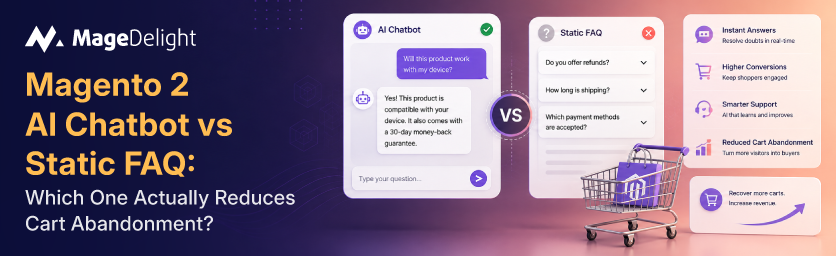
If you need one answer: a well-built static FAQ page wins for stores with predictable, repetitive pre-sale questions such as shipping, sizing, returns, and compatibility. An AI chatbot is a win for stores with complex, configurable products, live inventory questions, or international shoppers who need answers in different languages at odd hours. Most mid-sized Magento 2 stores get the best results by running both, with the FAQ handling high-volume, low-complexity questions and the chatbot picking up what the FAQ cannot anticipate.
The reasoning behind that split is worth unpacking, because the data on AI chatbots is more mixed than most vendor pages suggest.
How a Static FAQ Page Actually Works on Magento 2
A static FAQ on Magento 2 is a content page or a product page tab populated with pre-written questions and answers. Extensions like MageDelight's Product Questions & FAQ extension let merchants add a Q&A tab directly on the product page, alongside a standalone FAQ page with keyword and tag search. The advantage of the product-page placement is that the answer appears at the exact moment of hesitation, rather than on a separate help page that the shopper has to navigate away to find.
Strengths
A static FAQ never gives an inaccurate answer unless a human wrote it wrong, since there is no generative model improvising a response. It costs little to maintain once written, and unlike a chatbot subscription, there is no ongoing per-conversation fee. It is also indexable by search engines, so a well-structured FAQ page can pull in organic traffic for exactly the questions shoppers are searching before they buy.
Where it falls short
A static FAQ can only answer the questions someone thought to write down in advance. If a shopper's question differs from the pre-written version or is specific to a configurable product variant, the FAQ offers no answer. It also requires the shopper to leave the product page or interrupt their flow to search, adding friction precisely when Forrester's research says shoppers are most likely to abandon.
How an AI Chatbot Actually Works on Magento 2?
A Magento 2 AI Product Q&A Chatbot sits as a widget on the storefront, using a language model, sometimes paired with the store's product catalog and order data, to answer questions conversationally instead of routing the shopper to a static page. The pitch is that it handles novel phrasing, follows up with clarifying questions, and can pull live data, such as stock levels or order status.
Strengths
A chatbot can handle questions nobody anticipated, in whatever phrasing the customer uses, at any hour. Gartner has projected that by 2029, agentic AI will autonomously resolve 80% of common customer service issues without human intervention, cutting operational costs by roughly 30%. For stores with complex products, that flexibility is genuinely valuable; a shopper comparing two configurable SKUs can ask a direct question instead of cross-referencing two separate FAQ entries.
Where it falls short
This is the part most AI chatbot vendor pages leave out. Gartner's customer survey of 497 B2B and B2C buyers found that only 8% of customers used a chatbot in their most recent service interaction, and just 25% of those who did said they would use one again. Separately, Gartner's research on deflection has found that while AI tools deflect more than 45% of queries from human agents, only about 14% of those interactions reach a genuine self-service resolution; the rest are customers who received a bot response and either gave up or returned through another channel entirely. A chatbot that technically handles a conversation without resolving it does not reduce cart abandonment. It just delays the moment the shopper leaves.
There is also a real cost and maintenance gap. A chatbot needs to be connected to accurate, up-to-date product and policy data, or it will confidently give an incorrect answer about a return window or a shipping deadline, which is worse for trust than no chatbot at all.
Side-by-Side Comparison
|
Dimension |
Static FAQ |
AI Chatbot |
|
Set up effort on Magento 2 |
Low: install extension, write content |
Moderate to high; requires catalog and policy data integration |
|
Ongoing cost |
One-time license plus occasional content updates |
Recurring subscription, often usage-based |
|
Accuracy risk |
Low; answers are pre-written and reviewed |
Moderate; risk of incorrect or outdated answers if not properly grounded |
|
Best for |
Repetitive, predictable pre-sale questions |
Novel phrasing, configurable products, live data lookups |
|
Checkout-stage usefulness |
High if placed on the product page tab |
High if integrated with cart and order data |
|
SEO value |
Strong; content is crawlable and can rank |
None; conversational answers are not indexed |
|
Customer return-usage rate |
Not directly measured, but content persists for future visits |
Only 25% of customers who use a chatbot say they would use one again, per Gartner |
What the Data Actually Says About Cart Abandonment Recovery?
Neither tool is a guaranteed fix for the 70.19% abandonment rate because Baymard's own research attributes a meaningful share of abandonment to behavior unrelated to available answers: comparison shopping, saving items for later, or simply browsing without intent to buy yet. Both tools can influence the subset of abandonment tied to unanswered questions, which Forrester puts at over half of all abandoners.
The honest comparison is not chatbot versus FAQ as competing technologies. It is a fast, accurate answer versus no answer. An FAQ provides answers to anticipated questions instantly and without the risk of an incorrect response. A chatbot handles unanticipated questions, but only if it is properly built and grounded in real store data, since Gartner's resolution numbers show that a poorly implemented chatbot adds friction rather than removing it.
For Magento 2 merchants running Adobe Commerce or Magento Open Source 2.4.8 and later, both options benefit from the platform's expanded GraphQL support, which makes it easier to pull live product and order data into either a chatbot or a dynamically updated FAQ page without heavy custom development.
Decision Framework: Which One Should Your Store Use
If your store has fewer than a few hundred SKUs and mostly simple products: start with a static FAQ. The questions are predictable, the cost is lower, and there is no risk of accuracy. A tool like MageDelight's Product Questions & FAQ extension can be live on product pages within a day.
If your store sells configurable or highly technical products with frequent variant-specific questions: add a chatbot, but ground it in real catalog and inventory data rather than a generic script. The flexibility matters more than the setup cost here.
If your support team is already overwhelmed by repetitive tickets: deploy the FAQ first to absorb the predictable volume, then layer a chatbot for what is left over. This sequencing aligns with how MageDelight positions FAQ extensions as a knowledge base that merchants build before adding automation on top, rather than the other way around.
If you are a small store testing both for the first time: run the FAQ for at least a full sales cycle before adding a chatbot. It is cheaper to measure whether unanswered questions are actually your abandonment driver before paying for a conversational layer.
FAQ
Quick answers to the questions that Magento merchants most often ask when weighing a chatbot against a static FAQ page.
1. Does An AI Chatbot Reduce Cart Abandonment More Than A Static FAQ?
Not automatically. A chatbot that fails to resolve a question, which Gartner's research suggests happens far more often than vendors advertise, can add friction rather than remove it. A well-built FAQ that answers the right questions at the product-page level frequently performs just as well for predictable pre-sale questions.
2. Can I Run Both A Chatbot And An FAQ On The Same Magento 2 Store?
Yes, and for most mid-sized stores, this is the practical answer. The FAQ absorbs high-volume, predictable questions, while the chatbot handles edge cases and live data lookups that the FAQ cannot anticipate.
3. What Is The Real Cost Difference Between The Two?
A static FAQ extension is typically a one-time or low annual license fee with no per-conversation cost. AI chatbots usually require a recurring subscription, often scaled by usage or conversation volume, plus the integration work needed to connect them to live product and order data.
4. Do AI Chatbots Ever Give Wrong Answers About Products Or Policies?
Yes, if they are not properly grounded in the current store data. An ungrounded chatbot can confidently state an incorrect return window or shipping estimate, which damages trust more than having no chatbot at all.
5. Which Option Works Better For Mobile Shoppers?
Both can work on mobile, but a static FAQ tab on the product page avoids the extra step of opening a chat widget, which matters given that mobile cart abandonment already runs higher than desktop. A chatbot's advantage on mobile shows up mainly for shoppers asking unanticipated questions outside support hours.
Conclusion
The 70.19% cart abandonment rate is not a single problem with a single fix, and neither a chatbot nor an FAQ page will resolve the share of it caused by browsing without intent to buy. But for the portion tied to unanswered questions, which Forrester's research puts above half of all abandoners, the right tool depends on whether your store's questions are predictable or novel. Most Magento 2 merchants do not need to choose one permanently. Starting with a product-page FAQ extension like MageDelight's gets the predictable questions answered immediately and cheaply, and a chatbot can be added later once it is clear what questions the FAQ still does not catch.
