


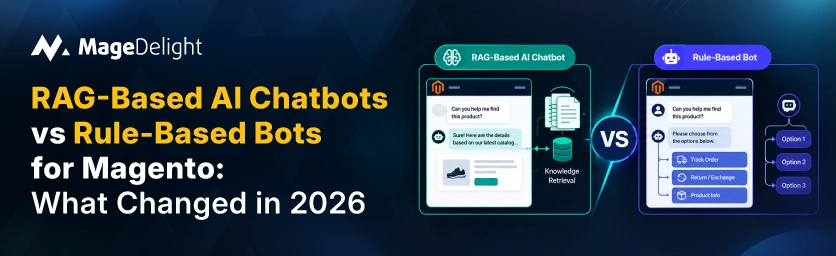
Rule-based bots fail in a predictable way: a shopper tries phrasing A, and the bot does not understand. They try phrasing B, still nothing. The bot shows the same menu again, and they either give up or angrily demand a human. That failure mode has not changed. What changed in 2026 is that Retrieval‑Augmented Generation, RAG, grew from a technique into the default architecture for production chatbots, and the accuracy gap between a well‑grounded RAG bot and an ungrounded bot became measurable and well‑documented enough that "just add AI" stopped being a viable strategy on its own.
For Magento stores specifically, the decision is no longer rule-based versus AI. Nobody ships a rule-based bot in 2026, and nobody ships a pure AI bot either; production deployments are hybrid, and the actual craft is knowing which architecture handles which type of question. This guide breaks down what a RAG-based chatbot actually does differently, where rule-based logic still earns its place, and what changed enough in 2026 to make this comparison worth revisiting if your store’s chatbot strategy predates this year.
What a Rule-Based Bot Actually Does
A rule‑based bot operates on decision trees: every possible interaction is pre‑defined, and if a shopper selects a button or types a recognized keyword, the bot triggers a scripted response. This works well when the journey is genuinely predictable: tracking an order, checking store hours, and confirming return eligibility are all structured tasks that do not require understanding nuance.
The failure mode is equally structural. The moment a conversation moves outside its expected paths- a shopper phrasing a question differently, or asking something the tree never anticipated- the bot can't adapt. It either fails outright or hands off to a human, and for a catalog with any meaningful product variety, scripting every possible question about every item would require an army of people building decision trees by hand.
What RAG Actually Changed
RAG separates two jobs that used to be mixed: understanding the question and knowing the answer. Instead of relying purely on a language model’s training data, a RAG pipeline retrieves relevant context, product specs, policy documents, and order history from your actual store data at the moment a question is asked, then generates a response grounded in what it just retrieved. The shopper asks a question in language; the system searches your trusted content for relevant information; the model writes its answer using that retrieved material rather than improvising from memory.
This is the detail most comparisons undersell: the model is not smarter in 2026 than it was in years mainly because of better language understanding; it is more reliable because the retrieval half of the pipeline matured. A tight RAG pipeline with a citation contract, where every factual claim must reference a retrieved passage and the model abstains if nothing supports the claim, cuts unsupported claims by half or more compared to a closed‑book baseline at the same model size. That is an architecture change, not a model.
The Hallucination Numbers That Actually Matter
Production hallucination rates vary sharply by task shape, and this is where a lot of chatbot marketing glosses over an important distinction. Extractive question-answering systems, the category most product Q&A chatbots fall into, hallucinate on roughly 3 to 8 percent of responses when properly grounded. Open-ended generation runs 15 to 25 percent, and multi-step agent workflows, chaining several tool calls together, run 20 to 40 percent. A chatbot answering "does this jacket come in size medium" from your actual product data is a fundamentally different reliability problem than one improvising a multi-step return-and-refund workflow.
Layered guardrails make a measurable difference: system prompts, RAG grounding, and real-time monitoring combined cut hallucination rates by 71 to 89 percent compared to an unguarded deployment, according to a 2026 meta-analysis of production deployments. The cost of getting this wrong isn't theoretical. Arthur AI reports that 34 percent of enterprises experienced a customer‑facing incident caused by an LLM hallucination in the past 12 months, with average remediation costs exceeding $50,000 for regulated industries. For ecommerce, the failure mode is concrete: a chatbot confidently quoting a discontinued product at last season’s price or describing a return window that expired three weeks ago. That is not a prompt‑engineering problem; the bot followed its instructions correctly; it just had the context to work from, which means the fix has to happen at the retrieval layer, not in how the question is phrased.
Side-by-Side Comparison
|
|
Rule-Based Bot |
RAG-Based AI Chatbot |
|
How it decides what to say |
Matches keywords/buttons to a predefined decision tree |
Retrieves relevant catalog/policy data, then generates a response |
|
Handles unexpected phrasing |
No; fails outside scripted paths |
Yes; interprets free-form, natural language |
|
Setup effort |
Manual flow-building for every question path |
Requires a retrieval pipeline connected to live store data |
|
Accuracy risk |
Zero hallucination, but frequent “I don't understand” dead ends |
3–8% hallucination on narrow, well-grounded queries (higher if ungrounded) |
|
Scalability |
Breaks down past a few dozen decision branches |
Scales to thousands of catalog items without new flows |
|
Best fit |
Small catalogs, highly predictable questions (hours, order status) |
Large catalogs, high query variability, product Q&A |
Why Hybrid Is the Actual 2026 Default
Deterministic handlers still return structured data, tracking numbers, order status, exact stock counts, with zero ambiguity, and that's exactly the kind of answer a shopper needs to be completely certain about. RAG-grounded handlers take over for everything with genuine variability: product comparisons, "will this work for," spec questions phrased ten different ways across ten different shoppers. Cutting the tether between a response and its retrieved source is precisely where things go wrong. Models have been observed confidently telling customers shipping was free when it wasn't, and quoting return windows that expired long ago, stated with the same confidence as a correct answer.
• Route order status, tracking, and account-specific lookups to deterministic, rule-based handlers that pull structured data directly, no generation involved.
• Route open-ended product questions, comparisons, and "which one should I get" queries to a RAG-grounded chatbot trained on your actual catalog and policy documents.
• Keep a citation or abstention rule in place: if the retrieval step doesn't surface a supporting passage, the bot should say so rather than generating a plausible-sounding guess.
• Treat catalog freshness as a first-class maintenance task. A RAG pipeline is only as accurate as the data it retrieves from. Stale pricing or inventory data produces confident, wrong answers regardless of how good the underlying model is.
What This Looks Like on a Magento Store
For a Magento catalog specifically, the retrieval layer needs to pull from your actual, live product data, descriptions, specs, current stock, active promotions, rather than a static snapshot that goes stale the moment you update a price or run out of an item. That is the difference between a chatbot that occasionally embarrasses you and one that quietly earns its keep answering the same fifty to two hundred product questions your support team currently handles by hand every week.
MageDelight’s AI Product Q&A Chatbot, part of its AI Powered Extensions lineup, is built around this pattern, grounding shopper‑facing answers in your store’s own product data rather than an ungrounded general‑purpose model so responses stay tied to what is actually in your catalog instead of drifting into plausible‑sounding guesses.
The Real Decision Isn't RAG vs. Rules
The comparison that mattered a few years ago, rule-based versus AI, has quietly become the wrong question. The real 2026 decision is which specific tasks deserve deterministic, zero‑ambiguity handling and which deserve a RAG pipeline grounded enough in your actual catalog to earn a shopper’s trust. Get that split right and a chatbot stops being a novelty that occasionally embarrasses your brand and starts being infrastructure that quietly deflects the repetitive questions your support team answers by hand every day.
If your store is evaluating where to start, grounding questions is usually the highest‑leverage first step. MageDelight’s AI Product Q&A Chatbot is built for that piece of the puzzle tied to your live Magento catalog rather than an ungrounded general model.
Frequently Asked Questions
Is a rule-based chatbot obsolete in 2026?
No, but it's no longer the default for anything with real conversational variability. Rule-based logic still handles highly structured, predictable tasks well- order status, store hours, appointment confirmation- and remains cheaper and more predictable for those specific paths. The shift is that RAG now handles everything a rule-based tree used to struggle with, rather than rule-based bots being asked to stretch beyond what they're built for.
How much does RAG actually reduce hallucination compared to no grounding at all?
Public benchmarks like FActScore and RAGTruth consistently show that a tight RAG pipeline cuts claims by half or more compared to a closed‑book baseline at the same model size. Layering system prompts and real‑time monitoring on top of RAG grounding pushes that reduction to 71 to 89 percent in production deployments according to 2026 meta‑analysis data.
Can a RAG chatbot still hallucinate even when it's grounded in my catalog?
Yes, grounding significantly reduces but doesn't eliminate the risk. Extractive question-answering tasks, the category most product Q&A falls into, still show a 3 to 8 percent hallucination rate even when properly grounded. The most common cause in ecommerce specifically is stale retrieval data, quoting a price or availability status that changed after the retrieval index was last updated, not the model inventing information from nothing.
Do I need to replace my existing rule-based bot entirely?
Usually not. The 2026 pattern that works best is hybrid: keep rule‑based handlers for the structured high‑certainty tasks they are already good at and add RAG‑based handling for the variable questions that were breaking your rule‑based bot in the first place. Few production deployments in 2026 are purely one or the other.
