


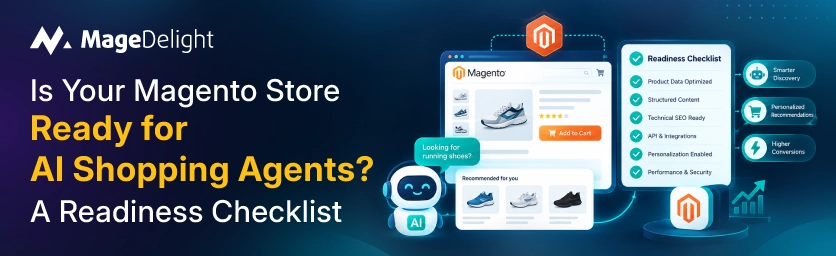
McKinsey says that AI that acts on its own will affect between three and five trillion dollars in retail business by 2030. Morgan Stanley also says almost half of shoppers will use AI tools to shop by then. These tools will be responsible for a quarter of their buying. This is not something that's far away anymore. AI shopping tools, like ChatGPT, Gemini, and Claude, which look for products and sometimes finish purchases for shoppers, are already a way to shop in 2026. Stores that got their product data right did better than others during the busy time of the year.
The hard part for Magento merchants is that being ready does not mean just adding a chatbot. It means making sure the store's business setup, product data, rules, connections, and ability to be scanned by robots are correct and easy to read by machines. Most stores are almost not seen by these agents today. It is not because the agents can't find the store. It is because they can't check whether what they find is enough to suggest or buy. This list explains what really needs to be true for a Magento store to be ready for these agents, one part at a time.
Why This Is Different From Traditional SEO
Agentic commerce optimization doesn't replace SEO. It builds on it. Both depend on structured content, proper schema markup, and accurate product details. But AI shopping agents don’t just glance at a page like a person might. They dig deeper. They check facts in time: price, stock, return policy before making a decision. If what they see online doesn’t match what’s actually true at the moment of purchase, the sale falls through. That mismatch hurts not the transaction but also trust in the store’s future recommendations.
Pillar 1: Structured Product Data and Schema
This is the bedrock. Everything else relies on it. If product descriptions are written for humans to scan, agents can’t read them well. They need data that’s machine-readable and consistent. Full Product schema price, availability, brand, and aggregateRating) must be on every product page, not on high-performing SKUs.
-
Product schema (price, availability, brand, aggregateRating) is present on every product page, not top sellers.
-
Product attributes such as dimensions, weight, color, material, and compatibility specs are standardized across all listings in a category, not entered freely per product.
-
Titles and descriptions use specific language that agents can match to a shopper’s query, not just marketing jargon.
Pillar 2: A Public Product Feed or API
Agents, like shopping aggregators and Google Merchant Center before them, work with feeds instead of going through a store's pages one by one. A feed in JSON or XML format at a URL should be available. This feed must include details for each product like SKU, title, description, price, availability, GTIN. Return policy. It needs to be up to date, ideally updated in time or at least every four hours.
-
A machine-readable product feed exists at a documented URL.
-
The feed updates in time or at least every four hours so agents do not show outdated prices or stock levels.
-
Catalog, cart, checkout, refund, and order-management functions are available through programming, not through a user interface that an agent cannot use fully.
Pillar 3: Machine-Readable Policies
Returns, shipping, and warranty policies need to be in structured, easy-to-read text. They should not be in a scanned PDF or an image-heavy page that a crawler cannot understand. Agents read these pages to help shoppers decide if a purchase is safe. Vague language is not helpful. Clear terms are better. For example, "30-day returns, no restocking fee, prepaid label included" is something an agent can use. Please see our returns page for details" is not.
-
Shipping, return, and warranty policies are written with clear, specific details about time frames and conditions.
-
Policy pages are not in scanned PDFs or images that a crawler cannot read.
Pillar 4: Protocol Compatibility
Depending on your platform, connecting to an emerging commerce protocol determines whether an agent can actually transact with your store, not just recommend it. A handful of standards have emerged through 2026, each backed by different players:
|
Protocol |
Backers |
What It Does |
|
UCP (Universal Commerce Protocol) |
Google + Shopify, with Etsy, Target, Walmart |
Shared catalog and cart standard for Google AI Mode, Gemini, Copilot |
|
ACP (Agentic Commerce Protocol) |
OpenAI-aligned |
Lets agents complete checkout inside a chat session |
|
MCP (Model Context Protocol, commerce use) |
Anthropic standard, deployed by Shopify |
Gives Claude and MCP-compatible agents structured catalog access |
Not every store needs every protocol on day one. The practical question is whether your platform and app stack have a path to supporting at least one of these as agent-driven checkout becomes more common, rather than discovering the gap only once a competitor is already transacting through it.
Pillar 5: Crawlability and llms.txt
None of the information is important if the crawlers that are behind these agents can't access it. Keep APIs from being misused without stopping the real agent traffic that you want. Make sure that robots.txt clearly allows the crawlers that are connected to ChatGPT, Gemini, Copilot, and Claude, rather than blocking them by default.
An llms.txt file tells AI agents and crawlers where your main product pages, category pages, and policy pages are. It also includes a robots.txt that actually allows the AI crawlers you want and a clean sitemap. For a Magento catalog of any size, creating and updating that file manually and keeping it up to date as products and categories change is not practical as a task.
MageDelights LLMs.txt File Generator takes care of this specifically for Magento. It creates a file that covers unlimited pages and products. It has scheduled updates so the file stays current as your catalog changes. It also has company metadata setup and flexible entity selection, so you decide which CMS pages, categories, and products are shared with ChatGPT, Gemini, and Claude.
-
Robots.txt clearly allows the AI crawlers connected to the agents you want to be found or blocks them by default.
-
An llms.txt file is in place, covers your catalog, and updates on a schedule to avoid getting outdated after the next product update.
Pillar 6: Trust Signals and Review Data
Agents rely heavily on customer reviews, especially when a human user clearly asks for "the reviewed" option. Review schema, visible rating counts, and consistent data across product listings all play a role in how an agent ranks different choices when the shopper hasn’t specified a particular product.
-
Review and rating data is marked up with schema. Appears directly on product pages, no hidden tabs, no unstructured data.
-
Review counts and scores match between what's shown on the page and what’s available in your feed or API. Agents check both sources. Any mismatch can break trust in your listing.
Measuring Whether It's Working
Readiness isn’t something you achieve once and call it done. You need tracking. Pay attention to which sales come specifically from AI-powered search surfaces. Regularly test your visibility by asking tools like ChatGPT or Google AI Mode to find products in your category. See if your store actually shows up. Keep an eye on analytics for AI traffic. Refine your product data and listings based on what agents seem to prefer. That’s how your store stays ready, not just ready once. Ready all the time.
Start With the Boring Infrastructure
Every source on this topic points to the unglamorous truth: the key to success is clean, complete product data, structured feeds and schema, machine-readable policies and crawlability that actually allows the agents you want to find you. None of it sounds exciting. This is what decides if your Magento store ends up on an agent’s shortlist or gets quietly ignored in favor of a competitor whose data an agent can actually verify.
If crawlability is the spot, in your current setup, MageDelight's LLMs.txt File Generator is a solid starting point. MageDelight’s broader.
Frequently Asked Questions
Do I need to completely rebuild my Magento store to support AI shopping agents?
Most merchants do not have to rebuild their technology stack. The main goal is to make the existing product data, policies, and feeds accurate and easy for machines to read. After that, you can look at adding a protocol such as UCP or ACP, following your platform’s roadmap of replacing the whole platform.
Is a chatbot widget the same thing as being agent-ready?
No. A chatbot on your site only answers questions from visitors who're already on your store. Agent readiness means checking whether an external AI agent, working on a shopper’s behalf, can find, confirm, and buy from your store without a person clicking through the user interface.
How often does my product feed need to update for agents to trust it?
Real‑time updates are best. A refresh every four hours is usually the acceptable limit. If an agent suggests a product using stock or price information and the item is then out of stock or priced incorrectly at checkout, the sale is lost, and the agent’s trust in your listings drops for future searches.
Which commerce protocol should a Magento store prioritize?
Which protocol a Magento store should focus on depends on where the traffic and existing integrations are headed. UCP is backed by Google and Shopify. Works well for merchants who rely on Google Shopping traffic. ACP is good for stores that want the checkout to finish inside a chat window. MCP is best for stores that need catalog access for agents such as Claude or other MCP‑compatible agents. Many larger merchants end up supporting protocols instead of choosing one early on.
