


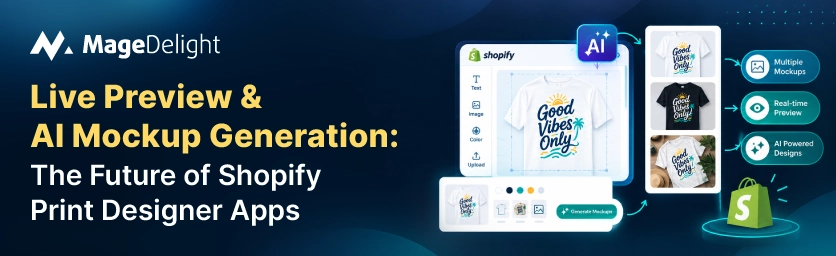
According to Deloitte research cited by Kickflip, 36 percent of buyers are interested in purchasing personalized products, rising to 48 percent for clothing and 53 percent for holidays and leisure travel. When close to half the buyers in a category expect a customization option, the question stops being whether to offer one and becomes how convincingly the store shows the result. That is the job live preview does, and it is why nearly every serious Shopify print designer app now leads with it.
Live preview is already table stakes. The interesting shift in 2026 is what is being built on top of it: AI filters that restyle a shopper's photo, mockup generators that produce a whole product gallery from one artwork file, and print-ready output that removes the manual step between a customer's design and a production file. This guide separates those capabilities, which are often lumped together, and covers what to look for when choosing an app.
Live Preview Is Now Table Stakes
A live preview shows the shopper their exact text, image, and layout choices rendered on the product before they pay. Customily's Shopify listing describes it as letting shoppers personalize in real time with text, photos, calendars, and AI filters, while Customix, a newer app, credits the live preview feature for giving customers clarity and confidence in what they are designing. The mechanism is simple: a shopper who can see the result has less to imagine, and less reason to hesitate or return the order.
Several vendors put numbers on this. Kickflip reports that product customizers with real-time visualization can cut return rates by up to 30 percent, and elsewhere cites conversion lifts of 20 to 60 percent over static product pages. Treat those figures carefully: Kickflip sells a customization platform, so they are vendor-reported. Podifai's 2026 comparison guide, which is itself published by a vendor in the space, offers a more cautious note: personalization research does not establish a specific revenue improvement from installing any one app, so it recommends measuring completed orders, order value, and customization-related errors in your own store rather than assuming a result.
That caution is worth keeping. The directional logic behind live preview is sound, because it sets accurate expectations before purchase, but the size of the benefit depends on your product, your traffic, and how accurate the preview really is.
Live Preview, Mockups, and AI Filters Are Three Different Jobs
Most confusion in this category comes from treating everything with an AI label as the same feature. In practice, there are three distinct capabilities, used by different people at different moments:
|
|
Live Preview |
AI Mockup Generation |
AI Filters / Effects |
|
Who uses it |
The shopper, on the product page |
The merchant, when building the catalog |
The shopper, while personalizing |
|
What it produces |
A real-time render of one custom order |
Product gallery images for many products at once |
A stylized version of an uploaded photo |
|
Main business value |
Confidence at checkout, fewer surprises on delivery |
Faster catalog launches, consistent imagery |
Novelty and perceived value of the product |
|
Real examples |
Customily, Teeinblue, Customix, MageDelight |
Dynamic Mockups, Printify's generator, Mockuplabs |
Teeinblue photo effects, Customily AI filters |
The distinction matters when you shop for an app. A tool with excellent live preview may have no help at all for generating catalog imagery, and a mockup generator may produce beautiful gallery images without letting shoppers personalize anything. Some apps now try to do both, which is where the category is heading.
What AI Is Actually Doing in Print Designer Apps Today
Looking at what apps actually list, rather than what marketing implies, the current use of AI falls into a few concrete areas.
Shopper-Side: Restyling and Cleaning Up Uploads
Customily's listing names AI filters, background removal, and a FaceCut feature alongside standard text and photo customization, plus import from Canva and export of print-ready, engrave-ready, or laser-cut files. Podifai's comparison guide describes Teeinblue's AI-generated photo effects as transforming uploaded photos into styles such as watercolor, sketch, or cartoon illustration. The common thread is that AI changes what the shopper can create, not just how it looks on screen.
Merchant-Side: Generating Mockups at Catalog Scale
Dynamic Mockups' Shopify listing describes uploading artwork once to create full product galleries from more than 1,000 templates, synced to Shopify media, with the same app also offering real-time personalization and production-ready files with correct sizing and bleed. Printify's free mockup generator covers 2,000-plus customizable products, with AI-generated scenes reserved for its premium tier. A 2026 comparison from Mockupify, itself a vendor in the space, describes Mockuplabs as using AI to detect design placement and adjust lighting and shadows across more than 10,000 templates.
A caution on the newest entrants: Dynamic Mockups' listing shows no reviews yet, which does not make it a poor product, but does mean there is little independent evidence about how it performs at volume. Older, higher-volume apps such as Teeinblue, with a 4.9 rating across several hundred reviews on the Shopify App Store, have a much longer paper trail.
Fulfilment-Side: Turning a Design Into a Production File
This is the least glamorous and often most valuable use of automation. Both Teeinblue and Customily emphasize automatically generating print-ready files and connecting to print-on-demand providers, so a customer's finished design reaches production without someone rebuilding it manually. The Guideflow evaluation guide makes the same point from the buyer's side: look past the preview to what happens after checkout, including output files, approval steps, and manufacturing handoff, because the tools that compound value turn a finished configuration into a production file automatically.
Where This Is Heading
The following is analysis rather than reported fact, but the direction of the listings above points one way. Live preview and mockup generation currently sit in separate tools or separate features, and the apps pulling them together, one artwork upload feeding both a merchant's catalog gallery and a shopper's personalization preview, are the ones that look most like the next generation. Dynamic Mockups' pairing of the two in one listing is an early example.
• Expect AI to move further into the shopper's side of the experience, handling image cleanup, style transfer, and layout suggestions, since these directly affect whether a customer finishes a design.
• Expect the merchant side to shift from static template libraries toward generated scenes, with quality still varying widely between tools.
• Expect print-ready output and fulfilment integration to become the deciding factor between apps, since preview quality is converging while production automation still differs meaningfully.
The Content Gap Nobody Talks About
Better previews and faster mockups create a side effect that most app comparisons skip: more products, more variations, and more product pages that each need accurate titles, descriptions, and metadata. A merchant who can launch fifty personalized products in a week still has to write fifty sets of copy, and writing them by hand is where the speed gained on the design side tends to get lost.
This is where an AI content layer fits, and it is worth being clear about scope. MageDelight's AI Content Generator is a Magento 2 extension, not a Shopify app, so it applies to merchants who run Magento, or who operate on both platforms. Within Magento, it generates content for products, categories, and CMS pages, works with ChatGPT, Gemini, or Claude models, and produces bulk short and long descriptions with SEO metadata, with full editing control and an approval flow before anything goes live.
For Magento merchants pairing personalized products with catalog-scale content, AI Content Generator is the piece that keeps copy production in step with how quickly new personalized products can now be listed.
On the Shopify side, MageDelight's Personalized Product Print Designer App covers the design side of the same workflow, with text and image uploads, live preview, and print configurations managed from the Shopify admin.
How to Evaluate a Print Designer App in 2026
|
What to Check |
Why It Matters |
|
Preview accuracy against the real print |
A preview that flatters the product creates the exact return it was meant to prevent |
|
Print-ready file output |
The value of a good preview is lost if someone still has to rebuild the file by hand |
|
Where AI runs (shopper side or merchant side) |
Shopper-side AI changes the product; merchant-side AI changes how fast you can list it |
|
Fulfilment integration |
Determines whether the design reaches production without manual steps |
|
Review history and maturity |
Newer listings may be excellent, but have less real-world evidence behind them |
|
How fees scale |
Per-order fees and flat pricing behave very differently as volume grows |
Whichever app you shortlist, run a scoped pilot on a single product line first, as Guideflow recommends, and measure conversion, returns, and time-to-launch against your current static product page before rolling it across the catalog.
Judge the Whole Workflow, Not One Feature
Live preview, AI mockups, and AI filters are separate capabilities that happen to share a marketing vocabulary. The apps worth shortlisting are the ones where the preview is accurate, the output file needs no rebuilding, and the AI features solve a real bottleneck in your own workflow rather than adding a demo-friendly extra. Preview quality is converging across the category, so production automation and how fees scale are increasingly where the meaningful differences sit.
If your catalog is growing faster than your product copy, AI Content Generator is worth a look for the Magento side of your business, alongside the design tooling above.
Frequently Asked Questions
Is AI mockup generation the same as live preview?
No. Live preview is what the shopper sees while personalizing a single order. Mockup generation is what the merchant uses to produce gallery images for many products at once. Some apps offer both, but they solve different problems for different people.
Do live previews actually reduce returns?
The logic is sound, since a preview sets accurate expectations before purchase, and vendors such as Kickflip report reductions of up to 30 percent. Those are vendor-reported numbers, though, and even vendor-published comparison guides recommend measuring returns in your own store rather than assuming a specific reduction.
Are newer apps with few reviews risky?
Not necessarily, but there is less independent evidence about how they behave at volume. A sensible approach is a small pilot on one product line, tracking orders, order value, and customization-related errors before committing the whole catalog.
Does the AI Content Generator work with Shopify?
No. It is a Magento 2 extension, compatible with Magento Open Source, Adobe Commerce, and Adobe Commerce Cloud on the 2.4.x line. It is relevant here for merchants who run Magento, or who operate on both Magento and Shopify.
