


Shopify confirmed back in 2017 that mobile devices had overtaken computers as the primary way people shop online, and that gap has only widened since. A theme that looks great on a 27-inch monitor but loads slowly on a phone is no longer a minor inconvenience. It is a direct hit to revenue.
Google's own research backs this up. In its study “The Need for Mobile Speed”, Google found that mobile sites loading in 5 seconds saw 70% longer average sessions and 25% higher ad viewability than sites loading in 19 seconds, the average load time for mobile sites at the time of the study. A separate study commissioned by Google and conducted with Deloitte, “Milliseconds Make Millions,” tracked 30 million user sessions across 37 retail, travel, and lead-generation brands and found that a 0.1-second improvement in mobile load speed lifted retail conversions by 8.4% and average order value by 9.2%. Speed is not a technical nice-to-have; it is a line item on your revenue statement.
This guide ranks the 15 best Shopify themes for 2026 using a different standard than most “best theme” roundups. Instead of relying on a single Lighthouse score pulled from a polished demo store, the rankings below lean on Shopify's own real-user Core Web Vitals data, published directly on Shopify's performance dashboard and updated as recently as June 2, 2026. That data reflects how each theme actually performs on live stores with real traffic, real apps installed, and real customer behavior, not a clean lab environment. Pricing and feature details come from each theme's official Shopify Theme Store listing or developer page.
Why Theme Choice Is an SEO and Revenue Decision, Not Just a Design One
Shopify's own conversion rate benchmarks put the average store conversion rate at around 1.4%, with established stores reaching 2.5% to 3%, and the top 20% of stores clearing 3.2% or higher. A theme that nudges your store even partway toward that top tier is worth far more than its sticker price, especially since most premium Shopify themes are a one-time purchase rather than a recurring fee.
Speed and Core Web Vitals matter for two separate reasons. First, Google uses Core Web Vitals as a ranking signal, so a theme with chronically poor Largest Contentful Paint or Interaction to Next Paint scores can quietly suppress your organic visibility before a customer ever sees your site. Second, speed shapes whether the customer sticks around once they do land on a page. Both effects compound: a slow theme can mean fewer people find your store, and fewer of those who do complete a purchase.
Mobile responsiveness is the other half of the equation. Shopify itself documented the shift to mobile-dominant shopping years ago, and current ecosystem data puts the share of mobile traffic for Shopify stores well above half of all visits. A theme that handles touch targets, image loading, and layout shift poorly on a phone is optimizing for a shrinking share of your audience.
How We Ranked These 15 Themes
Each theme below is evaluated on three factors pulled from primary sources rather than marketing copy. Real-user Core Web Vitals performance comes from Shopify's official aggregated performance data, which tracks the percentage of stores where at least 75% of users experienced a “Good” score on Largest Contentful Paint (LCP), Cumulative Layout Shift (CLS), and Interaction to Next Paint (INP). Pricing and section counts come from each theme's listing on the official Shopify Theme Store or, for themes sold outside the Theme Store, the developer's own site. Design and conversion features are drawn from the official theme descriptions and demo stores, cross-checked against the Theme Store's published feature lists.
The 15 Best Shopify Themes for 2026
Here are the 15 best Shopify themes to consider.
1. Dawn
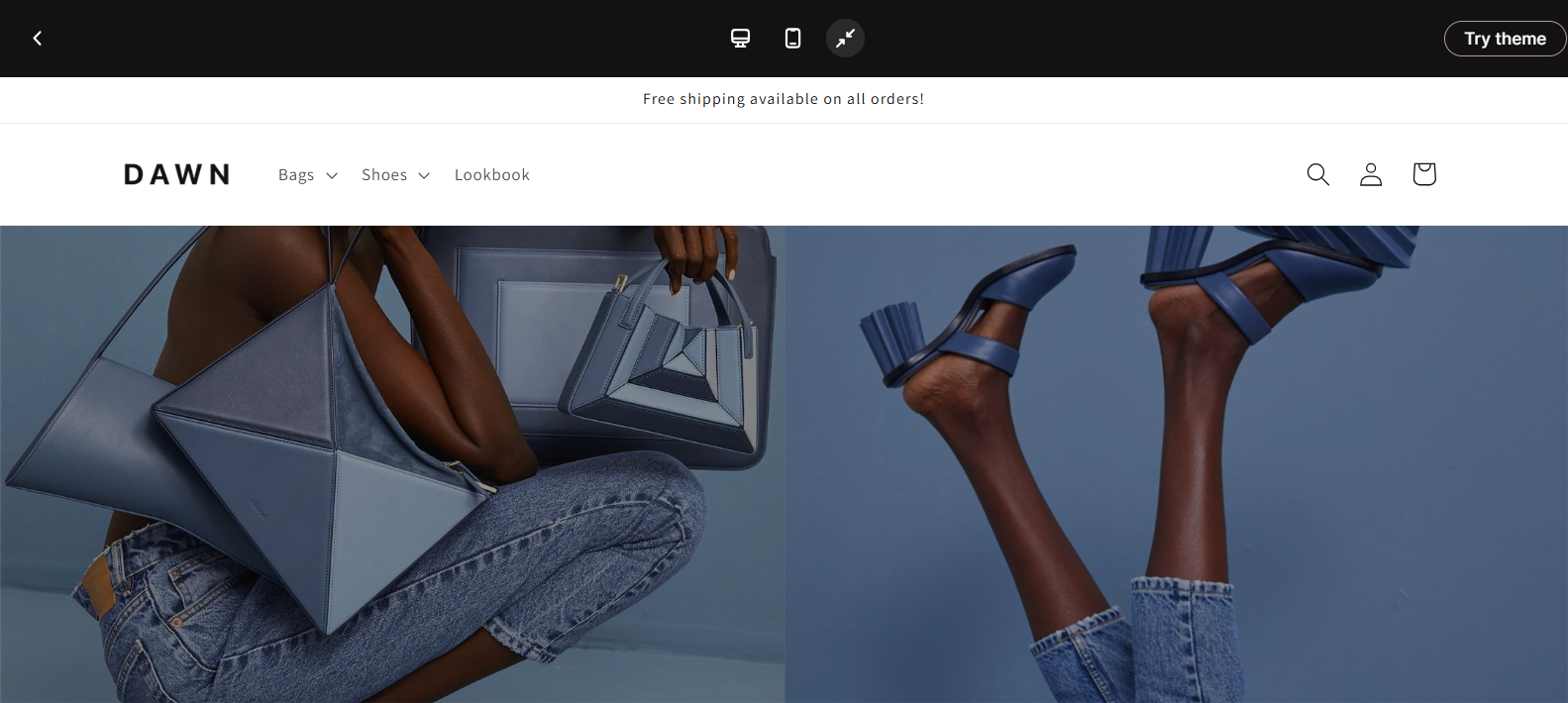
Dawn is Shopify's longtime default free theme, introduced alongside the Online Store 2.0 framework, and it remains the most widely installed theme in the Shopify ecosystem even after losing its “default” status to Horizon in 2025. It is a minimalist, image-forward theme with native support for FAQ pages, promotional banners, recommended products, and an enhanced search experience, all without installing a single app.
According to Shopify's official Core Web Vitals data table, Dawn passes the “Good” threshold on LCP for 96.4% of stores and on INP for 95.6% of stores, with an overall Core Web Vitals pass rate of 84.9%. That is a strong baseline for a free theme, particularly one that ships with zero customization out of the box. The trade-off is a more limited feature set than premium alternatives: no built-in upsell modules, no sticky add-to-cart, and basic filtering compared to paid themes.
- Best for: new stores, lean catalogs, anyone who wants speed without paying for it
- Price: Free
- Core Web Vitals pass rate: 84.9% (Shopify official data)
2. Horizon

Horizon is Shopify's new default theme foundation, introduced at the Summer 2025 Editions event and built around a fully modular, nested block system that lets merchants build complex layouts without touching code. It shipped alongside ten free presets, including Ritual, Fabric, Tinker, and Vessel, each tuned for a different industry. Horizon also integrates Shopify Magic's AI block generator, so merchants can describe a section in plain language and get working Liquid code back.
Shopify's Core Web Vitals data shows Horizon passing “Good” on LCP for 95.7% of stores and CLS for 96.4%, with an overall pass rate of 81.0%, respectable for a theme this new and this feature-dense. The honest caveat: independent testing has found Horizon's mobile PageSpeed scores trail Dawn's on equivalent demo content, largely because of additional JavaScript for web components and animations that run by default. Shopify has continued shipping quarterly performance improvements since launch.
- Best for: new stores that want AI-assisted, code-free layout flexibility
- Price: Free
- Core Web Vitals pass rate: 81.0% (Shopify official data)
3. Impact
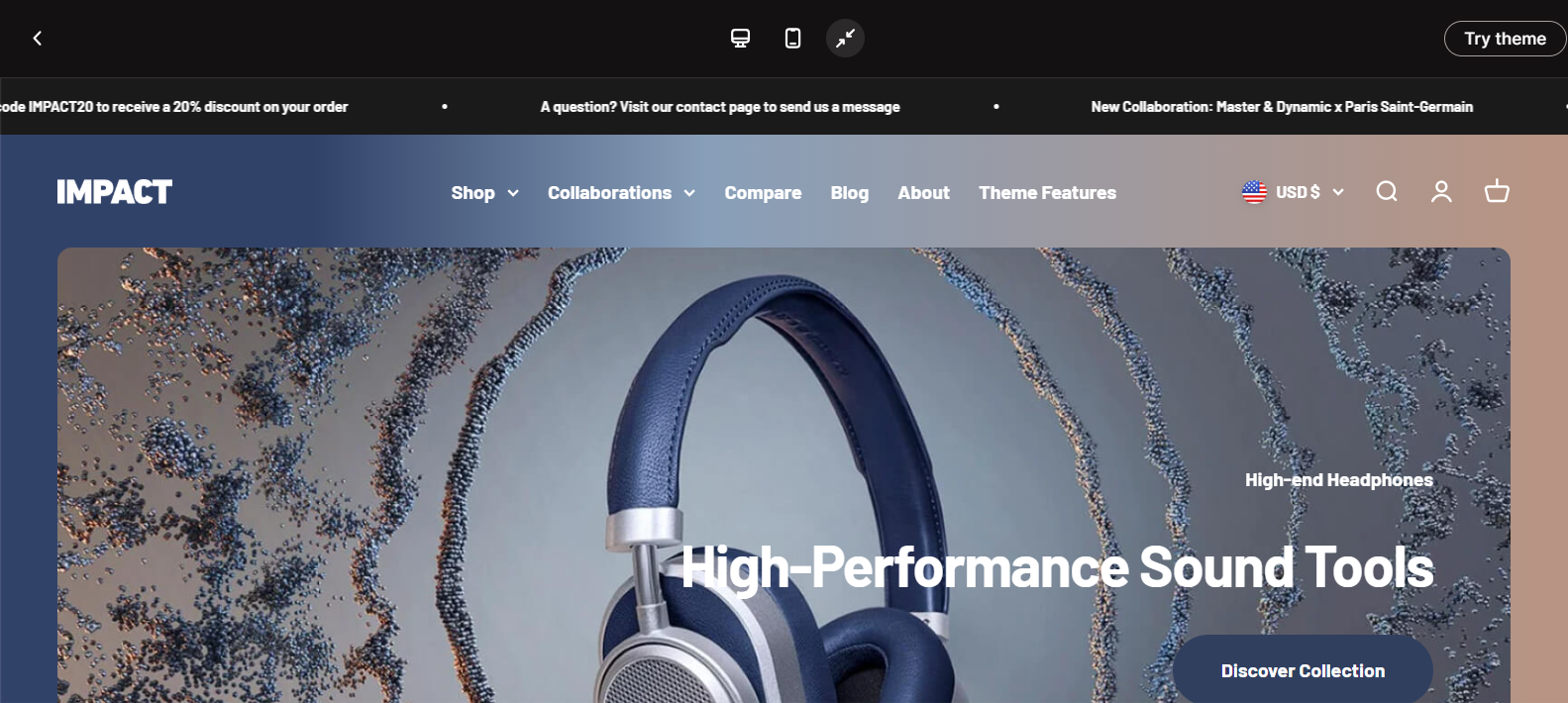
Impact, built by Maestrooo, is the theme most often recommended to brands with meaningful monthly revenue who want a visually bold storefront without hiring a developer. It ships with more than 35 customizable sections, gradient backgrounds, animated transitions, and a faceted filtering system built to handle catalogs of 500 or more products without slowing down. Conversion features come built in: sticky add-to-cart, quick buy on collection pages, and complementary product recommendations on product pages.
Official Shopify performance data puts Impact's LCP pass rate at 97.8%, and its overall Core Web Vitals pass rate at 91.3%, among the strongest results for a premium theme this feature-rich. Impact is priced at $380 as a one-time purchase, with free updates and an unlimited free trial before you buy, and is available through the Shopify Theme Store.
- Best for: fashion, beauty, and lifestyle brands that want a distinctive, animation-rich storefront
- Price: $400 one-time
- Core Web Vitals pass rate: 91.3% (Shopify official data)
4. Sense
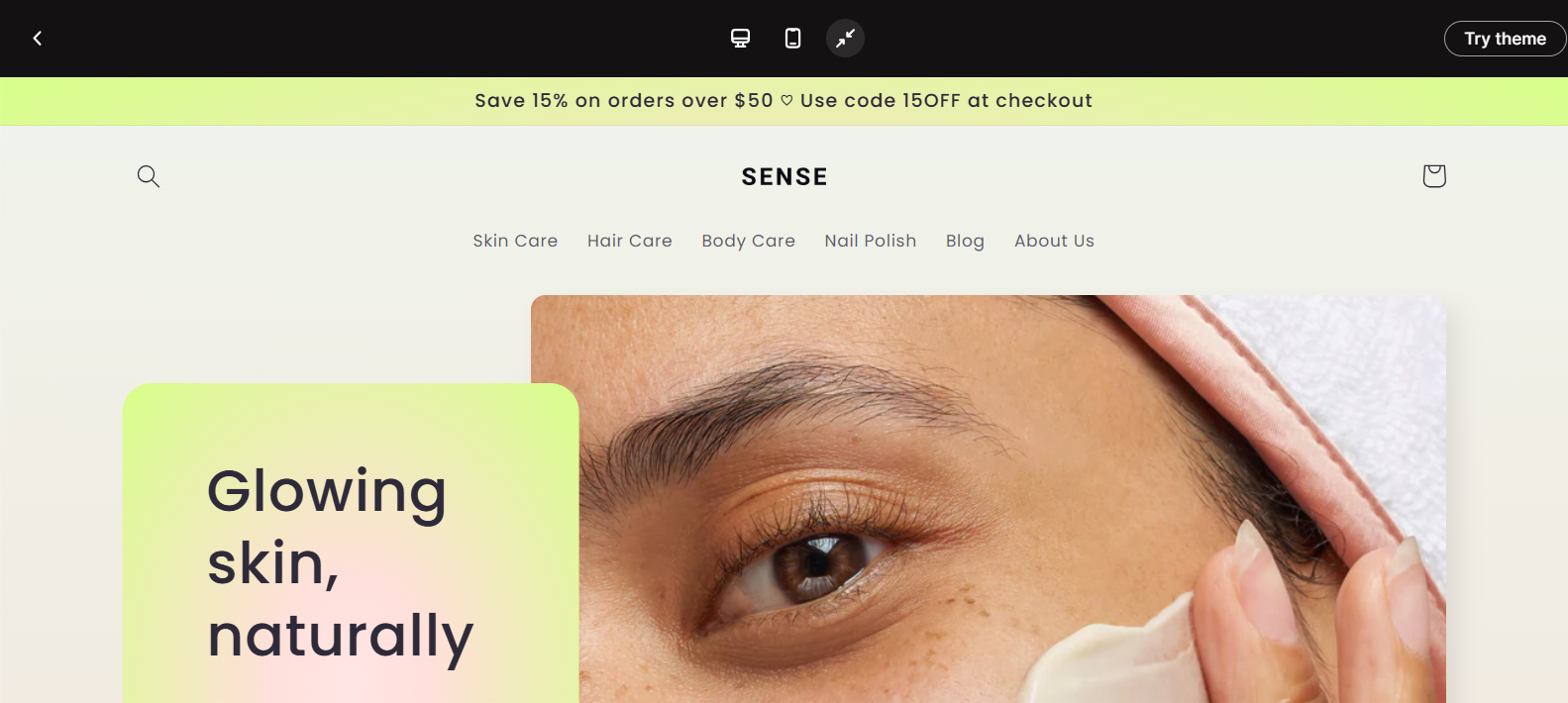
Sense is a leaner, a pick worth considering if you want premium-grade code quality without Impact's full price tag. Maestrooo's themes share a common technical foundation, so Sense inherits the same clean section architecture, SEO-friendly markup, and responsive design discipline the developer is known for, with a more restrained visual style suited to brands that prioritize clarity over spectacle.
Shopify's official data shows Sense passing “Good” on LCP for 95.7% of stores, with an overall Core Web Vitals pass rate of 82.1%. That places it slightly behind Impact on raw real-user performance but well within the range merchants should expect from a Theme Store listing built by an established developer with thousands of live installs. For stores that do not need 35-plus sections and elaborate animation, Sense delivers the core mechanics of a high-converting layout at a meaningfully lower starting cost.
- Best for: merchants who want Maestrooo's code quality without Impact's higher price
- Price: Free
- Core Web Vitals pass rate: 82.1% (Shopify official data)
5. Impulse
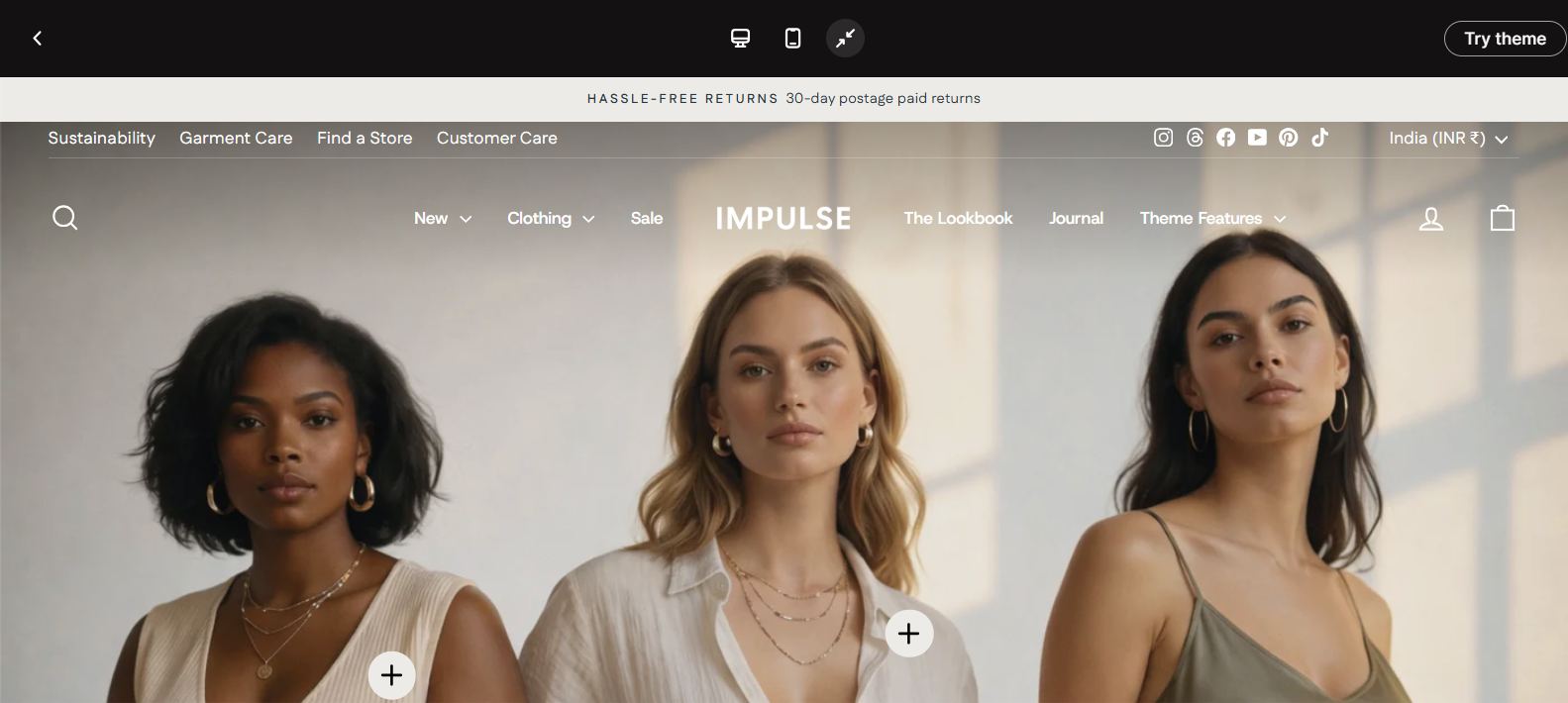
Impulse, from Archetype Themes, leans into editorial design: lookbooks, lifestyle photography, and curated collection storytelling. It is one of the most frequently recommended premium themes in Shopify's own community forums for merchants seeking professional, SEO-friendly storefronts, alongside Impact and Prestige. The promotional pop-ups and slide-out cart are polished straight out of the box, and fashion brands, in particular, tend to rely on Impulse's mega menu and high-level customization options to manage large seasonal collections.
Shopify's official Core Web Vitals table shows Impulse passing “Good” on INP for 97.7% of stores and on CLS for 96.1%, with an overall pass rate of 91.2%, putting it just ahead of Impact on the aggregate metric. Impulse is available through the official Shopify Theme Store.
- Best for: fashion and lifestyle brands building around lookbooks and seasonal collections
- Price: $450
- Core Web Vitals pass rate: 91.2% (Shopify official data)
6. Turbo
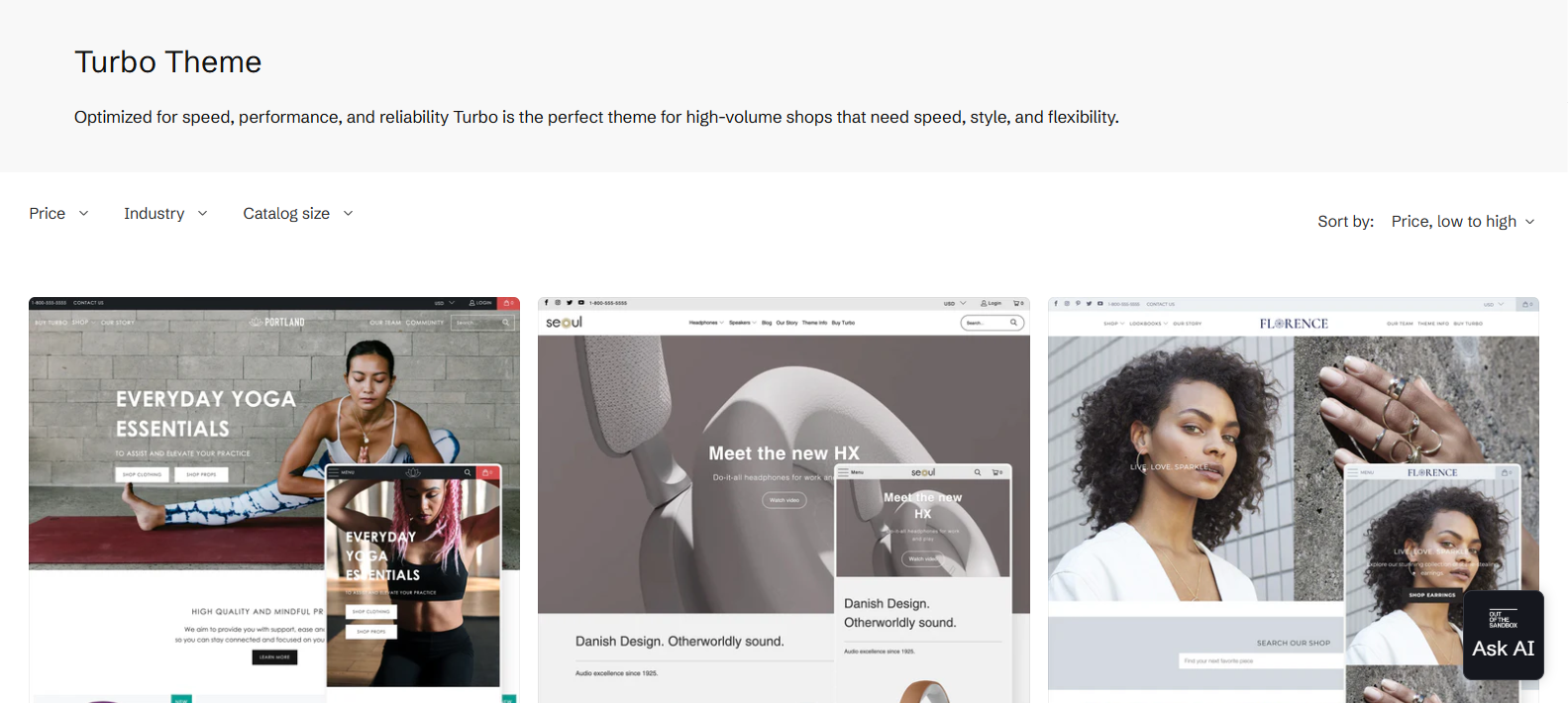
Turbo, built by Out of the Sandbox, is the theme to pick if speed is the deciding factor. It ships with more than 40 features, including smart page preloading that predicts what a shopper will click next and begins loading it in advance, predictive search, and six preset options. Out of the Sandbox positions Turbo specifically for merchants who need both style and raw performance at scale, and it is sold exclusively through Out of the Sandbox's own store rather than the Shopify Theme Store.
According to Shopify's official performance data, themes in this speed-focused category consistently post some of the strongest LCP numbers in the ecosystem, and Turbo's architecture (minimal blocking scripts, aggressive preloading) is built around that priority. Merchants comparing Turbo against Impact or Impulse should weigh the trade-off: Turbo trades some of the visual flourish those themes offer in exchange for consistently faster perceived load times, particularly on product and collection pages.
- Best for: high-volume stores where every fraction of a second of load time affects revenue
- Price: $425, with a 14-day refund window
- Best for: experienced merchants prioritizing raw speed over heavy visual customization
7. Studio
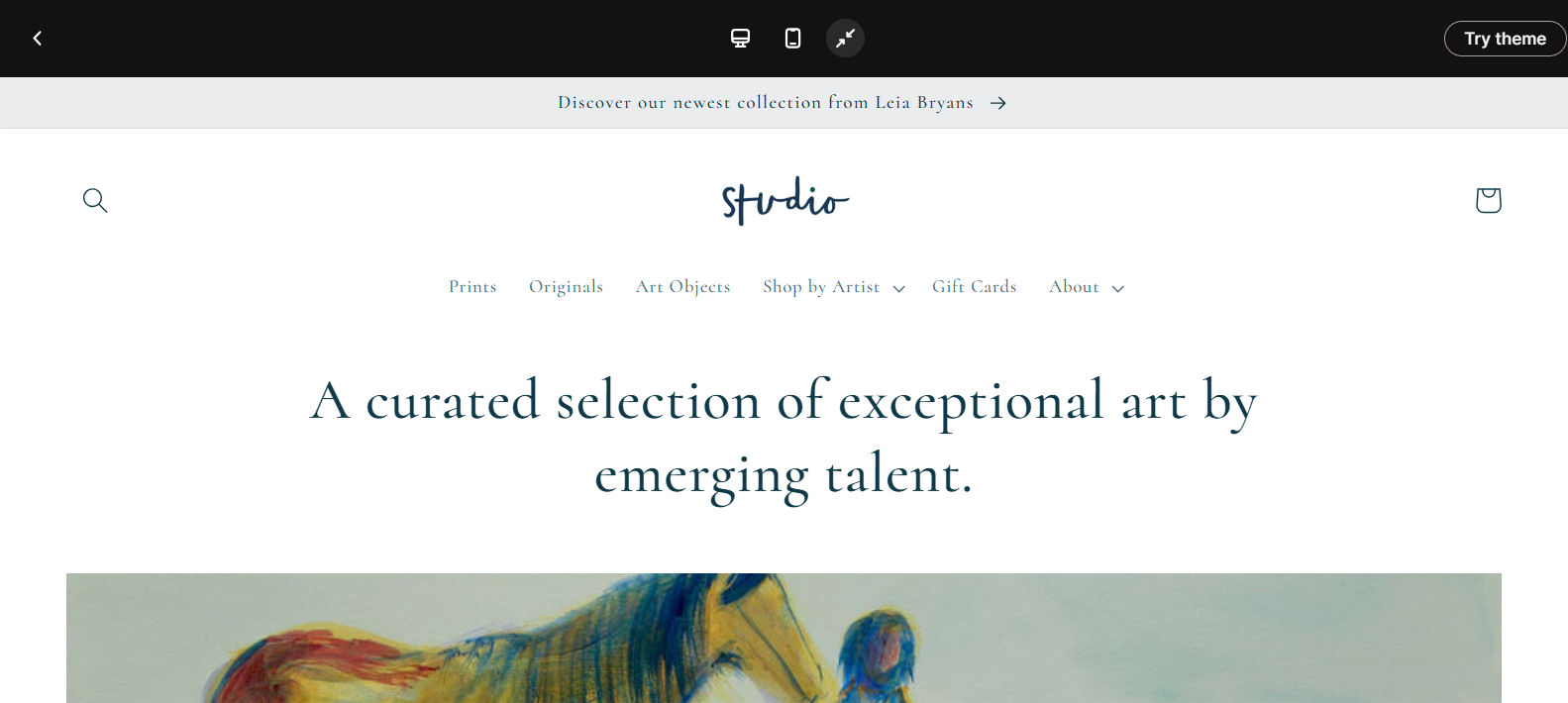
Studio is one of Shopify's most widely adopted free themes, alongside Dawn, serving as a go-to starting point for new merchants. It supports high-resolution images with rollover options, lookbook layouts, product videos, FAQ pages, promotional banners, and a mega menu suited to stores with many categories and subcategories. Shopify's official Core Web Vitals data shows Studio passing “Good” on LCP for 98.6% of stores and on INP for 98.2%, with an overall pass rate of 90.1%, a genuinely strong result for a free theme.
The mega menu and lookbook features make Studio a better fit than Dawn for stores with deeper catalogs or a strong visual storytelling angle, and it costs nothing to install.
- Best for: stores with multiple categories that want a visual, mega-menu-driven layout for free
- Price: Free
- Core Web Vitals pass rate: 90.1% (Shopify official data)
8. Craft
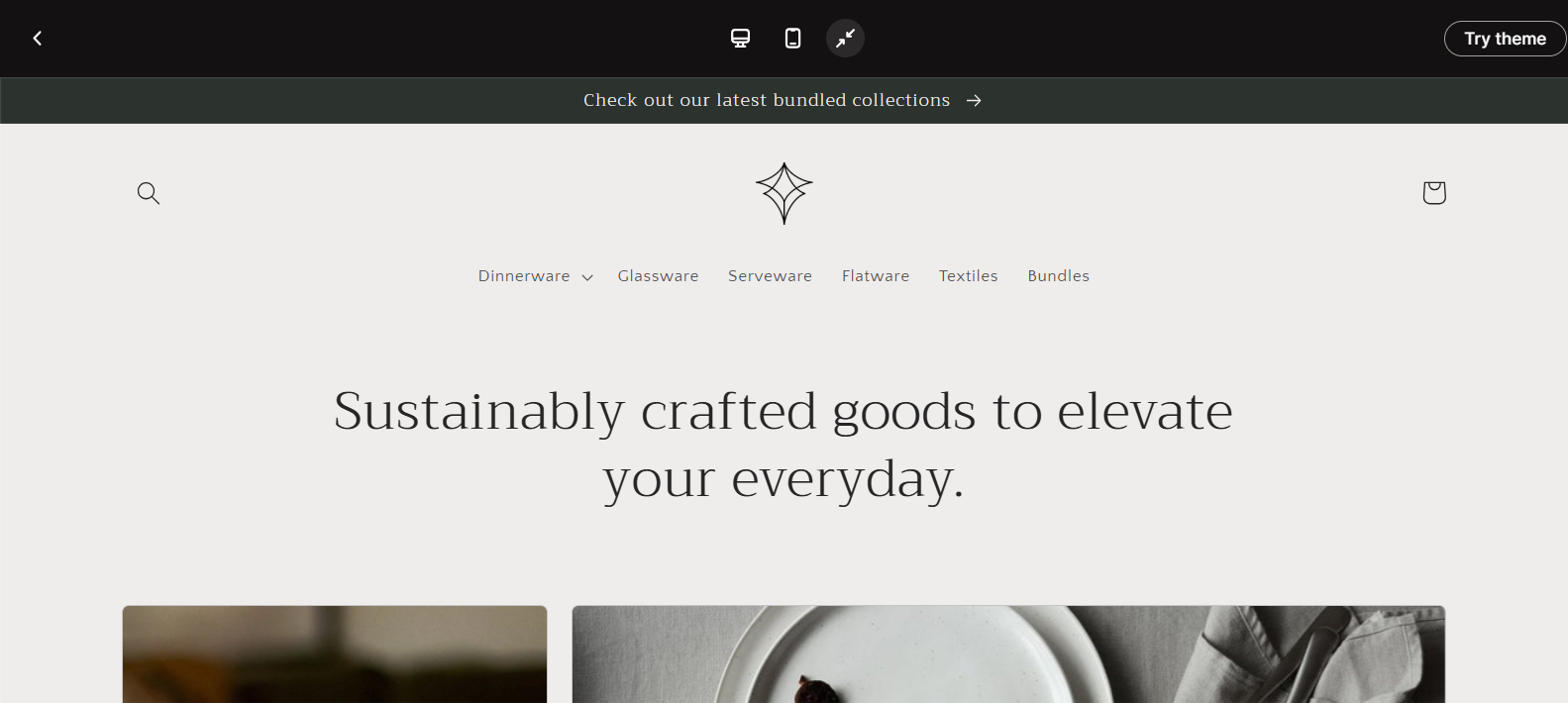
Craft is Shopify's free theme built for brand storytelling, with dedicated sections for “Our Story” and “Our Process” content, along with full-screen image galleries that showcase the making of a product. It suits artisanal, handmade, and creator-led brands that want to sell the process behind the product, not just the product itself.
Shopify's official performance data shows Craft passing “Good” on LCP for 98.3% of stores and on INP for 97.9%, with an overall Core Web Vitals pass rate of 89.9%, among the better results in the entire free theme lineup. For a brand whose differentiation is the story behind what they make, Craft is a free theme that does not force a compromise on speed to get there.
- Best for: artisanal, handmade, and creator-led brands selling on story as much as product
- Price: Free
- Core Web Vitals pass rate: 89.9% (Shopify official data)
9. Expanse
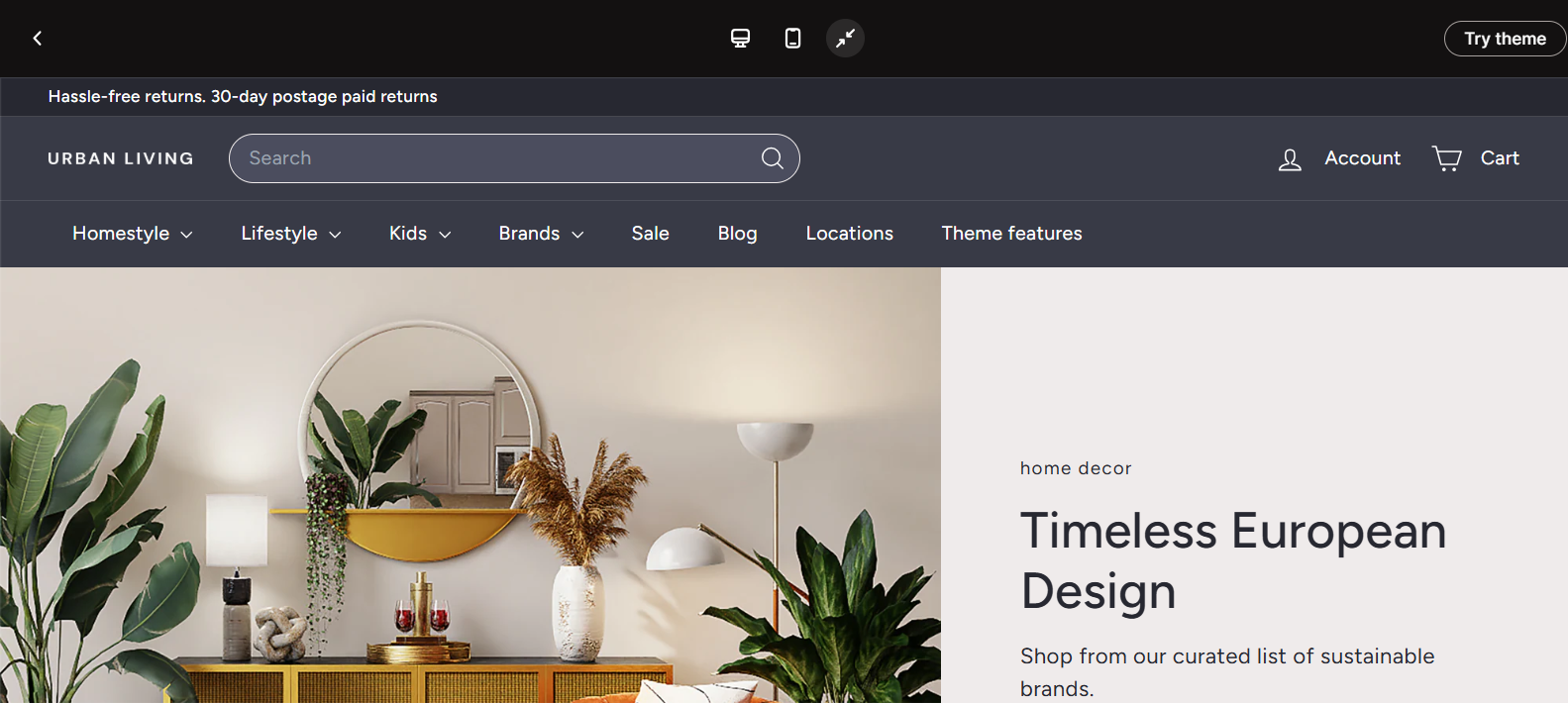
Expanse, from Archetype Themes, is purpose-built for large catalogs. Shopify community moderators frequently point merchants with large inventories toward Expanse alongside Empire for its marketplace-style layout and advanced filtering, which holds up under hundreds or thousands of SKUs without the navigation collapsing into a confusing mess.
Official Shopify data shows Expanse passing “Good” on CLS for 97.8% of stores and overall Core Web Vitals at 89.2%, a solid number considering how much filtering and faceted navigation logic a large-catalog theme typically has to run on collection pages.
- Best for: large catalogs that need deep filtering without sacrificing page stability
- Price: $420
- Core Web Vitals pass rate: 89.2% (Shopify official data)
10. Warehouse
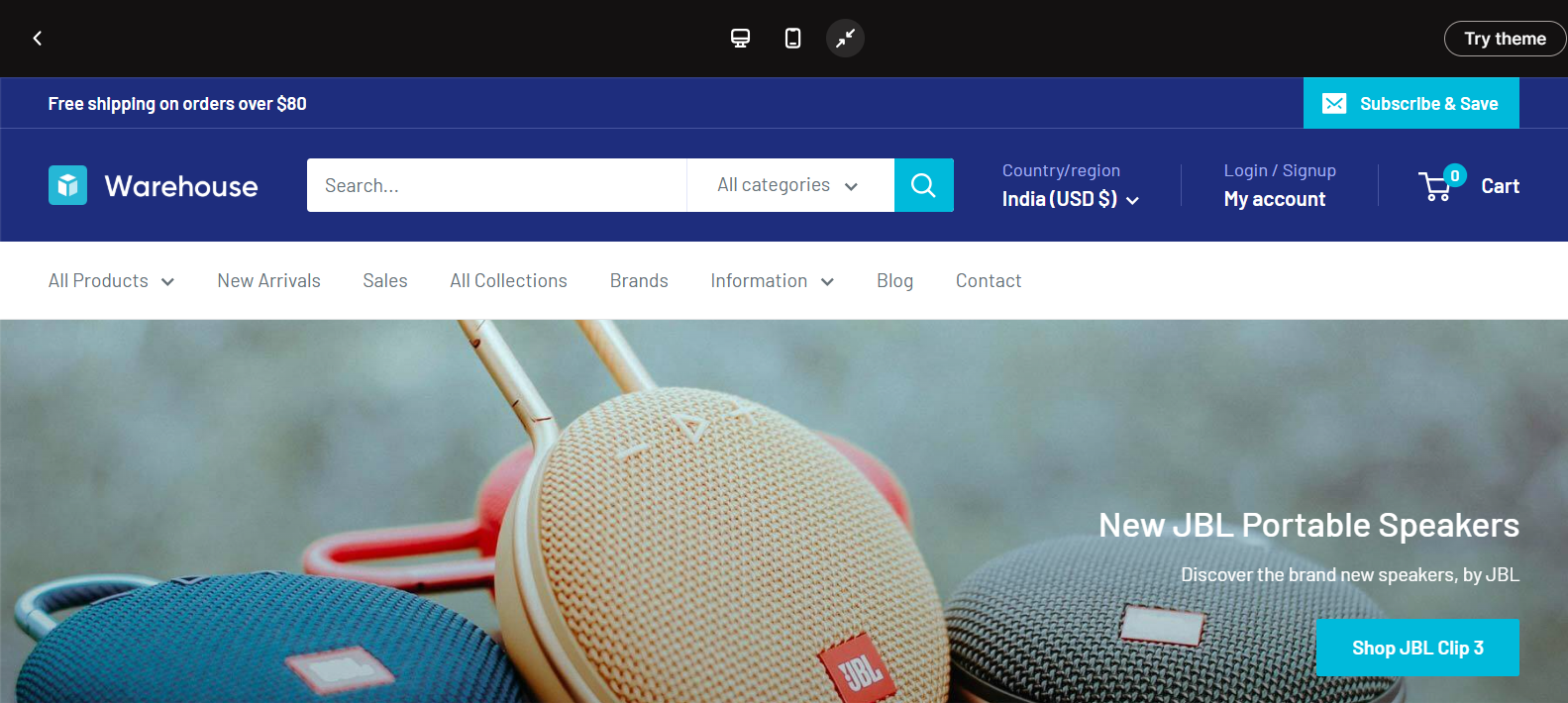
Warehouse, also built by Maestrooo, targets large catalogs and dropshipping operations specifically, with advanced filtering and sorting options designed for stores carrying hundreds of SKUs. It shares Maestrooo's broader reputation for conversion-rate focus and strong page speed performance even when displaying large volumes of product imagery, a combination that is harder to pull off than it sounds, since image-heavy collection pages are usually where large-catalog themes start to slow down.
Warehouse is positioned as a more budget-friendly large-catalog option relative to Impact, while still inheriting the same underlying code discipline.
- Best for: dropshipping and high-SKU stores that need fast-loading collection pages
- Price: $320
- Best for: merchants prioritizing speed-at-scale over heavy customization
11. Prestige
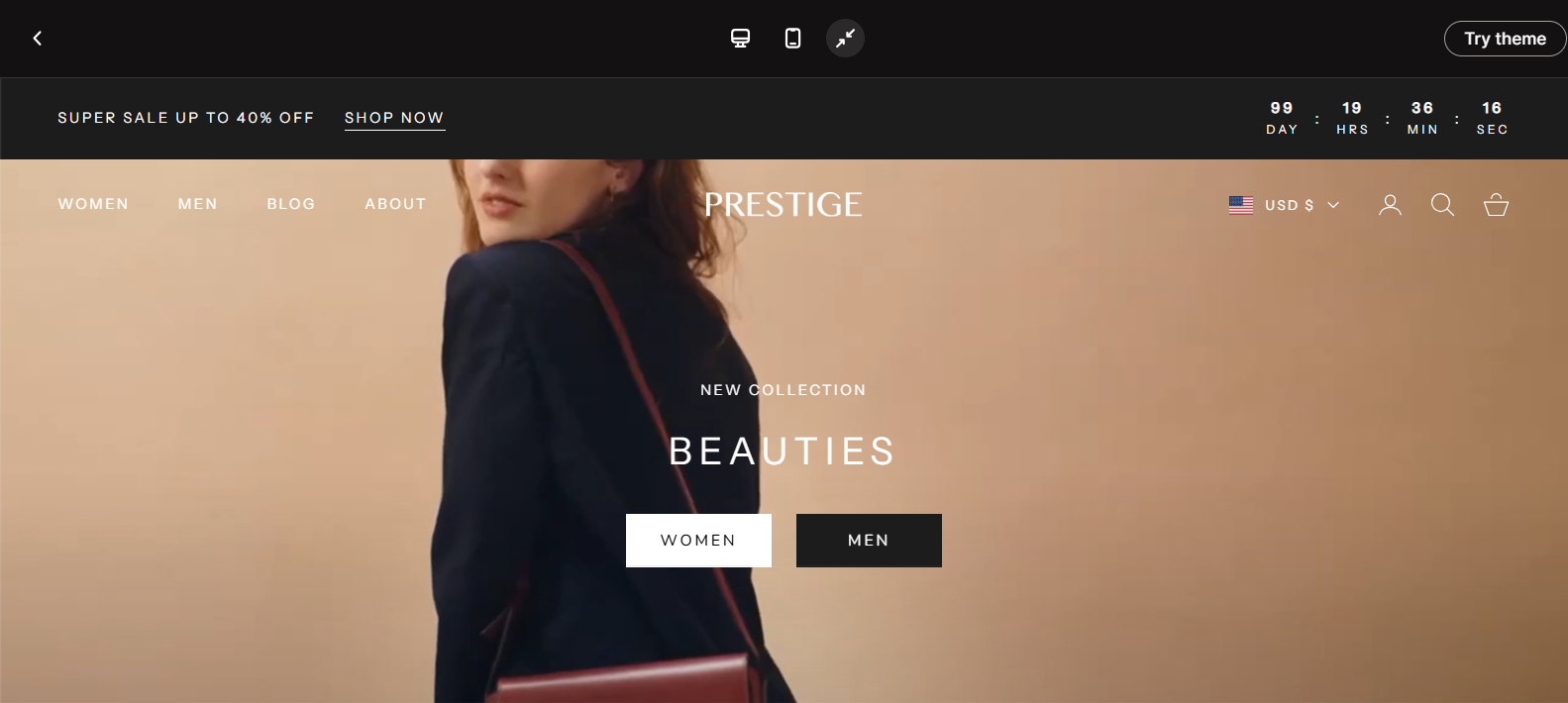
Prestige, also from Maestrooo, has earned a reputation in the Shopify community as the “signature Shopify look”: clean, minimalist, and built around clear product presentation rather than heavy ornamentation. It is one of the themes most frequently mentioned by name in Shopify's own community forums when merchants ask for a professional, SEO-friendly storefront, typically recommended in the same breath as Impact and Impulse.
Shopify's official Core Web Vitals data shows Prestige passing “Good” on LCP for 96.4% of stores and CLS for 97.1%, with an overall pass rate of 89.3%. With 28 sections, it offers less raw customization than Impact's 35-plus, which is a deliberate trade-off: less flexibility in exchange for a tighter, more consistent visual language that suits upscale and boutique brands particularly well.
- Best for: high-end, boutique, and luxury brands that want an elegant, refined look without heavy customization
- Price: $400
- Core Web Vitals pass rate: 89.3% (Shopify official data)
12. Flex
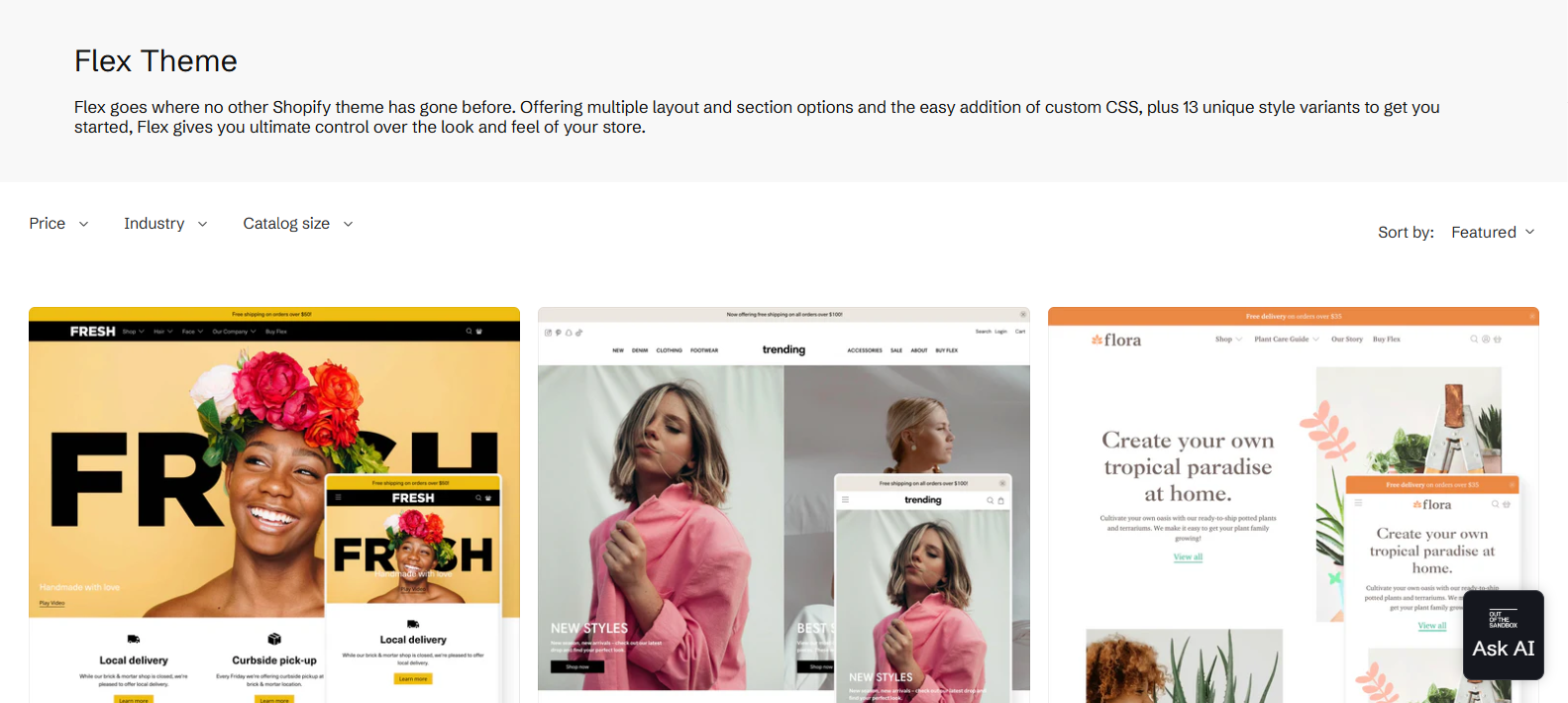
Flex, from Out of the Sandbox, is the most customizable theme on this list, built specifically for developers, freelancers, agencies, and merchants who want maximum creative control. It ships with 28 sections and 13 pre-built layouts, giving teams more room to build a genuinely unique storefront without resorting to a third-party page builder app.
That flexibility comes with a real trade-off: more code running on the page generally means a harder ceiling on raw speed. Out of the Sandbox positions Flex for power users who are comfortable trading some out-of-the-box speed for creative range, and the theme is sold through Out of the Sandbox's own platform rather than the Shopify Theme Store.
- Best for: agencies and power-merchants who want maximum design flexibility
- Price: $495 one-time
13. Local
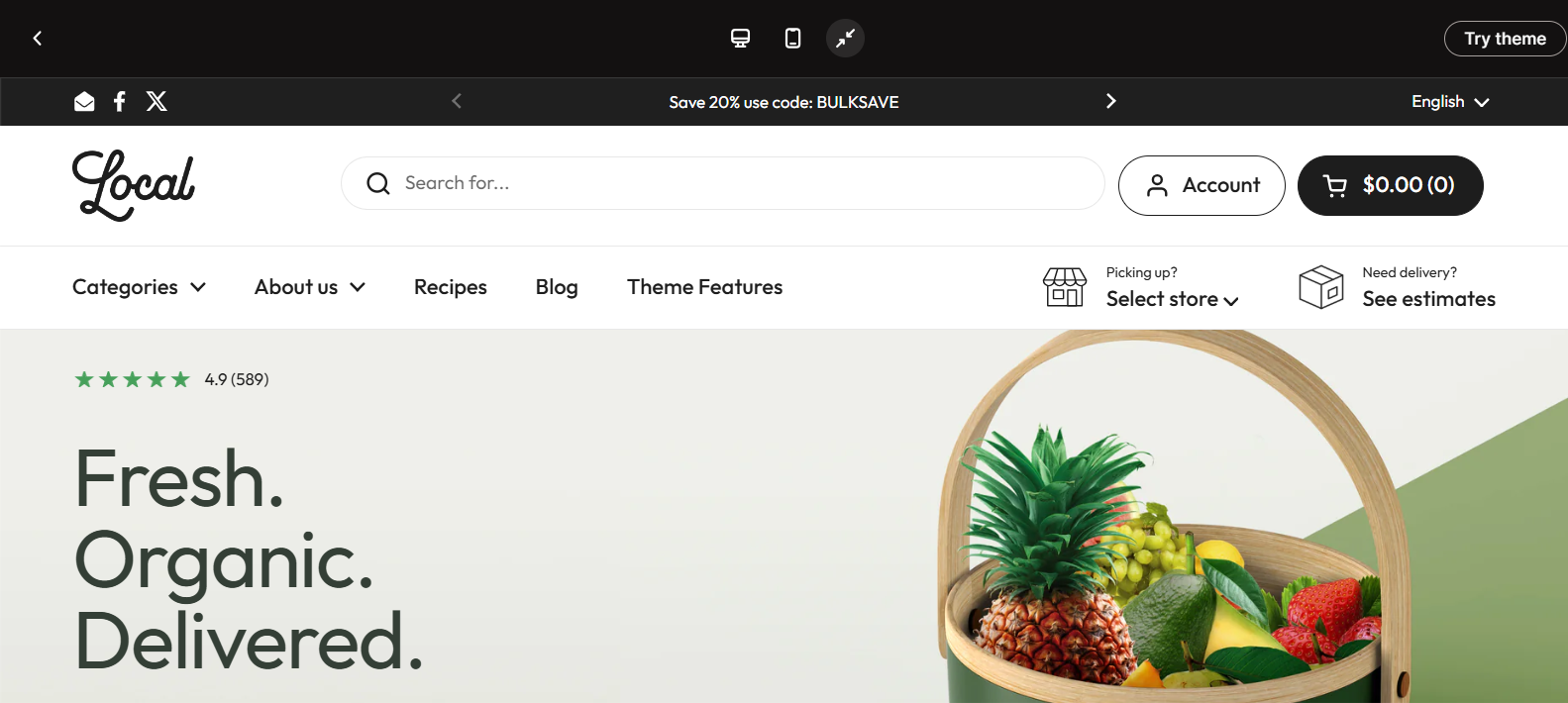
Local is built specifically for food, drink, and retail businesses that operate both online and in person. It includes a store locator, an event calendar, and an age verification pop-up, features that matter specifically for breweries, wineries, and specialty food brands that need to confirm a customer's age before checkout or direct local shoppers to a physical location.
Because Local solves a specific operational need rather than competing purely on aesthetics, it tends to fly under the radar in general “best theme” lists despite being a strong, purpose-built option for the right business type. It is available through the Shopify Theme Store.
- Best for: food, beverage, and brick-and-mortar-plus-online retail businesses
- Price: check current listing on the official Shopify Theme Store
14. Taiga
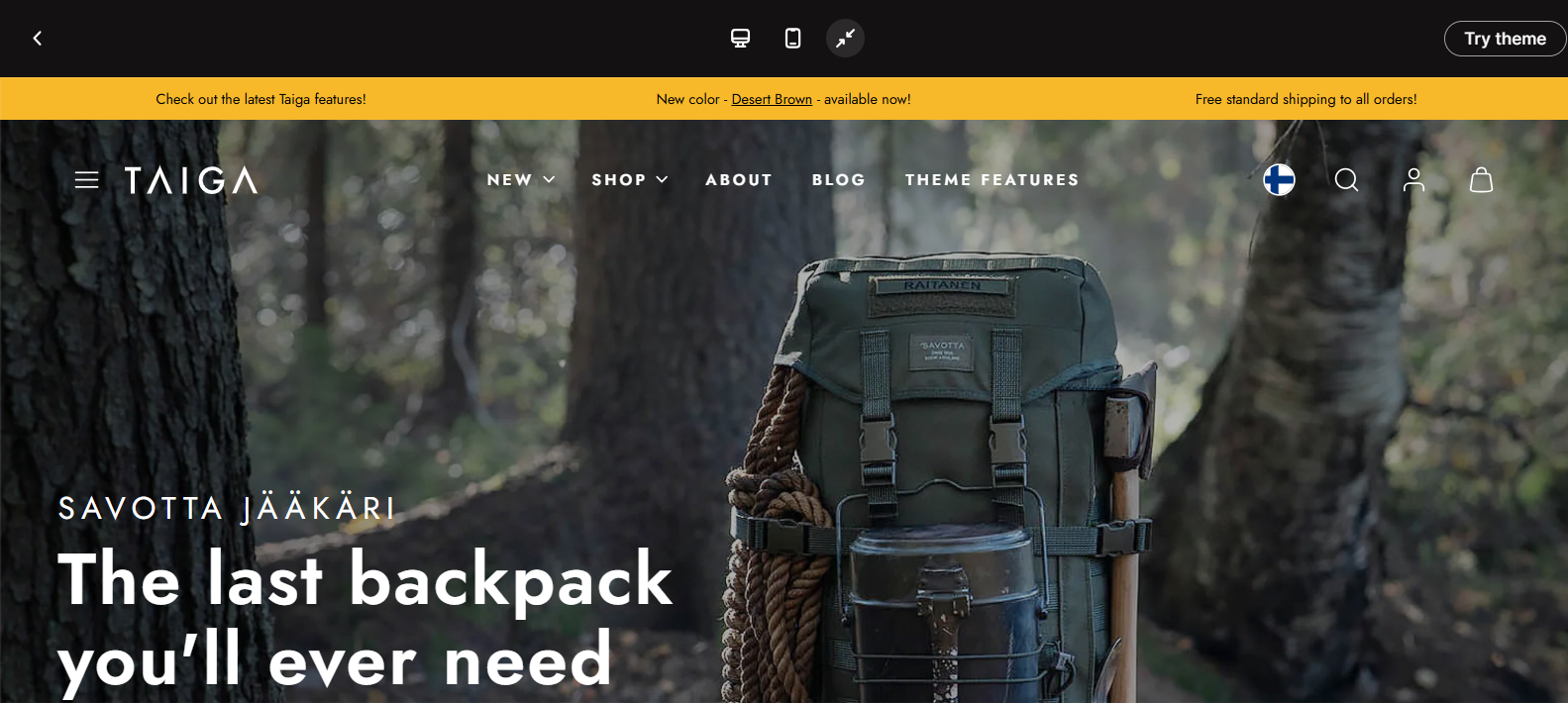
Taiga is a Shopify 2.0 premium theme designed for fashion and apparel brands seeking visual freedom paired with strong, consistent performance. It is featured by direct-to-consumer apparel brands as a fast-loading option in a category where heavy lifestyle photography often drags load times down. Taiga is sold directly through the official Shopify Theme Store.
The theme's appeal for fashion brands specifically is that it manages to support rich, image-forward layouts without the performance penalty that usually comes with that visual density, a balance that is genuinely difficult to strike in the apparel category.
- Best for: fashion and apparel brands that want rich imagery without sacrificing speed
- Price: $500
- Best for: D2C apparel brands scaling a visually driven catalog
15. Symmetry
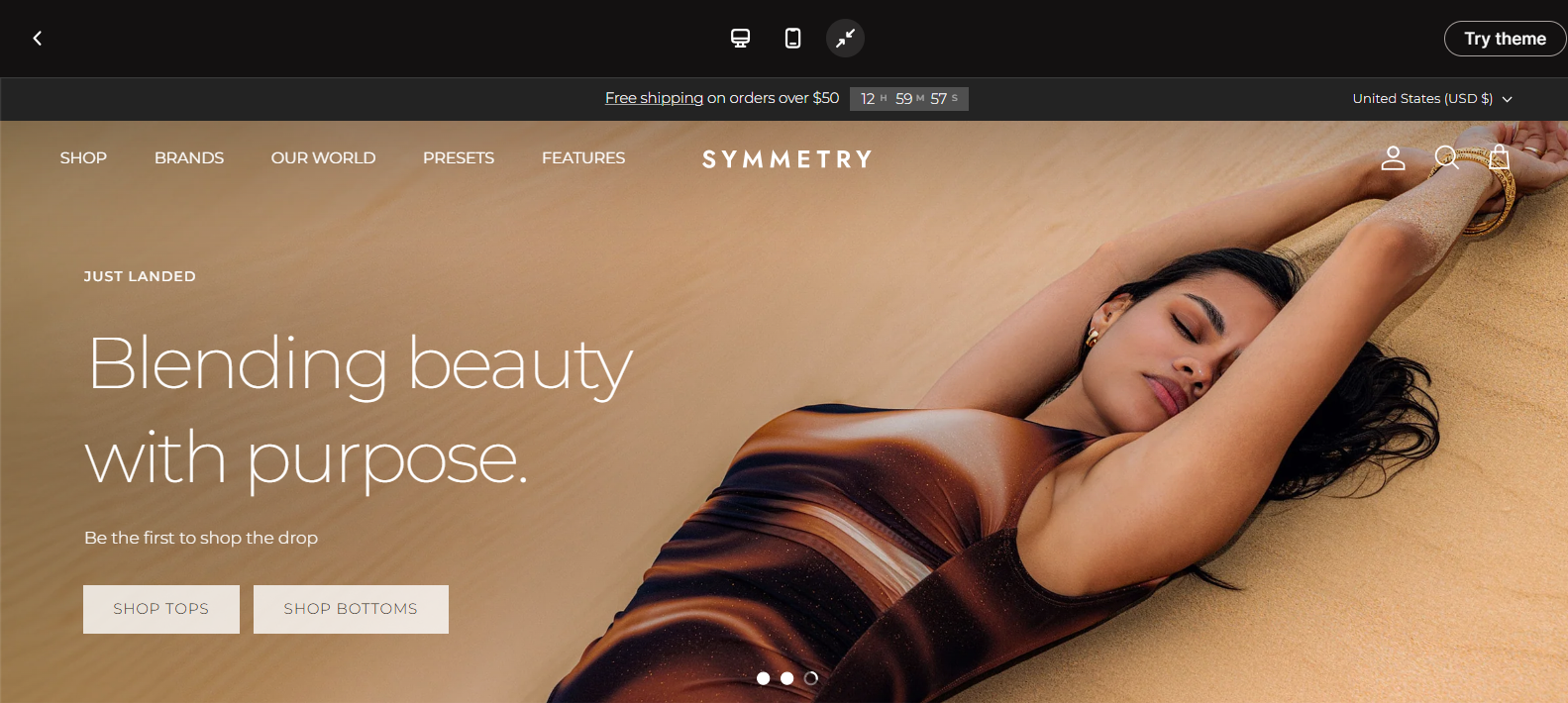
Symmetry, from Clean Canvas, rounds out this list as a strong all-rounder for fashion, beauty, and larger catalogs that need both versatility and flexibility. It is frequently positioned as a feature-rich alternative to Impact at a similar price point, with one independent review counting more than 58 built-in features and a high review score among premium themes in its price bracket.
Shopify's official Core Web Vitals data shows Symmetry passing “Good” on INP for 97.2% of stores and an overall pass rate of 89.3%, putting it in solid company among the premium themes on this list. For merchants who want Impact-level feature depth with a slightly different visual language, Symmetry is the most direct comparison point.
- Best for: fashion and beauty brands that want to feature depth comparable to Impact
- Price: $420
- Core Web Vitals pass rate: 89.3% (Shopify official data)
Shopify Theme Speed Comparison: Real-User Core Web Vitals (2026)
The table below is pulled directly from Shopify's official aggregated performance dashboard, last updated on June 2, 2026. Each percentage reflects the share of stores using that theme in which at least 75% of real users achieved a “Good” score on that metric during the most recent seven-day measurement window.
|
Theme |
LCP Good |
CLS Good |
INP Good |
Overall CWV Pass Rate |
|
Dawn |
96.4% |
90.5% |
95.6% |
84.9% |
|
Horizon |
95.7% |
96.4% |
85.5% |
81.0% |
|
Impact |
97.8% |
97.5% |
94.9% |
91.3% |
|
Sense |
95.7% |
91.8% |
90.9% |
82.1% |
|
Impulse |
95.9% |
96.1% |
97.7% |
91.2% |
|
Studio |
98.6% |
92.6% |
98.2% |
90.1% |
|
Craft |
98.3% |
92.8% |
97.9% |
89.9% |
|
Expanse |
92.7% |
97.8% |
96.8% |
89.2% |
|
Prestige |
96.4% |
97.1% |
94.0% |
89.3% |
For reference, Shopify's most recent aggregate data across all themes in the dataset puts the median overall Core Web Vitals pass rate at 86.0%, with the weakest-performing theme at 36.5% and the strongest at 99.1%. Most of the themes on this list sit at or above that median, which is exactly why they made the cut.
Free vs. Premium Shopify Themes: Which Should You Choose?
A free theme like Dawn, Horizon, Studio, or Craft is the right starting point if you are testing a new product, working with a small catalog, or simply do not yet know which features your store will need in the long term. Shopify maintains all of its free themes directly, which means consistent updates and a baseline level of performance that beats a poorly configured premium theme almost every time.
A premium theme earns its one-time cost when your catalog grows past what a free theme's section count can comfortably handle, or when you need built-in conversion features that would otherwise require three or more separate paid apps, things like sticky add-to-cart, quick buy, countdown timers, and advanced filtering. Since most premium Shopify themes are a single one-time payment rather than a subscription, the math tends to favor upgrading once you are confident in your product and traffic, rather than before.
How Theme Choice Affects Shopify SEO
Core Web Vitals are a confirmed Google ranking signal, which means a theme with a chronically poor LCP or INP score is not just a user experience problem, it is a visibility problem. Beyond raw speed, theme choice also determines how cleanly your store's structured data and heading hierarchy come out of the box. Some Shopify themes, including Dawn, ship with built-in JSON-LD product schema, while others leave gaps that require manual Liquid edits or a dedicated app to fill in correctly. A heading structure with a single clear H1 per page and a logical H2 and H3 hierarchy underneath it helps both search engines and shoppers understand what a page is about, and theme quality is the single biggest factor in whether that structure comes out right by default.
Mobile responsiveness ties directly back into this. With mobile traffic now representing the majority of Shopify store visits, a theme that handles responsive breakpoints, touch targets, and image loading poorly on a phone is optimizing for a shrinking share of the audience that actually reaches your store from a Google search.
Frequently Asked Questions
These are the questions Shopify merchants ask most often when comparing themes, answered straight, with no fluff.
1. What is The Most Popular Theme in Shopify?
Dawn has been the most widely used Shopify theme for years, having served as the platform's default free theme from the Online Store 2.0 launch through mid-2025. Shopify replaced Dawn with Horizon as the new default theme at its Summer 2025 Editions event, so Horizon is now what new stores see first, though Dawn remains supported with bug fixes and continues to power a large share of existing stores.
2. Can You Make $10k A Month On Shopify?
Yes, but it is not the typical outcome. Industry revenue data puts the average Shopify store's monthly revenue in the low thousands of dollars, with roughly the top 10 to 20% of established stores reaching $10,000 or more per month after consistent traffic, conversion optimization, and repeat customers. Reaching that figure depends far more on product-market fit, traffic acquisition, and conversion rate than on theme choice alone, though a fast, well-structured theme removes one common obstacle along the way.
3. What is the Best $100 Shopify Theme?
There is no widely used official Shopify theme currently priced at exactly $100; most premium options from established developers like Maestrooo, Archetype Themes, and Out of the Sandbox fall in the $300 to $500 one-time range. If a tight budget is the priority, the more practical move is to start with one of Shopify's free themes, such as Dawn, Horizon, Studio, or Craft, all of which post strong Core Web Vitals scores in Shopify's own official data, and upgrade to a premium theme once revenue justifies the cost.
4. What Are The High-Converting Themes For Shopify?
Impact, Impulse, and Sense lead this list on built-in conversion mechanics, including sticky add-to-cart, quick buy on collection pages, and complementary product recommendations, paired with strong real-user Core Web Vitals scores in Shopify's official data. Turbo is the strongest pick, especially when raw page speed is the primary lever, since faster load times have a documented, direct relationship with conversion rate, according to Google and Deloitte's joint research.
Which Shopify Theme Should You Pick?
If you are launching a new store on a tight budget, start with Dawn or Horizon. Both are free, both post strong real-user Core Web Vitals scores in Shopify's own data, and neither will force you into a redesign once you start generating real traffic. If your brand lives or dies on visual storytelling, lookbooks, or a strong “behind the product” narrative, Studio or Craft gives you that for free, while Impact and Impulse offer the premium version of the same idea with more sections and built-in conversion tools.
Large catalogs change the calculus entirely. Expanse and Warehouse are both built around filtering and navigation that holds up under hundreds of SKUs, which a smaller theme like Dawn was never designed to handle gracefully. And if speed alone is the deciding factor, whether because your traffic comes overwhelmingly from paid ads with thin margins or because your catalog is image-heavy enough that every fraction of a second matters, Turbo remains the most speed-focused premium option on this list, while Sense offers a leaner, more budget-conscious route to similar performance without Impact's full price tag.
Whichever theme you choose, treat the decision as infrastructure, not decoration. The data is consistent across every primary source cited here: speed and structure drive both your search visibility and the percentage of visitors who actually become customers.
